NEWS
Social Media Rules for Children: India Weighs Under-18 Account Restrictions, Supreme Court Told
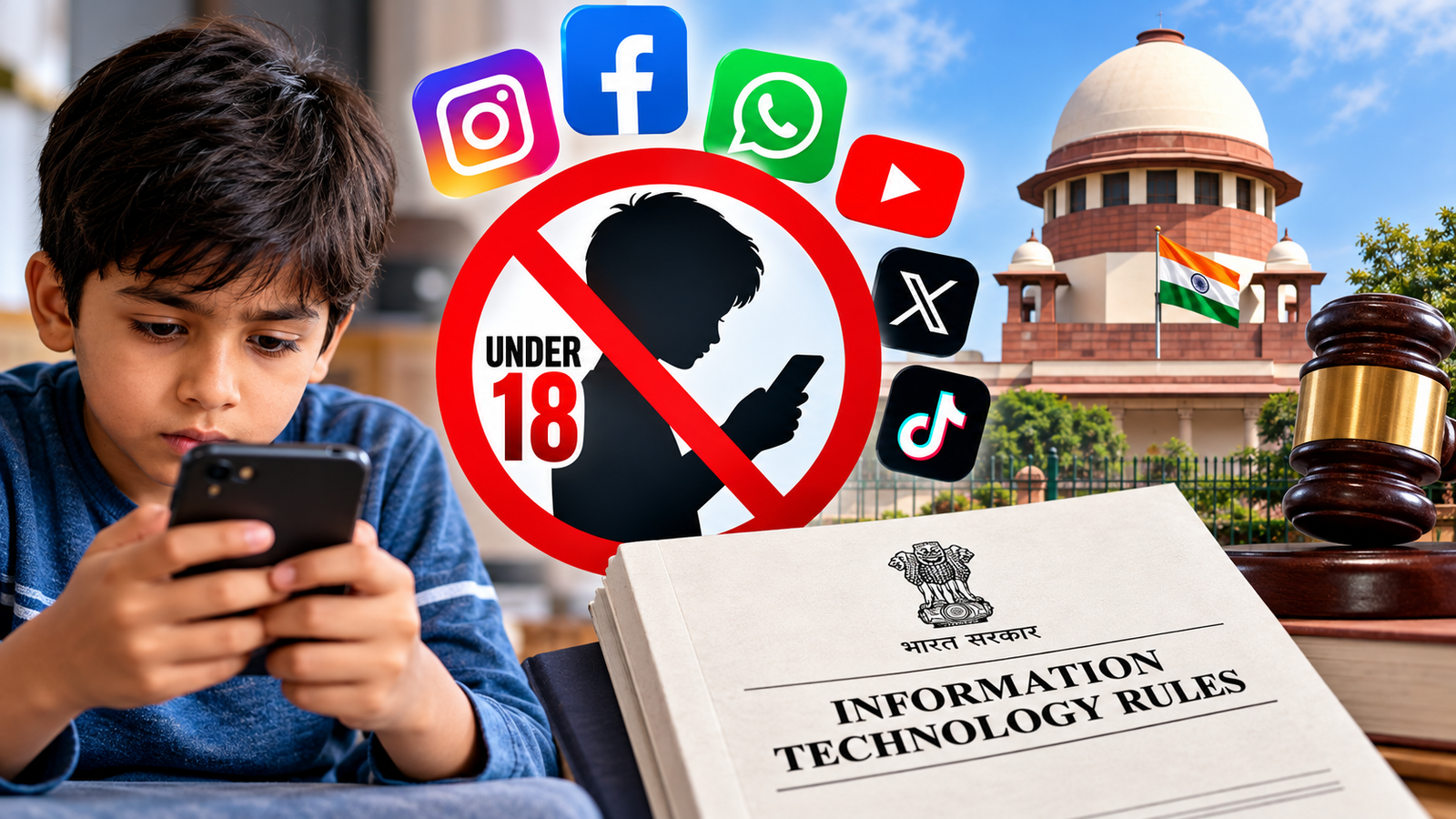
India could introduce stricter rules governing children's access to social media as concerns over online safety, privacy and age verification receive greater attention.
The Central government has informed the Supreme Court that changes to the Information Technology (Intermediary Guidelines and Digital Media Ethics Code) Rules are being considered. One of the possibilities discussed before the court involves restricting people below the age of 18 from independently opening accounts on social media platforms.
Importantly, this should not be interpreted as an immediate nationwide ban that has already come into force. The matter relates to possible regulatory changes being considered, and the final framework will depend on the rules ultimately notified by the government.
The discussions come amid concerns over children's exposure to cyberbullying, online grooming, inappropriate content, profiling and misuse of personal information.
Under-18 Social Media Accounts Could Face New Restrictions
During proceedings before the Supreme Court, Solicitor General Tushar Mehta, appearing for the Centre, discussed the possibility of creating a stronger regulatory framework for minors using social media.
According to the information presented in the case, the government could move towards a system under which children below 18 would not be permitted to independently create social media accounts.
The discussion also focused on whether such restrictions should be incorporated into enforceable rules rather than being left merely as voluntary guidelines.
If eventually adopted in this form, social media companies operating in India could be required to change how they determine whether a user meets the prescribed age requirements.
However, the details of any final restriction—including its scope, exceptions and verification mechanism—would depend on the regulatory framework ultimately introduced.
Educational Platforms Could Be Treated Differently
A key issue is how rules designed to protect children on social networks would affect other online services used by minors.
The discussion before the court indicated that educational websites and online learning platforms could be treated differently from conventional social media services.
Instead of preventing children from using such services altogether, a system based on parental consent could potentially be considered for educational platforms.
Such a distinction would be important because children increasingly depend on digital services for schoolwork, online classes, educational videos and other learning resources.
The challenge for regulators would therefore be to improve online safety without unnecessarily blocking access to legitimate educational services.
Social Media Platforms May Need Stronger Age Checks
Any effective age restriction would raise another major question: How will a platform know that a user is actually below or above the required age?
At present, simply asking users to enter a date of birth may not always provide reliable age verification.
The Supreme Court proceedings also raised questions about the responsibility of technology companies operating in India to ensure that their systems comply with Indian law.
If stronger age restrictions are introduced, platforms could have to develop or modify technical mechanisms to enforce them.
That could put age-assurance or age-verification systems at the centre of the debate. At the same time, any such mechanism would also need to address privacy concerns because age verification itself can involve the processing of personal information.
Why Has Children's Online Safety Become a Major Issue?
The case has brought attention to several risks that the petitioner NGO says can arise from children's use of social media.
Among the concerns highlighted are online grooming, sexual exploitation, cyberbullying, harassment, exposure to content unsuitable for children and misuse of personal data.
Another concern involves behavioural profiling. Social media services can collect information about users' interactions and interests, raising questions about how children's activity and data should be handled.
The petitioner has argued that the absence of a consistent and effective system for verifying the age of social media users can weaken safeguards intended to protect minors.
These concerns are part of a wider debate over how technology companies should design services used by children and what level of responsibility should fall on platforms, parents and regulators.
Supreme Court Examines How Platforms Handle Age Restrictions
The matter was heard by a Supreme Court bench headed by Chief Justice Surya Kant, along with Justice Joymalya Bagchi and Justice V. Mohana.
The proceedings also examined how social media companies implement age-related requirements in other countries and whether their technology can be adapted to meet Indian legal requirements.
This issue is particularly significant for global platforms because the rules governing children's online access are not identical in every country.
Companies may therefore need country-specific compliance mechanisms where domestic law requires different age thresholds or safeguards.
What Could Change for Parents and Children?
For the moment, parents and young social media users should distinguish between a proposal being discussed and a rule that has already taken effect.
The possibility of restricting social media accounts for users below 18 has entered the regulatory and judicial discussion, but the final requirements will depend on the government's eventual amendments and their notified provisions.
If stricter rules are introduced, social media platforms could face additional compliance obligations relating to age checks and children's accounts. Educational services may also receive separate treatment where parental permission or other safeguards are considered appropriate.
The larger debate goes beyond simply setting an age limit. Policymakers will also have to address how age can be verified reliably, how children's privacy will be protected, which services should fall within the restrictions and what responsibilities platforms will have when minors attempt to access their services.
Until final rules are formally notified, reports that India has already imposed a complete social media ban on everyone below 18 should therefore be treated cautiously. The current development concerns potential changes to India's online-safety framework for children, rather than a blanket restriction that has already taken effect.