With electricity bills rising during the summer season, many homeowners are turning to rooftop solar systems as a long-term solution. Air conditioners are among the highest power-consuming appliances in a home, making solar energy an attractive option for reducing monthly electricity expenses.
However, one of the most common questions before installing a solar system is: How much solar capacity is required to run one, two, or three air conditioners?
The answer depends on several factors, including the AC's capacity, daily usage, other household electrical appliances, and whether you choose an on-grid, off-grid, or hybrid solar system.
Here's a simple breakdown to help you estimate the right solar system size for your needs.
How Much Power Does a 1.5-Ton AC Consume?
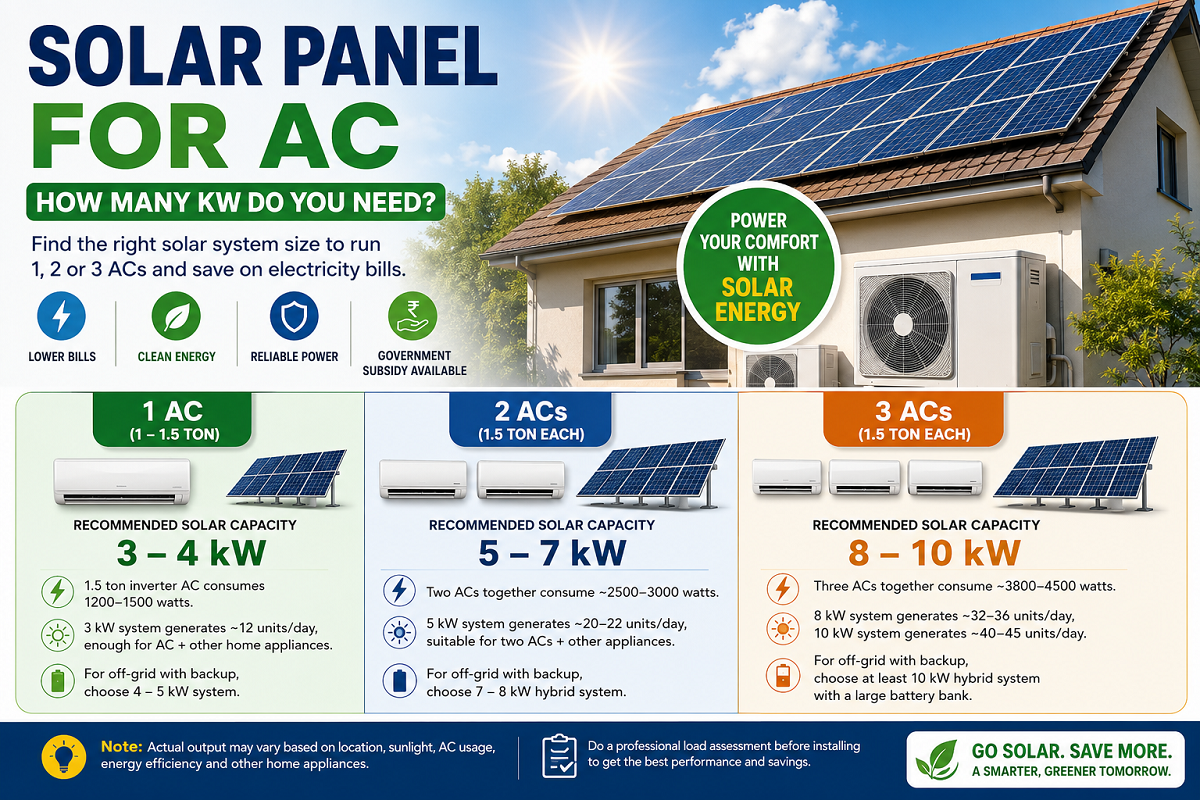
A modern 1.5-ton inverter air conditioner generally consumes around 1,200 to 1,500 watts while operating, although actual electricity usage varies depending on the energy rating, room temperature, and usage pattern.
When calculating the required solar capacity, homeowners should also consider the electricity consumed by other appliances such as fans, lights, refrigerators, televisions, washing machines, and kitchen equipment.
Solar Capacity for One Air Conditioner
If your home has one 1-ton or 1.5-ton inverter AC, experts generally recommend installing a 3 kW to 4 kW rooftop solar system.
A typical 3 kW on-grid solar system can generate approximately 12 units of electricity per day, depending on sunlight conditions and location. This output is usually sufficient to support one inverter AC along with regular household electricity consumption.
If you plan to install an off-grid system with battery backup for power during outages, a 4 kW to 5 kW solar system is generally considered more suitable.
Solar Capacity for Two Air Conditioners
Homes with two 1.5-ton inverter ACs require a larger solar installation.
Running two AC units simultaneously can consume around 2.5 kW to 3 kW of electricity. After including other household appliances, the total connected load may reach approximately 4 kW to 4.5 kW.
For such households, a 5 kW to 7 kW rooftop solar system is generally recommended.
A 5 kW on-grid solar system can typically generate around 20 to 22 units of electricity per day, which is adequate for two AC units under normal operating conditions.
If uninterrupted backup power is also required, a 7 kW to 8 kW hybrid solar system with battery storage may be a more appropriate choice.
Solar Capacity for Three Air Conditioners
Larger homes or offices equipped with three 1.5-ton air conditioners require a significantly higher-capacity solar installation.
Three ACs operating together can consume approximately 3.8 kW to 4.5 kW, while the total household electricity demand can rise to 6 kW to 7 kW after including other appliances.
In such cases, an 8 kW to 10 kW rooftop solar system is generally recommended.
Typical daily power generation includes:
- 8 kW system: Around 32–36 units of electricity per day.
- 10 kW system: Approximately 40–45 units per day under favourable sunlight conditions.
For homes seeking complete backup during grid outages, a 10 kW hybrid solar system with a large battery bank is usually considered the preferred option.
Factors That Influence Solar System Size
The required solar capacity may vary depending on:
- AC tonnage and energy efficiency.
- Number of hours the AC runs each day.
- Total household electricity consumption.
- Local sunlight availability.
- Roof space available for panel installation.
- Type of solar system (On-grid, Off-grid, or Hybrid).
For this reason, it is advisable to conduct a professional load assessment before selecting a rooftop solar system.
Government Subsidy May Reduce Installation Cost
Eligible homeowners can also benefit from financial assistance under the PM Surya Ghar: Muft Bijli Yojana, subject to the scheme's terms and conditions. The subsidy can help lower the overall installation cost of residential rooftop solar systems.
Before finalizing a solar installation, homeowners should compare quotations from authorized vendors, estimate their daily electricity consumption, and select a system that can comfortably handle both current and future energy requirements.
Choosing the right solar capacity not only helps reduce electricity bills but also improves long-term energy savings while supporting cleaner and more sustainable power generation.