NEWS
Smartphone Fingerprint Unlock After Death: The Science Behind Biometric Sensors and Why They May Fail
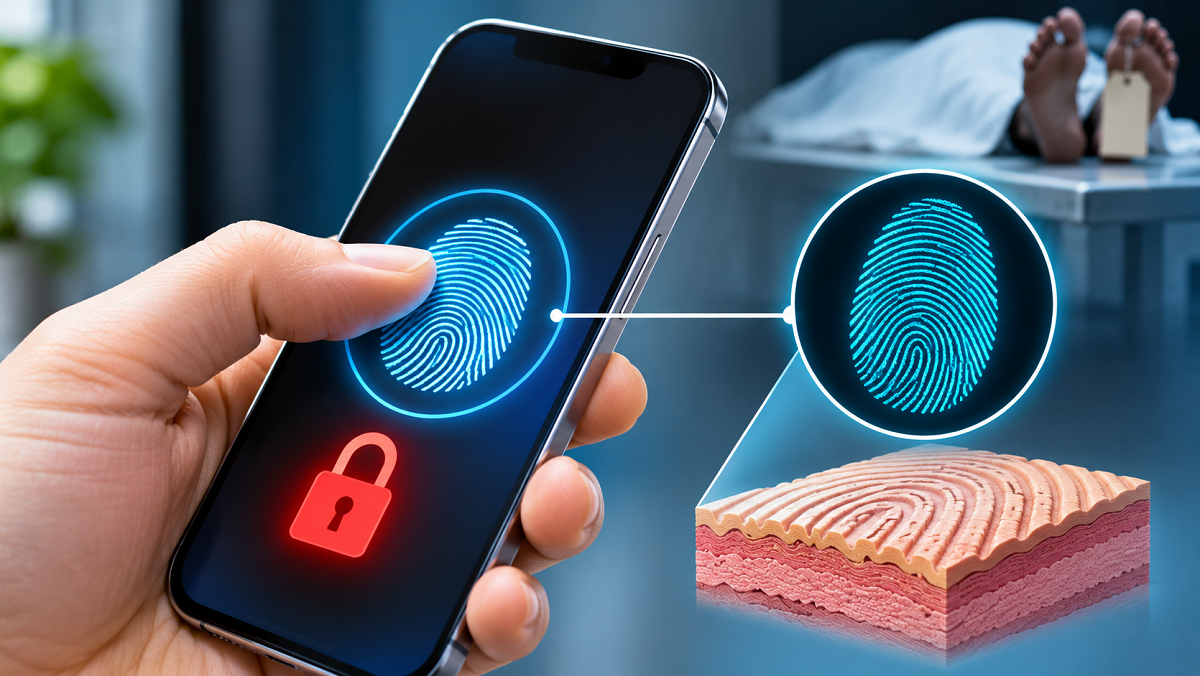
Fingerprint recognition has become an essential security feature in modern smartphones. From unlocking mobile devices and accessing banking applications to authorising digital payments, biometric authentication makes everyday activities faster and more convenient.
However, an interesting scientific question often arises: why might a smartphone fail to recognise a person's fingerprint after their death, even though the fingerprint pattern does not immediately disappear?
The answer lies in the relationship between human biology, skin properties and the technology used in modern biometric authentication systems.
Contrary to popular belief, fingerprint sensors do not necessarily stop recognising a person's finger immediately after death. Their response depends on several factors, including the sensor technology, changes in the skin and the smartphone's security mechanisms.
How Does a Smartphone Recognise Your Fingerprint?
Every individual has a distinctive fingerprint pattern consisting of tiny raised ridges and recessed areas known as valleys.
When users register their fingerprints on a smartphone, the device analyses these distinctive characteristics and creates a digital biometric template.
Whenever a registered finger touches the sensor, the smartphone captures fingerprint information and compares it with the previously stored template.
If the captured information meets the required matching and security criteria, the device grants access.
Modern smartphones generally use three major types of fingerprint recognition technology: capacitive, optical and ultrasonic sensors.
Although all three technologies serve a similar purpose, their operating principles are different.
What Happens to Human Skin After Death?
When a person dies, the body's normal physiological processes gradually cease. Blood circulation stops, oxygen delivery to tissues ends and cellular activity begins to decline.
These biological changes also affect the skin.
Living human skin contains moisture, electrolytes and other substances that influence its physical and electrical characteristics.
Following death, changes in hydration, tissue structure, temperature and electrical properties can affect how biometric sensors interact with the skin.
Although fingerprint ridges may remain visible, a smartphone sensor may struggle to capture information that meets its authentication requirements.
However, fingerprint recognition does not universally require a heartbeat or active blood circulation. The assumption that every smartphone automatically rejects a fingerprint immediately after death is scientifically inaccurate.
Three Types of Fingerprint Sensors Used in Smartphones
1. Capacitive Fingerprint Sensors
Capacitive fingerprint scanners are widely used in smartphones and other electronic devices.
These sensors contain miniature electronic components that measure variations in electrical capacitance associated with the ridges and valleys of a fingerprint.
The collected information is processed to identify the unique characteristics of the user's fingerprint.
Changes in skin moisture and electrical properties can affect the quality of readings obtained by these sensors.
2. Optical Fingerprint Sensors
Optical fingerprint scanners use light to capture an image of the fingerprint pattern.
These sensors are commonly found in smartphones featuring under-display fingerprint recognition.
The captured image is analysed using specialised software to identify distinctive fingerprint characteristics and compare them with the registered biometric template.
Image quality, skin condition and additional security checks can influence authentication accuracy.
3. Ultrasonic Fingerprint Sensors
Ultrasonic fingerprint recognition technology uses high-frequency sound waves to collect information about the surface structure of a finger.
This technology allows compatible devices to generate detailed representations of fingerprint characteristics.
Ultrasonic sensors are used in several premium smartphones and are designed to provide reliable biometric authentication.
However, their performance also depends on hardware design, software algorithms and the quality of the captured biometric information.
Capacitive vs Optical vs Ultrasonic Fingerprint Sensors
| Fingerprint Sensor | Operating Technology | Primary Function |
|---|---|---|
| Capacitive sensor | Electrical capacitance | Identifies fingerprint ridges and valleys |
| Optical sensor | Light and image processing | Captures a fingerprint image |
| Ultrasonic sensor | High-frequency sound waves | Maps fingerprint surface characteristics |
| Advanced biometric systems | Multiple security mechanisms | Improves authentication reliability and security |
Different smartphone manufacturers may incorporate additional security features to strengthen biometric authentication.
Do Fingerprints Disappear After Death?
No, fingerprint patterns do not immediately disappear when a person dies.
The distinctive ridges on human fingers are physical structures formed in the skin. These patterns can remain identifiable after death, although natural changes in tissues and decomposition may eventually affect their condition.
Forensic specialists use fingerprints as one of several established methods for identifying deceased individuals.
However, forensic fingerprint identification and smartphone biometric authentication are fundamentally different processes.
A forensic examination focuses on identifying physical fingerprint characteristics, whereas a smartphone must capture and process biometric information that satisfies its specific security requirements.
Why Fingerprint Recognition Sometimes Fails Even in Living People
Fingerprint authentication failures are not limited to post-mortem biological changes. Smartphone users may occasionally experience recognition problems during normal daily activities.
Several factors can affect fingerprint scanning accuracy:
- Excessively dry or wet fingers.
- Cuts, scratches or damage to the skin.
- Dirt or oil on the fingerprint sensor.
- Certain skin conditions.
- Incompatible screen protectors.
- Hardware or software problems.
Keeping the fingerprint sensor clean and maintaining updated smartphone software can help improve everyday authentication reliability.
Smartphone Security Goes Beyond Fingerprint Recognition
Modern smartphones use multiple layers of protection to safeguard personal information.
Fingerprint authentication is generally supported by alternative security methods such as passwords, PINs and device-specific security mechanisms.
Depending on the manufacturer and operating system, a smartphone may require its primary passcode after a restart, repeated unsuccessful authentication attempts or other security-related events.
These protections are designed to reduce unauthorised access and protect sensitive personal information, including banking details, photographs, private messages and official documents.
Families seeking access to a deceased relative's digital information should follow the device manufacturer's official account recovery procedures and applicable legal requirements.
The Connection Between Human Biology and Smartphone Technology
Fingerprint authentication demonstrates how modern technology uses distinctive human physical characteristics to establish identity.
After death, biological changes can affect the quality of fingerprint information captured by smartphone sensors. However, there is no universal rule stating that every fingerprint scanner stops recognising a person immediately after death.
The outcome depends on the device's technology, biometric security design and physical condition of the skin.
As smartphone security continues to evolve, manufacturers are developing more sophisticated authentication systems to improve reliability while protecting users against unauthorised access.
Disclaimer: This article is intended for scientific and technological awareness. Fingerprint sensor behaviour varies across devices, and the original report's technical claims have not been independently tested.