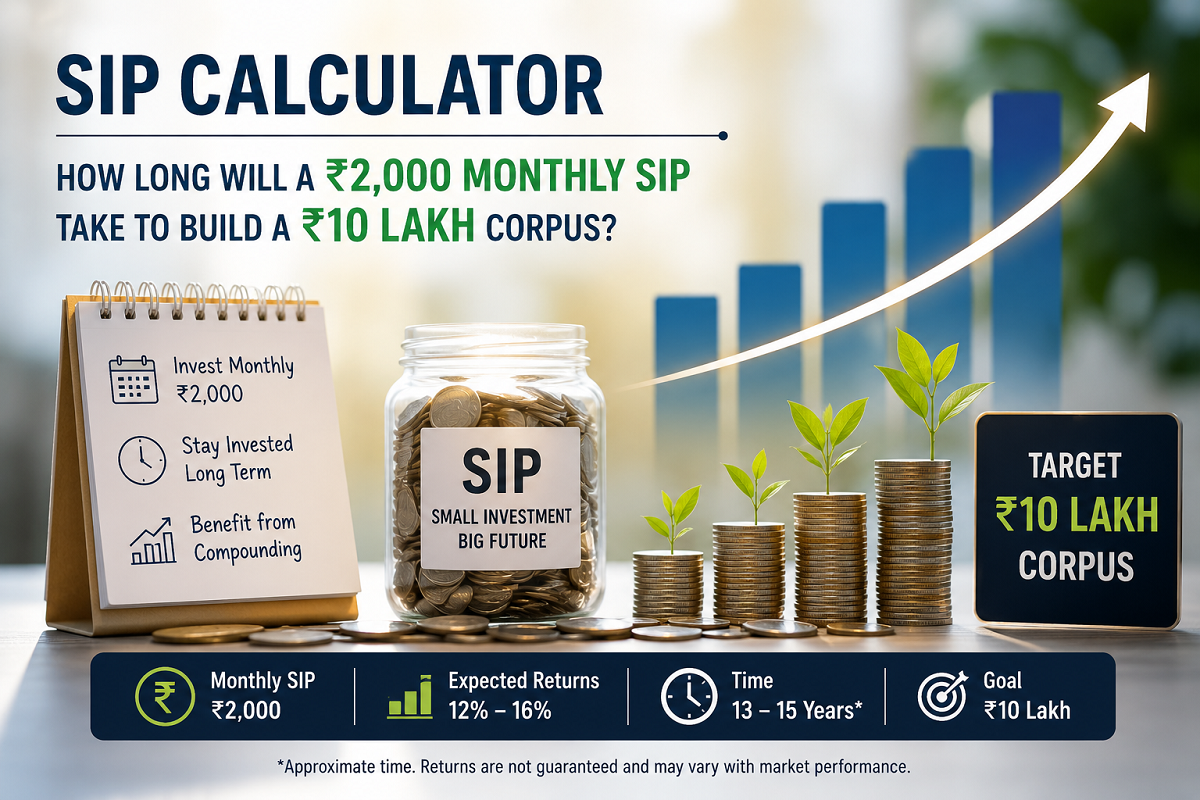
A Systematic Investment Plan (SIP) allows investors to begin their wealth-building journey with a small monthly contribution while benefiting from the power of long-term compounding. Contrary to the common belief that investing requires a high income, even a modest SIP of ₹2,000 per month can grow into a substantial corpus if maintained consistently over the years.
The time required to accumulate ₹10 lakh depends mainly on the annual rate of return and the investor's commitment to staying invested. Here's a detailed breakdown of how disciplined investing and a simple step-up strategy can help you reach your financial goal faster.
Why Starting Early Matters More Than Investing Big
Many people postpone investing because they believe they need a higher salary before they can afford it. In reality, delaying investments often means missing out on years of compounding.
A SIP encourages regular investing regardless of market conditions. By investing a fixed amount every month, investors average out market fluctuations and steadily build wealth over time.
Financial planners often emphasize that consistency is more important than the size of the initial investment. Starting with ₹2,000 today can be far more beneficial than waiting several years to invest a larger amount.
The Power of Compounding
Compounding is one of the biggest advantages of long-term investing.
When your investment generates returns, those returns also begin earning returns over time. As the investment period increases, the growth accelerates because the earnings themselves continue to compound.
This is why long-term investors often see significant wealth creation even with relatively small monthly contributions.
How Long Does It Take to Reach ₹10 Lakh?
Assuming different annual return scenarios, here is the estimated time required for a monthly SIP of ₹2,000 to accumulate a corpus of ₹10 lakh.
| Estimated Annual Return | Approximate Time to Reach ₹10 Lakh |
|---|---|
| 12% | About 15 years |
| 14% | About 14 years |
| 16% | About 13 years |
These calculations are based on projected returns and are meant for illustration only. Actual mutual fund performance can vary depending on market conditions.
Step-Up SIP Can Help You Reach the Goal Faster
Investors looking to build wealth more quickly can consider a Step-Up SIP strategy.
Instead of investing the same amount every year, a Step-Up SIP gradually increases the monthly investment by a fixed percentage, usually in line with annual salary increments.
For example:
- Start with a monthly SIP of ₹2,000.
- Increase the SIP amount by 10% every year.
- Continue this pattern throughout the investment period.
A small annual increase can significantly reduce the time needed to achieve the same financial target without placing a heavy burden on your monthly budget.
Comparison: Regular SIP vs Step-Up SIP
The following estimates show how a 10% annual increase in SIP contributions can accelerate wealth creation.
| Regular SIP | 10% Step-Up SIP | Estimated Time Saved | Expected Annual Return |
|---|---|---|---|
| About 15 years | About 12 years | Around 3 years | 12% |
| About 14 years | About 11 years | Around 3 years | 14% |
| About 13 years | About 11 years | Around 2 years | 16% |
This comparison highlights how gradually increasing investments can significantly improve long-term outcomes.
Benefits of Choosing a Step-Up SIP
A Step-Up SIP offers several advantages for long-term investors:
- Matches increasing income over time.
- Builds wealth faster than a fixed SIP.
- Maximizes the benefits of compounding.
- Helps achieve financial goals earlier.
- Requires only a modest annual increase in investment.
Because the increase is gradual, most investors find it easier to accommodate within their yearly budget.
Discipline Is the Key to Successful Investing
Investment experts consistently stress that discipline plays a more important role than trying to time the market.
Regular SIP contributions, combined with patience during market ups and downs, allow investors to benefit from rupee-cost averaging and long-term capital appreciation.
Missing contributions or stopping investments during periods of market volatility can reduce the long-term benefits of compounding.
Remember: Returns Are Not Guaranteed
While equity mutual funds have historically delivered attractive long-term returns, future performance cannot be predicted with certainty.
The projected returns of 12%, 14%, and 16% used in these calculations are only illustrative examples. Mutual fund returns depend on market performance, economic conditions, and the quality of the underlying portfolio.
Before investing, individuals should evaluate their financial goals, investment horizon, and risk tolerance. Consulting a qualified financial advisor may also help in selecting suitable mutual fund schemes.
Final Takeaway
A monthly SIP of ₹2,000 may seem modest, but with consistent investing and the power of compounding, it can grow into a ₹10 lakh corpus over time. Investors who adopt a Step-Up SIP by increasing their contributions each year can potentially achieve the same milestone several years earlier.
The earlier you begin and the longer you stay invested, the greater your chances of building substantial long-term wealth.