Business
PM Vishwakarma Yojana 2026: Get ₹15,000 for Tools and Loans Up to ₹3 Lakh, Check Eligibility and Apply
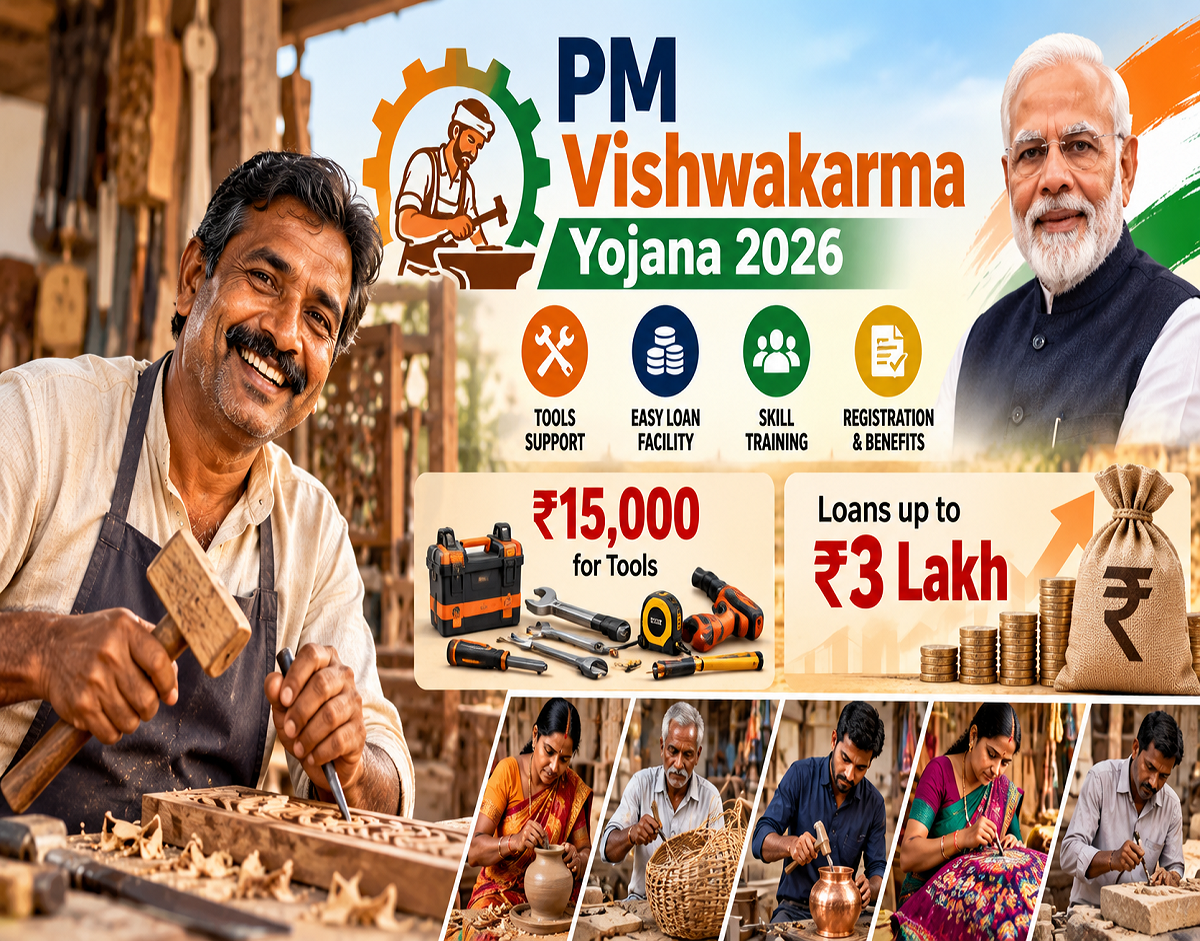
PM Vishwakarma Scheme 2026: Traditional artisans and craftspeople across India can receive financial assistance, skill development training and business loans under the Pradhan Mantri Vishwakarma Yojana. The central government scheme provides eligible beneficiaries with toolkit support worth up to ₹15,000, collateral-free loans of up to ₹3 lakh at a concessional interest rate of 5%, and a daily stipend of ₹500 during approved training. Carpenters, tailors, blacksmiths, potters, barbers and workers engaged in other recognized traditional occupations can benefit from the initiative.
What Is PM Vishwakarma Yojana and Who Can Benefit?
The Pradhan Mantri Vishwakarma Yojana was launched on September 17, 2023, to support individuals who earn their livelihoods through traditional craftsmanship and manual skills.
The programme focuses on artisans who primarily work with their hands and tools, helping them improve their professional capabilities and access modern equipment.
Many traditional workers operate small businesses or provide services independently. Limited access to affordable credit, professional training and advanced tools can make it difficult for them to expand their activities.
PM Vishwakarma aims to address these challenges through a combination of financial support, technical training and business development assistance.
Eligible beneficiaries can also receive a PM Vishwakarma certificate and identity card recognizing their traditional occupation.
The scheme covers qualified artisans in both rural and urban areas.
PM Vishwakarma Yojana 2026: Major Benefits Explained
The scheme offers several forms of assistance intended to improve productivity and strengthen self-employment opportunities.
| Scheme Benefit | Assistance Available |
|---|---|
| Toolkit Assistance | Up to ₹15,000 |
| Basic Skill Training | Generally 5–7 Days |
| Training Stipend | ₹500 Per Day |
| First Business Loan | Up to ₹1 Lakh |
| Second Business Loan | Up to ₹2 Lakh |
| Total Loan Facility | Up to ₹3 Lakh |
| Beneficiary Loan Interest Rate | 5% Per Annum |
| Digital Transaction Incentive | ₹1 Per Eligible Transaction, Up to 100 Monthly |
| Identity Recognition | PM Vishwakarma Certificate and ID Card |
These benefits are provided according to the scheme's eligibility requirements and applicable approval procedures.
Importantly, the ₹15,000 toolkit assistance and ₹3 lakh loan facility are different benefits. The loan must be repaid under the prescribed terms, while the toolkit support is provided through the approved assistance mechanism.
₹15,000 Toolkit Assistance: How Artisans Can Receive Support
One of the important features of PM Vishwakarma is financial assistance for purchasing work-related tools and equipment.
Eligible artisans can receive toolkit support worth up to ₹15,000 through an e-voucher-based arrangement.
The assistance is designed to help workers obtain equipment relevant to their traditional occupations.
For example, carpenters may require woodworking tools, while tailors may need equipment to improve their stitching and garment-making activities.
Similarly, potters, blacksmiths and other craftspeople may benefit from better tools that help them work more efficiently.
Access to improved equipment can potentially increase productivity, improve the quality of finished products and reduce the time required to complete certain tasks.
However, beneficiaries should understand that the assistance is not necessarily provided as unrestricted cash that can be spent on any purpose.
Its use is governed by the toolkit distribution rules and approved procedures under the scheme.
PM Vishwakarma Loan 2026: How to Get Up to ₹3 Lakh
The scheme also offers access to affordable business credit for eligible artisans who want to develop or expand their occupations.
A total loan facility of up to ₹3 lakh is available in two stages.
First Loan: Up to ₹1 Lakh
Under the initial stage, eligible beneficiaries may obtain a collateral-free loan of up to ₹1 lakh.
The repayment period is generally 18 months.
Completion of the prescribed basic skill training is an important requirement for accessing this loan facility.
The loan can help artisans meet business-related financial needs, subject to the applicable lending conditions.
Second Loan: Up to ₹2 Lakh
After meeting the requirements associated with the first loan, eligible beneficiaries may apply for a second loan of up to ₹2 lakh.
The repayment period for this stage is generally 30 months.
Eligibility for the second loan depends on the prescribed conditions, which may include maintaining satisfactory repayment conduct and fulfilling requirements relating to advanced training or digital transactions.
The scheme provides loans at a concessional interest rate of 5% per annum for beneficiaries.
However, loan approval is not automatic. Applications are subject to eligibility verification, lending assessments and the applicable rules of participating financial institutions.
Earn ₹500 Per Day During Skill Development Training
PM Vishwakarma provides skill development opportunities to help traditional workers strengthen their existing knowledge and learn improved techniques.
The basic training programme generally lasts between five and seven days.
During approved training, beneficiaries receive a stipend of ₹500 per day.
For example, a participant completing five eligible training days could receive ₹2,500 in stipend payments, while seven eligible days would correspond to ₹3,500.
These figures are illustrative and depend on verified attendance and the applicable training arrangements.
Advanced training opportunities are also available for eligible artisans interested in developing additional professional skills.
The training component aims to introduce better working methods, improve product quality and support the use of suitable modern technologies.
Digital Payment Incentive: Additional Benefit for Artisans
The government also encourages beneficiaries to adopt digital payment methods in their businesses.
Under the scheme, eligible artisans can receive an incentive of ₹1 for each qualifying digital transaction, subject to a maximum of 100 eligible transactions per month.
This means the maximum incentive under this component can reach ₹100 per month when the required conditions are satisfied.
The initiative is intended to help traditional businesses become more comfortable with digital transactions and maintain clearer payment records.
Using digital payment systems may also make it easier for customers to pay artisans without relying exclusively on cash.
PM Vishwakarma Eligibility 2026: Who Can Apply?
Applicants must satisfy specific requirements to qualify for benefits under the scheme.
The major eligibility conditions include:
- The applicant must be at least 18 years old on the date of registration.
- The individual must be engaged in one of the 18 recognized traditional occupations covered by the scheme.
- The applicant should be working as an artisan or craftsperson using hands and tools.
- The individual must be actively engaged in the relevant occupation at the time of application.
- Only one eligible member of a family can receive benefits under the scheme.
- Government employees and their family members are not eligible.
- Restrictions may apply to applicants who have previously received loans under certain government-supported self-employment schemes.
For the purpose of the scheme, the definition of family and other eligibility conditions are determined by the official guidelines.
Applicants should carefully review these rules before submitting their registration details.
List of 18 Traditional Trades Covered Under PM Vishwakarma
The scheme recognizes 18 categories of traditional trades.
| No. | Eligible Traditional Trade |
|---|---|
| 1 | Carpenter (Suthar/Badhai) |
| 2 | Boat Maker |
| 3 | Armourer |
| 4 | Blacksmith (Lohar) |
| 5 | Hammer and Tool Kit Maker |
| 6 | Locksmith |
| 7 | Goldsmith (Sonar) |
| 8 | Potter (Kumhaar) |
| 9 | Sculptor / Stone Carver / Stone Breaker |
| 10 | Cobbler / Shoesmith / Footwear Artisan |
| 11 | Mason (Rajmistri) |
| 12 | Basket, Mat and Broom Maker / Coir Weaver |
| 13 | Traditional Doll and Toy Maker |
| 14 | Barber (Naai) |
| 15 | Garland Maker (Malakaar) |
| 16 | Washerman (Dhobi) |
| 17 | Tailor (Darzi) |
| 18 | Fishing Net Maker |
Workers engaged in these occupations may apply if they satisfy the remaining eligibility conditions.
Simply belonging to one of the listed trades does not automatically guarantee selection or financial assistance.
How to Apply for PM Vishwakarma Yojana in 2026
Eligible artisans can seek registration assistance through an authorized Common Service Centre (CSC).
The application process involves entering the applicant's details and completing the required verification steps.
Applicants can generally follow this procedure:
- Visit a nearby authorized Common Service Centre.
- Inform the operator that you want to register for PM Vishwakarma Yojana.
- Provide your Aadhaar details and other required information.
- Complete the applicable identity verification process.
- Share details of your traditional occupation and business activities.
- Provide the necessary family and banking information.
- Review the application carefully before submission.
- Keep the registration or acknowledgment details for future reference.
Applications are subject to the scheme's verification and approval process.
Submitting an application does not mean that toolkit assistance, training or a loan will be approved immediately.
Documents Required for PM Vishwakarma Registration
Applicants should keep the relevant documents and information ready before visiting a CSC.
These may include:
- Aadhaar card
- Aadhaar-linked mobile number
- Bank account details
- Ration card or required family information
- Details of the applicant's traditional occupation
Additional information may be requested depending on the applicant's circumstances and verification requirements.
Providing accurate details is important because incorrect or inconsistent information may delay processing.
Can Rural and Urban Artisans Apply for the Scheme?
Yes. PM Vishwakarma is designed to support eligible traditional workers living in both villages and cities.
The scheme is not restricted to artisans operating in rural areas.
For example, a carpenter working independently in a village and a tailor operating a small shop in a city may both be considered for benefits if they meet the prescribed conditions.
The programme focuses on the nature of the traditional occupation and the applicant's eligibility rather than limiting participation to a particular type of residential location.
This broader coverage is intended to help preserve traditional skills while supporting livelihood development.
Important Things to Check Before Applying
Artisans interested in the scheme should understand that different benefits have separate requirements.
The toolkit incentive is subject to the approved assistance process, while business loans require additional eligibility and lending checks.
Applicants should also ensure that their Aadhaar and bank details are accurate and that they are registered under the correct occupational category.
Registration through authorized channels is important to avoid fraud.
Individuals should be cautious of agents promising guaranteed loan approval or demanding unauthorized payments.
For accurate information about registration, eligibility and benefits, applicants should consult the official PM Vishwakarma portal at pmvishwakarma.gov.in or an authorized Common Service Centre.
PM Vishwakarma Yojana 2026: Financial Support for Traditional Workers
PM Vishwakarma brings together skill development, professional recognition, equipment assistance and affordable business credit under one government initiative.
Eligible artisans can receive toolkit assistance of up to ₹15,000, a daily stipend of ₹500 during approved training and access to collateral-free loans totaling up to ₹3 lakh at a concessional interest rate.
The scheme also encourages digital transactions and provides recognition through official certification.
For carpenters, tailors, potters, blacksmiths, barbers and other eligible traditional workers, these benefits may help improve skills and support business development.
Applicants should confirm their eligibility, complete the required registration process and rely on official government information before applying for any financial assistance.
Disclaimer: This article is intended for general information and is based on the PM Vishwakarma scheme details provided. Benefits, registration availability, eligibility requirements and loan approvals are governed by official government guidelines and participating financial institutions. Applicants should verify the latest conditions through authorized government channels.