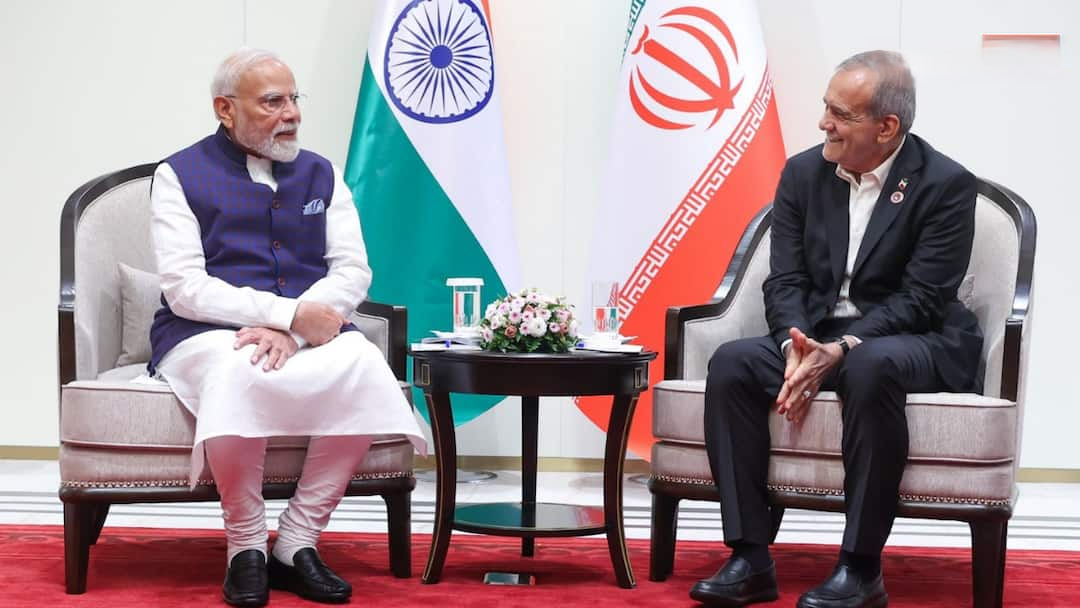
PM Narendra Modi, who reached Bishkek, the capital of Kyrgyzstan, after Uzbekistan, met Iranian President Masoud Pezeshkian at the Shanghai Cooperation Organisation (SCO) summit.
An important meeting took place between Indian Prime Minister Narendra Modi and Iranian President Masoud Pezeshkian in Kyrgyzstan.
Prime Minister Narendra Modi, who visited Bishkek, the capital of Kyrgyzstan, after Uzbekistan, met with Iranian President Masoud Pezeshkian on Monday at the Shanghai Cooperation Organization (SCO) summit. This bilateral meeting is considered extremely important. This was the first face-to-face meeting between the two leaders since the Iran War began in February.
In a post on Twitter, the PM said, "Met with President Masoud Pezeshkian in Bishkek. We reiterated our commitment to further strengthen India's long-standing friendship with Iran in various fields. We look forward to expanding and diversifying our trade in the future. We discussed the current situation in the region. India will continue to support all efforts to ensure lasting peace."
The Iranian embassy issued a statement after the meeting.
The official account of the Iranian Embassy in India said in the post that President of the Islamic Republic of Iran Dr. Masoud Pezeshkian met and held talks with Indian PM Narendra Modi during the first leg of his visit to Kyrgyzstan to attend and address the Shanghai Cooperation Organisation Summit and Shanghai Plus Summit.
India's Ministry of External Affairs spokesperson Randhir Jaiswal posted about the meeting, stating that PM Modi held a productive meeting with Iranian President Masoud Pezeshkian on the sidelines of the SCO Summit in Bishkek. The statement further stated that the two leaders discussed various aspects of bilateral relations and reviewed recent developments in the West Asia region.
Why is the meeting of the two leaders considered important?
According to experts, this meeting holds significant geopolitical significance. The ongoing war between the US and Iran has stalled the Strait of Hormuz. This marks the first face-to-face meeting between PM Modi and Pezeshkian.
India is extremely sensitive to disruptions to energy supplies in the Middle East. The blockade and military strikes around the Strait of Hormuz pose a threat to India's domestic stability.
Furthermore, financial institutions like Citi estimate that if global oil prices remain between $90 and $100 per barrel due to the crisis, inflation in India could rise by 50 basis points. This could significantly harm India's economy. Experts say that the main focus of PM Modi's talks will be on ensuring uninterrupted transportation of goods and energy.
Another serious humanitarian issue facing India is the safety of Indian citizens in the conflict. India is actively negotiating for the safe passage of its commercial vessels, as 28 ships carrying approximately 800 Indian sailors are still stranded in the Strait of Hormuz. Experts say direct diplomatic dialogue with Tehran is needed to ensure their safety and safe return.
Furthermore, with the ongoing war between the US and Iran and tensions in the Red Sea closing traditional sea routes, SCO countries are turning to alternative connectivity. The Modi-Pegeshkian meeting is crucial for advancing the 7,200-km-long International North-South Transport Corridor. This network connects Mumbai to St. Petersburg via Iran, avoiding congested waterways. India can demand free navigation from Iran and promote a diplomatic resolution to the conflict. India is a neutral voice in this conflict.