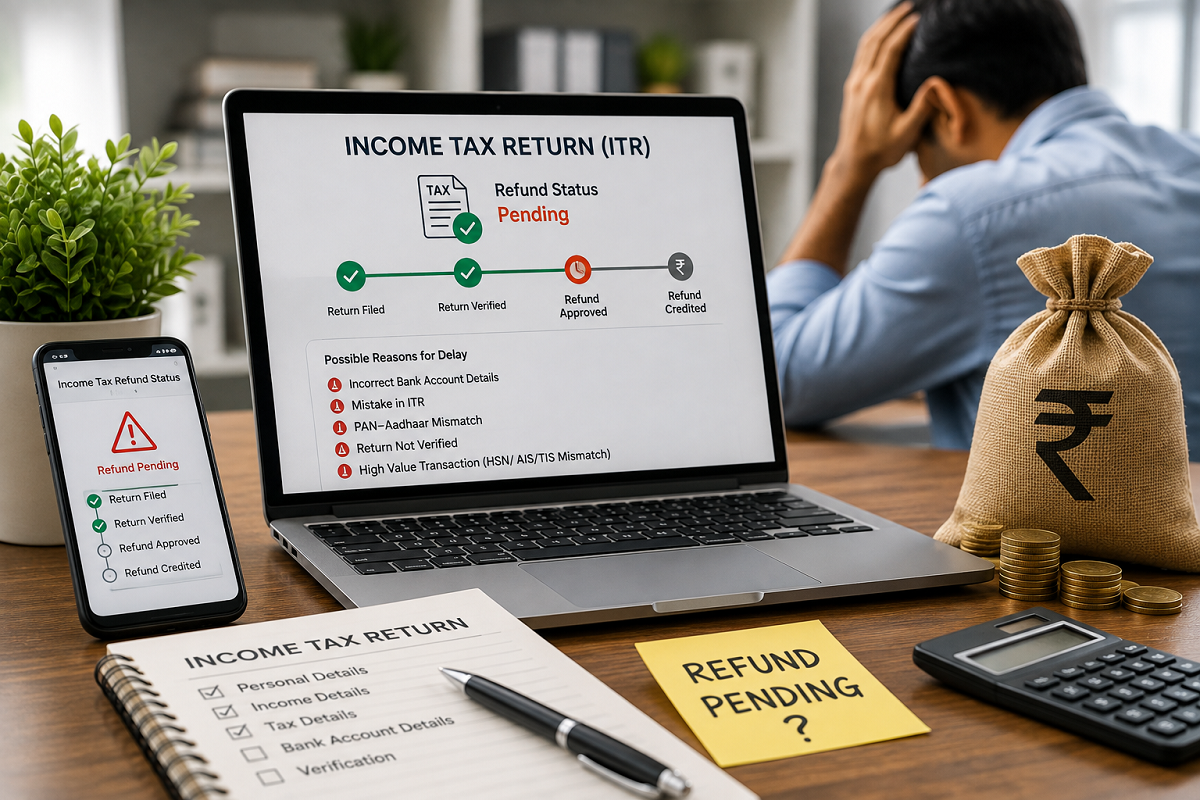
Income Tax Refund Delay: Filed your Income Tax Return but still waiting for the refund to reach your bank account? A delayed refund does not always mean that the Income Tax Department is simply taking longer to process your return. In many cases, issues related to bank validation, incorrect details, tax-credit mismatches or additional verification can hold up the payment.
Taxpayers who are expecting a refund should therefore check not only the status of the filed return but also whether all information linked to the return is accurate and properly verified.
The Income Tax Department allows taxpayers to track the status of their refund and view the life cycle of a filed ITR through the e-Filing portal.
Here are five major reasons your income tax refund may still be pending.
1. Your ITR May Still Be Under Processing
The first and most common reason for a delayed refund is that the return has not yet completed processing.
After an ITR is filed and successfully verified, the Income Tax Department processes the return and checks the information reported by the taxpayer.
If the e-Filing portal shows a status such as “Return Under Processing”, it generally means that the return is still being examined and the final processing result has not yet been generated.
A refund can normally be issued only after the return is processed and the system determines that an amount is payable back to the taxpayer.
Processing time may differ from one return to another depending on the complexity of the case, information matching and other checks.
2. Your Bank Account Details May Be Causing a Problem
An income tax refund is generally credited electronically to the bank account selected for receiving the refund.
If the account is not properly validated on the e-Filing portal, the refund process may face problems.
Taxpayers should check whether the bank account added to their profile is active and whether the details entered on the portal are correct.
The Income Tax Department provides a My Bank Account service through which registered taxpayers can add and pre-validate their bank account.
Important details to check include:
- Bank account number
- IFSC
- PAN linkage with the bank account
- Account status
- Bank account validation status
The department itself advises taxpayers to ensure that their bank account is pre-validated so that any refund due can be credited successfully.
If a bank has merged, the branch has changed, or your account details have been modified, checking the validation status becomes especially important.
3. Incorrect Information in the ITR Can Delay the Refund
Errors in the tax return can also result in slower processing or a mismatch during assessment.
For example, a taxpayer may accidentally enter incorrect details relating to:
- Bank account information
- Income
- Tax deducted at source
- Tax payments
- Deductions
- Interest income
- Other financial information
If an error materially affects the tax computation or refund claim, corrective action may be required.
Depending on the nature of the mistake and the applicable timeline, a taxpayer may need to file a revised return or use another correction facility available under the Income Tax rules.
This is why it is important to review the ITR carefully before filing rather than depending entirely on auto-populated information.
4. TDS Details May Not Match Form 26AS or Tax Records
A mismatch in tax credit is another common reason for additional checks.
Suppose you claim a certain amount of TDS in your ITR, but the corresponding amount available in the department's records is lower or different.
The system may identify this as a tax-credit mismatch.
The Income Tax Department's tax-credit mismatch facility allows taxpayers to compare the amount of TDS, TCS or other tax credit claimed in the return with the amount available in Form 26AS.
Such differences may arise because:
- An employer or bank reported incorrect TDS
- TDS was deposited but not correctly mapped to your PAN
- The taxpayer entered the wrong amount
- The deductor has not yet corrected an earlier filing
- Income information does not match supporting statements
Taxpayers should also review their Annual Information Statement, or AIS, to ensure that income and transaction information reported by financial institutions is consistent with the return.
If the figures differ, it is better to understand the reason and take corrective action instead of ignoring the mismatch.
5. Your Return May Have Been Selected for Additional Verification
Not every ITR is processed in exactly the same manner.
Some returns may require additional verification or scrutiny because of inconsistencies, unusually large claims, mismatches or other factors identified by the tax system.
If the department seeks clarification or sends a notice, the taxpayer should respond within the prescribed period.
Ignoring a communication can delay resolution of the case and, consequently, the refund.
Taxpayers should regularly check the registered email address, mobile number and e-Filing portal for any communication from the Income Tax Department.
Make Sure Your ITR Has Been Verified
Another important point is verification of the return.
Merely uploading an ITR does not complete the filing process. The return must also be verified using one of the permitted methods.
The Income Tax Department currently supports different e-verification options, including Aadhaar OTP, EVC through an eligible pre-validated bank or demat account, net banking and Digital Signature Certificate, depending on eligibility.
If a return remains unverified, processing can be affected.
Taxpayers should therefore confirm that the filed return shows as successfully verified on the portal.
How to Check Income Tax Refund Status Online
Taxpayers can check the progress of their return and refund through the official Income Tax e-Filing portal.
The general process is:
Step 1: Log in to the Income Tax e-Filing portal using your credentials.
Step 2: Navigate to the section for filed Income Tax Returns.
Step 3: Select the relevant Assessment Year.
Step 4: Open the details of the filed return.
Step 5: Check the current processing and refund status.
The Income Tax Department's refund-status service allows taxpayers to select the relevant Assessment Year and view refund details as well as the life cycle of the filed return.
If the refund has already been issued, the portal may also provide related payment or status information.
What If the Refund Was Issued but Failed?
Sometimes the Income Tax Department may process and issue the refund, but the payment can still fail because of a problem with the bank account or other details.
In such cases, eligible taxpayers can use the Refund Reissue facility on the e-Filing portal.
The Income Tax Department allows users to log in, go to Services, select Refund Reissue and create a new request for the relevant refund record.
Before submitting a reissue request, make sure that the bank account intended for the refund is correctly added and validated.
What Taxpayers Should Do If the Refund Is Taking Too Long
If your refund has not arrived, start by checking the status of your return rather than assuming that the payment has been rejected.
Confirm that:
- The ITR has been successfully verified
- The return has been processed
- The bank account is active and validated
- PAN and bank information are correct
- TDS details match Form 26AS
- Income reported is consistent with AIS and other records
- There is no pending notice or request for clarification
If the return has already been processed and the refund shows as issued but the payment has failed, consider using the refund-reissue service after correcting the bank-account issue.
Income Tax Refund Pending? Small Errors Can Make a Big Difference
A pending tax refund may be caused by something as simple as an unvalidated bank account or a mismatch in TDS information.
In other cases, the return may simply still be under processing or may require additional verification.
The best approach is to regularly monitor the e-Filing portal, check bank and tax-credit information, and respond promptly to any communication issued by the Income Tax Department.
Correct and consistent information across your ITR, Form 26AS, AIS and bank records can help reduce avoidable delays in processing and refund credit.
Disclaimer: This article is intended only for general informational purposes and does not constitute tax or legal advice. Income-tax procedures, timelines and rules may change. Taxpayers should verify the latest information on the official Income Tax Department portal or consult a qualified tax professional for case-specific guidance.