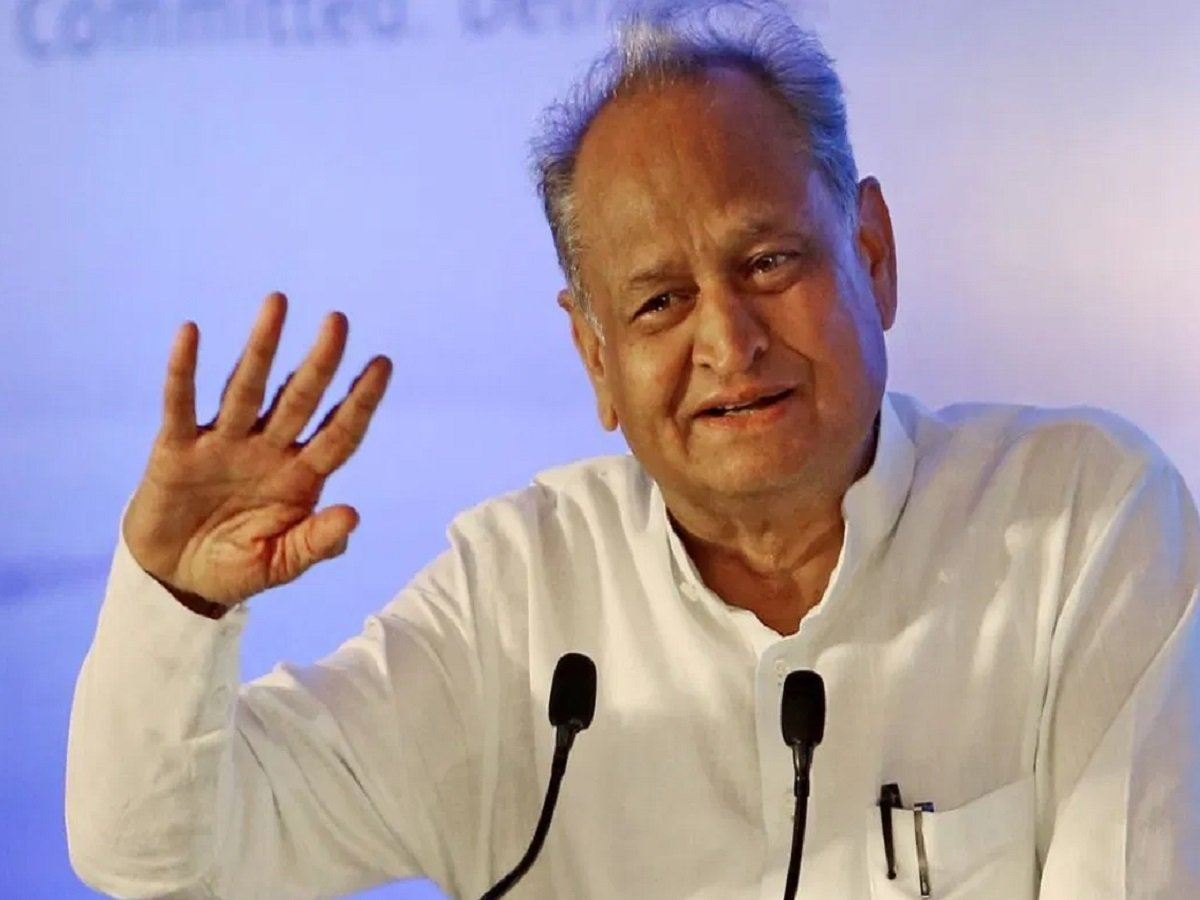
Former Rajasthan Chief Minister Ashok Gehlot has stepped up his attack on the BJP-led state government, citing findings from a Comptroller and Auditor General (CAG) report to raise questions about expenditure on welfare programmes meant for children, girls, college students and women.
In a social media post on Monday, Gehlot alleged that funds provided for several welfare schemes were not spent despite budgetary provisions. He claimed that the situation had directly affected intended beneficiaries and demanded accountability from the state government.
The Congress leader also alleged that programmes launched during the previous Congress administration were effectively being weakened by keeping expenditure at zero even when funds had been announced.
Gehlot Cites CAG Report to Question Welfare Spending
Gehlot said the CAG report placed important details regarding the implementation of welfare schemes before the Rajasthan Assembly.
According to figures cited by the former chief minister, 21 out of 37 schemes concerning children, girls and women recorded no expenditure at the ground level.
He further claimed that around ₹3,000 crore had been budgeted for programmes intended to benefit more than one crore children, female students and women, but expenditure under the schemes highlighted by him remained zero.
Gehlot used these figures to question the priorities and implementation record of the state government.
His remarks represent the opposition's interpretation of the CAG findings and criticism of the BJP government.
Gehlot Highlights Kali Bai Bheel Scooty Scheme and RTE Funds
The former chief minister also identified specific schemes where he claimed allocated funds had not been utilised.
According to Gehlot, ₹21.61 crore linked to the Kali Bai Bheel Medhavi Chhatra Scooty Yojana remained unspent.
He also referred to ₹6 crore earmarked for the construction of Maa-Badi centres and ₹55.31 crore connected with reimbursement of private school fees under the Right to Education framework.
Gehlot alleged that these amounts were not spent despite being provided for the respective programmes.
The Congress leader argued that delays or non-utilisation of such funds ultimately affect students and families who are supposed to receive benefits through these schemes.
Questions Raised Over Nine Schemes for College Students and Women
Gehlot also focused on nine programmes concerning female college students and women.
He claimed that all nine schemes recorded zero expenditure and specifically referred to programmes such as the Ladli Suraksha Yojana and the pension scheme for deserted women.
According to the former chief minister, failure to spend the allocated money has a direct impact on beneficiaries who depend on government assistance.
He argued that simply including a programme in the state budget does not fulfil its objective if funds are not subsequently utilised.
Gehlot Accuses BJP Government of Weakening Congress-Era Schemes
Gehlot went beyond questioning expenditure figures and made a broader political allegation against the BJP government.
He claimed that several public welfare initiatives introduced during the previous Congress government were being pushed towards an unofficial shutdown.
According to Gehlot, the government did not formally discontinue these programmes after coming to power but, in his view, withholding expenditure despite budget announcements could have a similar effect.
He asked why money was announced for these programmes if the government did not intend to spend it.
The former chief minister described the situation as more serious than an administrative lapse and alleged that beneficiaries were being denied support that had been provided for them.
Budget Allocation and Actual Expenditure Come Into Focus
The political dispute has also highlighted an important distinction in public finance: a budgetary provision does not necessarily mean the entire amount has already been spent.
Government programmes typically move through several stages, including budget allocation, administrative approval, release of funds and final expenditure. Delays can occur for different reasons, including procedural requirements, beneficiary verification, implementation schedules or changes in programme design.
However, when expenditure remains unusually low or at zero, questions can arise about whether a scheme is functioning as intended.
This is the central issue Gehlot has sought to raise through his criticism of the Rajasthan government.
Political Debate Over Welfare Programmes Intensifies
The CAG findings cited by Gehlot are likely to add to the political debate over the implementation of welfare programmes in Rajasthan.
His allegations focus particularly on programmes involving children, girls and women, making the issue politically significant because of the large number of potential beneficiaries.
At the same time, Gehlot's statements are political claims and should be distinguished from an independent conclusion about the government's intent. A complete assessment would require examination of the relevant CAG observations, department-wise expenditure records and the Rajasthan government's explanation for the reported non-utilisation of funds.
The state government's detailed response to the specific allegations made by Gehlot was not included in the source report.
The controversy is therefore likely to centre on one key question: whether the reported zero expenditure resulted from administrative or implementation issues, or whether, as Gehlot alleges, welfare programmes introduced by the previous government are being allowed to become inactive despite receiving budgetary provisions.