
Mission Gaganyaan: ISRO said both the tests met all the predetermined objectives, confirming the drogue performance and reliability under challenging conditions.
ISRO conducts test for Gaganyaan crew module
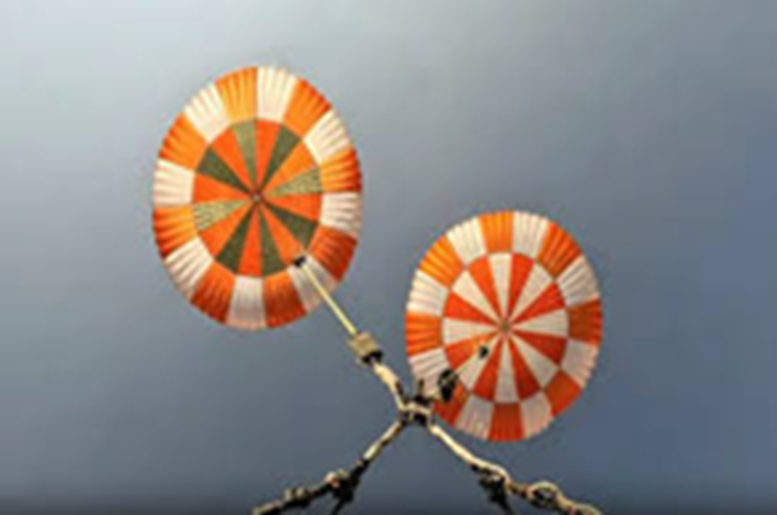
The Indian Space Research Organisation (ISRO) has successfully completed the qualification trials of the drogue parachute deployment for the Gaganyaan crew module at the Rail Track Rocket Sled (RTRS) facility of DRDO's Terminal Ballistic Research Laboratory (TBRL) in Chandigarh. These trials validated the performance and reliability of the drogue parachute under various flight conditions, which is a crucial step towards qualifying the parachute system for the human spaceflight (Mission Gaganyaan) programme.
ISRO issued an official statement on Saturday (December 20, 2025) stating that the tests were conducted during Thursday-Friday (December 18-19, 2025). ISRO said that both tests met all predetermined objectives, confirming the drogue performance and reliability under challenging conditions.
The multi-stage parachute assembly consists of 10 parachutes
The Gaganyaan crew module's deceleration system is a complex, multi-stage parachute assembly consisting of 10 parachutes of four types. The spacecraft's descent sequence begins with the deployment of two apex cover separation parachutes, which remove the protective cover of the parachute compartment. This is followed by the deployment of the two drogue parachutes, which stabilize the module and significantly reduce its speed. Once the drogue parachutes have completed their task, three pilot parachutes are deployed to enable the main parachutes to be deployed. These main parachutes further slow the crew module, ensuring a controlled descent and safe landing.
The role of the drogue parachute is very important – ISRO
ISRO said, "Drogue parachutes play a crucial role in these phases. They are responsible not only for stabilizing the crew module after atmospheric re-entry, but also for reducing its speed to a level suitable for deployment of the main parachute."