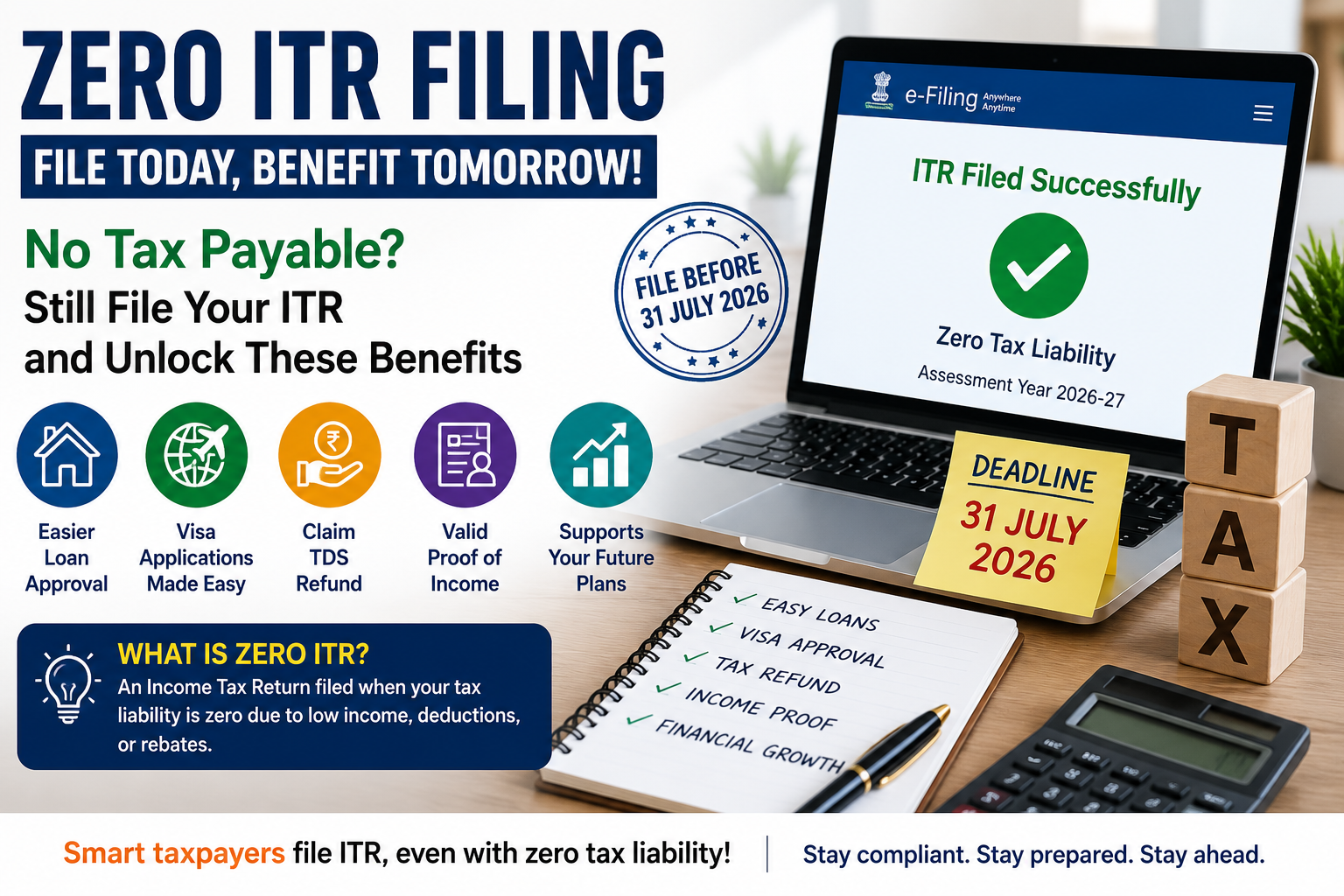
Many taxpayers assume that filing an Income Tax Return (ITR) is unnecessary if they do not have any tax liability. However, submitting what is commonly known as a Zero ITR can offer several financial and legal advantages, even when no income tax is payable.
Whether you are planning to apply for a loan, seek a tax refund, or submit documents for a visa application, a Zero ITR can serve as an important proof of income and financial compliance.
Here's everything you need to know about Zero ITR filing, including the deadline, eligibility and the benefits it can provide.
What Is a Zero ITR?
A Zero ITR refers to an Income Tax Return filed by an individual whose final tax liability is zero.
This situation may arise if:
- Your taxable income is below the basic exemption limit.
- Your tax liability becomes zero after claiming eligible deductions and rebates.
- Tax deducted at source (TDS) exceeds your final tax liability, resulting in no tax payable.
Although there is no tax payable in such cases, filing an ITR can still be beneficial for several reasons.
Zero ITR Filing Deadline
For Financial Year 2025-26 (Assessment Year 2026-27), the due date for filing an Income Tax Return is July 31, 2026, for eligible non-audit taxpayers.
If you miss the original deadline, you may still be able to file a belated return, subject to the applicable provisions of the Income Tax Act.
However, delayed filing may attract late filing fees and other consequences depending on your individual circumstances.
Is Filing a Zero ITR Mandatory?
If you are not legally required to file an Income Tax Return because your income is below the prescribed threshold and no mandatory filing conditions apply, failing to submit a Zero ITR generally does not attract any penalty.
However, voluntarily filing a Zero ITR can create several long-term financial advantages and provide official proof of income.
Benefits of Filing a Zero ITR
Easier Loan Approval
Banks and financial institutions frequently ask applicants to provide Income Tax Returns while processing applications for:
- Home loans
- Car loans
- Personal loans
- Education loans
Even a Zero ITR serves as an official record of your income and financial discipline, making the loan application process smoother.
Many lenders prefer borrowers who have a consistent tax filing history.
Helpful During Visa Applications
Several countries require applicants to submit Income Tax Returns while applying for visas.
Visa authorities in countries such as:
- United States
- Canada
- United Kingdom
- Australia
- Many European nations
may request recent ITR acknowledgements as evidence of financial stability.
A Zero ITR can therefore strengthen your visa documentation if no tax liability exists.
Claiming a TDS Refund
One of the biggest advantages of filing a Zero ITR is the ability to claim a refund of excess tax deducted at source.
For example, if:
- Your employer deducted TDS from your salary, or
- Tax was deducted on interest income,
but your final tax liability is zero, you can recover the deducted amount only by filing an Income Tax Return.
Without filing the return, the refund generally cannot be processed.
Official Proof of Income
An Income Tax Return acts as an important government-recognized financial document.
It can serve as proof of income for:
- Financial transactions.
- Legal proceedings.
- Property purchases.
- Investment documentation.
- Scholarship applications.
- Immigration purposes.
Maintaining a regular filing history can simplify future documentation requirements.
Useful for Business and Professional Activities
A filed ITR may also be required in several business-related situations.
These include:
- Government tenders.
- Startup funding applications.
- Business loans.
- Credit facilities.
- Vendor registrations.
- Financial due diligence.
Even individuals with little or no tax liability may benefit from maintaining a consistent ITR filing record.
Who Should Consider Filing a Zero ITR?
Although filing may not always be compulsory, it can be beneficial for individuals in several situations.
You may consider filing a Zero ITR if:
- TDS has been deducted from your income and you wish to claim a refund.
- You expect to apply for a home, vehicle or personal loan in the future.
- You plan to travel abroad and may require an ITR for visa processing.
- You want to establish an official record of your annual income.
- You anticipate participating in financial or business transactions where income proof is required.
Key Takeaway
A Zero ITR is more than just a tax return with no tax payable—it is an important financial document that can support future borrowing, visa applications, refund claims and income verification.
While taxpayers with no tax liability may not always be legally required to file an Income Tax Return, doing so voluntarily can offer practical benefits and strengthen their financial profile.
Before filing, taxpayers should carefully choose the appropriate ITR form, verify all income details and ensure that any eligible TDS credits have been correctly reflected.
Disclaimer: This article is intended for informational purposes only and should not be considered tax or legal advice. Tax laws may change over time, and filing requirements vary depending on individual circumstances. Readers should consult a qualified tax professional or refer to the latest Income Tax Department guidelines before making any tax-related decisions.