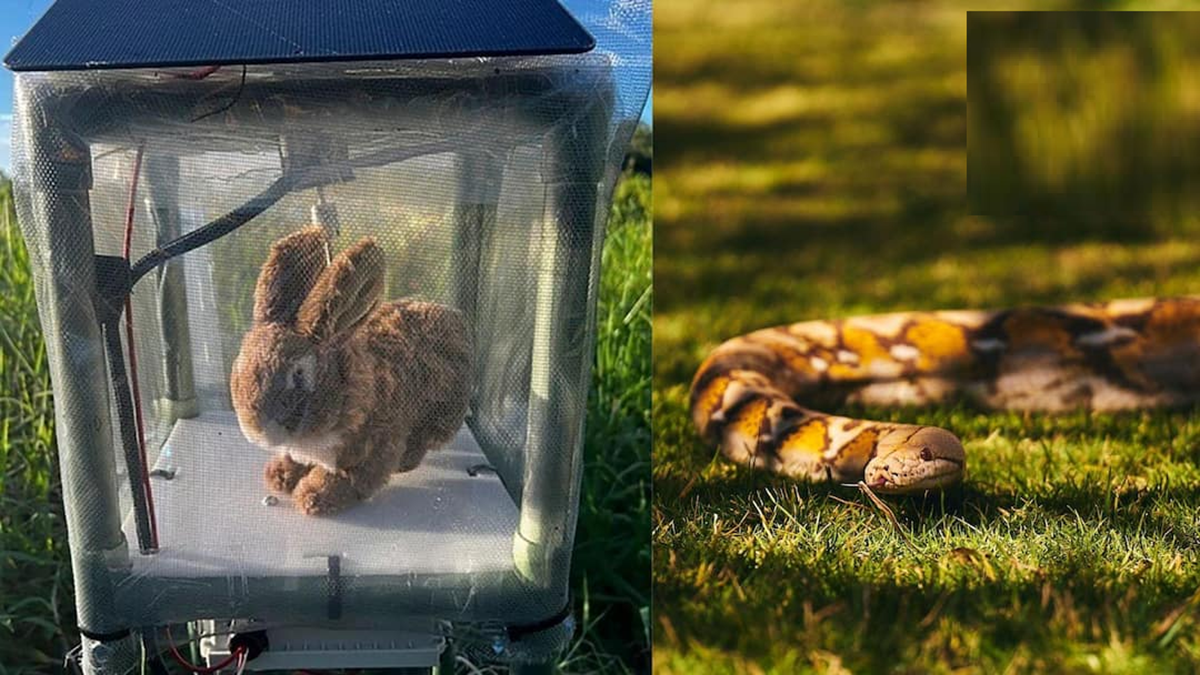
Robotic rabbits have been deployed in Florida, USA, to capture dangerous Burmese pythons. Equipped with AI cameras and special technology, these devices help detect the snakes. Learn how they work.
Taking help from 'rabbit' to catch python
Many technologies are being developed around the world that are making difficult tasks easier for humans. Robots are farming, and machines are monitoring wildlife in the wild. But have you ever heard that a rabbit could be used to capture a dangerous python?
It may sound a bit strange, but such an experiment is underway in Florida, USA. Solar-powered robotic rabbits are being used instead of real rabbits. This is to lure Burmese pythons out of their hiding places and help identify and capture them.
Burmese pythons terrorize Florida.
The increasing presence of Burmese pythons in the Everglades region of Florida, USA, has become a major threat to wildlife and the environment. These snakes are native to Southeast Asia but were introduced to the United States through the pet trade. Subsequently, some snakes escaped or were released into the wild, establishing their populations. Burmese pythons are large and kill their prey by constricting them. Their diet includes small mammals, birds, and other snakes. Their increasing numbers in Florida's natural environment pose a threat to local wildlife. According to the United States Geological Survey (USGS), the spread of pythons in parts of the Everglades has led to a significant decline in the populations of many local mammals.
Robotic rabbits will catch pythons.
Robotic rabbits will be used to capture these pythons. These robotic rabbits are designed using special technology to mimic real-life rabbit prey, not toys. They are solar-powered and remote-controlled. Their unique feature is that they generate body heat and emit a scent that attracts pythons. They are also equipped with AI-based cameras that monitor the surrounding area. Whenever a python is spotted near one of these robotic rabbits, the cameras detect its movement and alert the authorities. Trained snake catchers then arrive at the scene and safely capture and remove the python. This technology was developed jointly by the South Florida Water Management District and the University of Florida. Its deployment began in 2025. Its purpose is to reduce the need for humans to constantly search the forests and make snake identification easier.
Pythons also hide in trees.
A new study by scientists using robotic rabbits has provided important insights into the behavior of Burmese pythons. Researchers monitored the movements of 346 pythons in Big Cypress National Preserve between 2017 and 2024. These included 188 adults and 158 young pythons. Over 4,000 pieces of environmental and habitat data were collected during this period. The research revealed that these snakes prefer to live on the ground, although young pythons were more likely to climb trees. During the study, approximately 17% of young pythons and 14% of adult pythons were recorded climbing trees at least once. Tree climbing accounted for less than 3% of all observed instances. According to the scientists, young pythons have a lighter body, making it easier for them to climb tree branches. As their size and weight increase, their ability to climb trees decreases.
Along with humans, wildlife will also get relief.
Florida doesn't rely solely on robotic rabbits to catch pythons. The Florida Python Challenge is held annually, where trained and civilian participants compete in python-catching events. The 2026 event attracted 907 participants, including participants from 30 US states, Vietnam, and Canada, and a total of 280 Burmese pythons were captured. More than 19,000 pythons have been removed since 2017 through contractors working with the Florida Fish and Wildlife Conservation Commission and other operations.