NEWS
RBI Ombudsman Scheme 2026: How to File a Complaint If Your Bank Ignores You or Your Money Is Stuck
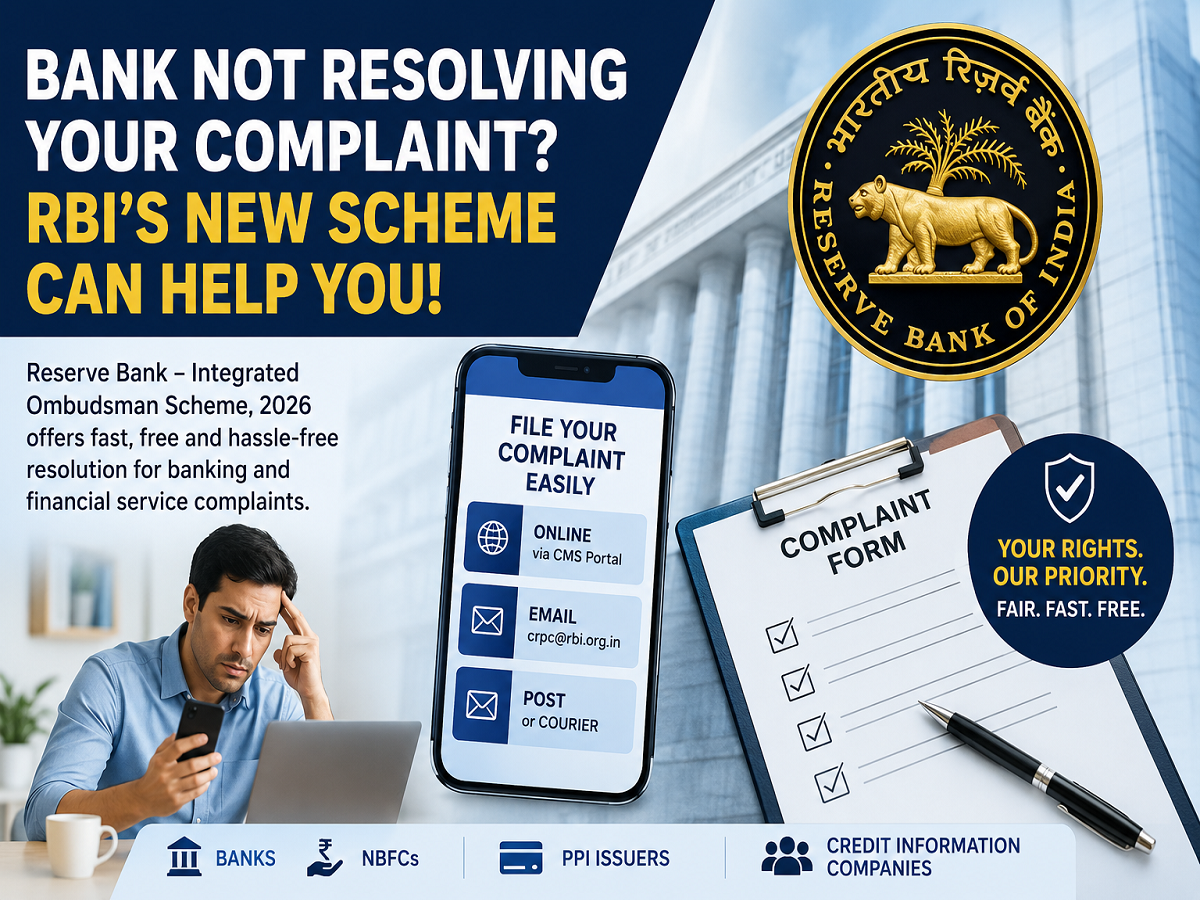
If your bank has failed to resolve a complaint or your funds remain stuck despite repeated follow-ups, the Reserve Bank of India (RBI) has introduced a stronger grievance redressal framework to help customers seek a fair resolution. The Reserve Bank – Integrated Ombudsman Scheme, 2026, which came into effect on July 1, 2026, offers a unified and cost-free mechanism for lodging complaints against RBI-regulated financial institutions.
The scheme is designed to make the complaint process easier, faster, and more transparent for consumers facing issues related to banking and financial services.
What Is the RBI Integrated Ombudsman Scheme 2026?
The Reserve Bank – Integrated Ombudsman Scheme, 2026 brings multiple complaint-handling mechanisms under a single platform. Customers who do not receive a satisfactory response from their bank or regulated financial institution within the prescribed timeline can escalate the matter directly to the RBI Ombudsman.
The grievance redressal process is completely free of cost and aims to provide timely resolution without requiring customers to approach multiple authorities.
Which Financial Institutions Are Covered?
The scheme applies to several RBI-regulated entities. Consumers can file complaints against:
- Scheduled and commercial banks
- Non-Banking Financial Companies (NBFCs)
- Non-bank Prepaid Payment Instrument (PPI) issuers
- Credit Information Companies (Credit Bureaus)
Complaints falling within the scope of the scheme are handled by RBI Ombudsman Offices. Matters outside its jurisdiction may be processed by the Consumer Education and Protection Cells (CEPCs).
When Can You Approach the RBI Ombudsman?
Before filing a complaint with the RBI, customers must first raise the issue with the concerned financial institution.
You can approach the RBI Ombudsman if:
- The bank or financial institution does not respond within the prescribed time.
- The response provided is unsatisfactory.
- Your grievance remains unresolved despite repeated communication.
Skipping the first step and approaching the RBI directly may result in the complaint being rejected.
Three Ways to Submit Your Complaint
The RBI provides multiple options for customers to register complaints conveniently.
1. Online Complaint Portal
Customers can submit complaints through the RBI's Complaint Management System (CMS), which allows faster processing, online acknowledgment, and real-time complaint tracking.
2. Email
Complaints can also be sent through the RBI's designated grievance email address, along with supporting documents and relevant details.
3. Post or Courier
Customers who prefer offline communication may send a written complaint along with supporting documents to the RBI's Centralised Receipt and Processing Centre (CRPC).
Documents You Should Keep Ready
To avoid delays, customers should attach the following documents while filing a complaint:
- Copy of the complaint submitted to the bank or financial institution
- Response received from the institution, if available
- Relevant account or transaction documents
- Identity and contact details, including mobile number and email address
Providing complete documentation helps speed up the grievance resolution process.
Best Practices While Filing a Complaint
The RBI advises customers to follow certain guidelines for smoother complaint handling.
Do
- Use the online CMS portal whenever possible.
- Fill in all mandatory details accurately.
- Attach supporting documents.
- Keep copies of all submitted records.
- Provide an active mobile number and email address for communication.
Don't
- File a complaint with the RBI before approaching the concerned institution.
- Submit incomplete information or unsupported claims.
- Ignore official communication seeking additional information.
Customer Support and Assistance
Customers seeking information about the scheme or the complaint process can contact the RBI's customer support services.
The RBI also provides a toll-free helpline where customers can obtain guidance regarding complaint registration, eligibility, and grievance procedures.
The Interactive Voice Response System (IVRS) remains available round the clock, while customer support executives are available during designated working hours in multiple Indian languages.
Separate Process for DICGC Complaints
Complaints relating to the Deposit Insurance and Credit Guarantee Corporation (DICGC) follow a separate grievance mechanism.
Consumers with issues involving deposit insurance matters must submit their complaints directly to the designated DICGC grievance cell through the prescribed communication channels.
Why the New Scheme Matters
The Integrated Ombudsman Scheme 2026 simplifies the grievance redressal process by creating a single platform for complaints against RBI-regulated financial institutions. Instead of navigating different complaint systems, customers now have a unified mechanism that offers better transparency, easier tracking, and quicker processing.
For individuals facing unresolved banking issues, delayed refunds, failed transactions, account-related disputes, or other service deficiencies, the scheme provides an accessible avenue to seek an independent review after exhausting the institution's internal complaint process.
As digital banking continues to expand across India, the RBI's integrated complaint framework is expected to strengthen consumer protection and improve accountability among regulated financial institutions.