Meteorologists Monitor a Vast Tropical Cloud System Stretching Across the Pacific and Bay of Bengal as Rainfall Prospects Improve
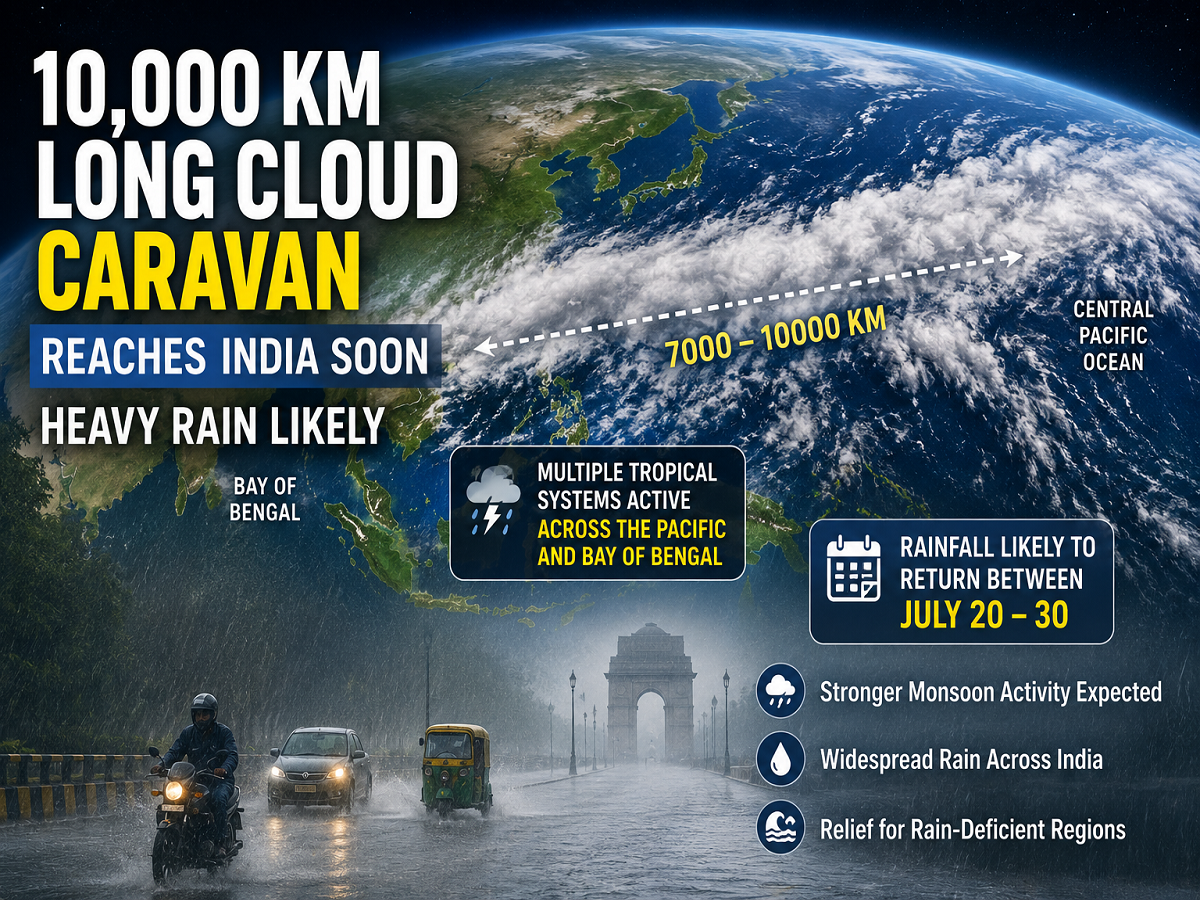
A massive belt of tropical clouds stretching thousands of kilometers across the Asia-Pacific region is drawing the attention of weather experts, as it could influence India's monsoon activity later this month. According to meteorological observations, an extensive cloud system extending from the Bay of Bengal to the central Pacific Ocean has become active, raising hopes of a fresh spell of widespread rainfall across several parts of the country.
The cloud formation, estimated to be between 7,000 and 10,000 kilometers long, contains multiple active tropical weather systems. If these systems strengthen and move closer to the Indian subcontinent, they could help revive the southwest monsoon between July 20 and July 30.
A Giant Tropical Cloud Formation Covers Thousands of Kilometers
Weather experts have identified a vast stretch of dense cloud activity spreading from the Bay of Bengal across Southeast Asia and into the central Pacific Ocean.
This large-scale atmospheric system includes several active tropical disturbances capable of influencing regional weather patterns. Although the cloud band is currently located away from India, meteorologists are closely tracking its movement over the coming days.
Its eventual path and intensity will determine whether it significantly boosts rainfall over the Indian subcontinent.
Multiple Tropical Systems Active Within the Cloud Belt
The extensive cloud formation is not a single weather system but a collection of tropical disturbances developing over warm ocean waters.
These systems can:
- Increase moisture transport toward the Indian subcontinent.
- Strengthen monsoon circulation.
- Trigger the formation of low-pressure systems.
- Enhance rainfall activity over central, eastern, and northern India.
The interaction between these tropical systems and existing monsoon winds will play a crucial role in determining future rainfall.
Monsoon Could Become Active Again
Several parts of India have witnessed uneven rainfall during recent weeks, with some regions experiencing below-normal precipitation.
Meteorologists believe that if the developing tropical systems move westward and align with favorable atmospheric conditions, monsoon activity could strengthen considerably during the last ten days of July.
Such a development may bring:
- Widespread rainfall across central India.
- Increased showers over eastern states.
- Fresh rain activity in northern India.
- Improved rainfall distribution in monsoon-deficient regions.
Rainfall May Increase Between July 20 and 30
Current weather assessments suggest that the period between July 20 and July 30 could witness renewed monsoon activity if the cloud systems continue to evolve as expected.
While forecasting the exact intensity or affected regions remains difficult at this stage, meteorologists indicate that favorable atmospheric conditions are gradually developing.
Residents in rain-deficient areas may receive much-needed precipitation if these systems maintain their projected course.
Why These Tropical Systems Matter
Large cloud formations over tropical oceans often influence weather across South Asia by supplying moisture and strengthening seasonal wind patterns.
Such systems can contribute to:
- Formation of low-pressure areas.
- Intensification of monsoon currents.
- Heavy rainfall episodes.
- Thunderstorms and localized flooding in some regions.
However, the final impact depends on how the systems interact with existing atmospheric conditions.
Forecast May Change
Weather experts caution that tropical systems are highly dynamic and can change direction or weaken depending on ocean temperatures, wind patterns, and atmospheric pressure.
For this reason, rainfall forecasts for late July may be revised as new satellite observations and weather model data become available.
People are advised to follow official updates issued by the India Meteorological Department (IMD) and local weather authorities for the latest forecasts.
Final Outlook
The development of a 7,000-10,000 km-long tropical cloud band has increased optimism for a stronger monsoon phase later this month. If the active weather systems embedded within this cloud formation continue moving toward the Indian region, India could witness a fresh spell of widespread rainfall between July 20 and July 30.
Although the exact trajectory and intensity remain under observation, the evolving weather pattern offers encouraging signs for regions awaiting the return of consistent monsoon showers.