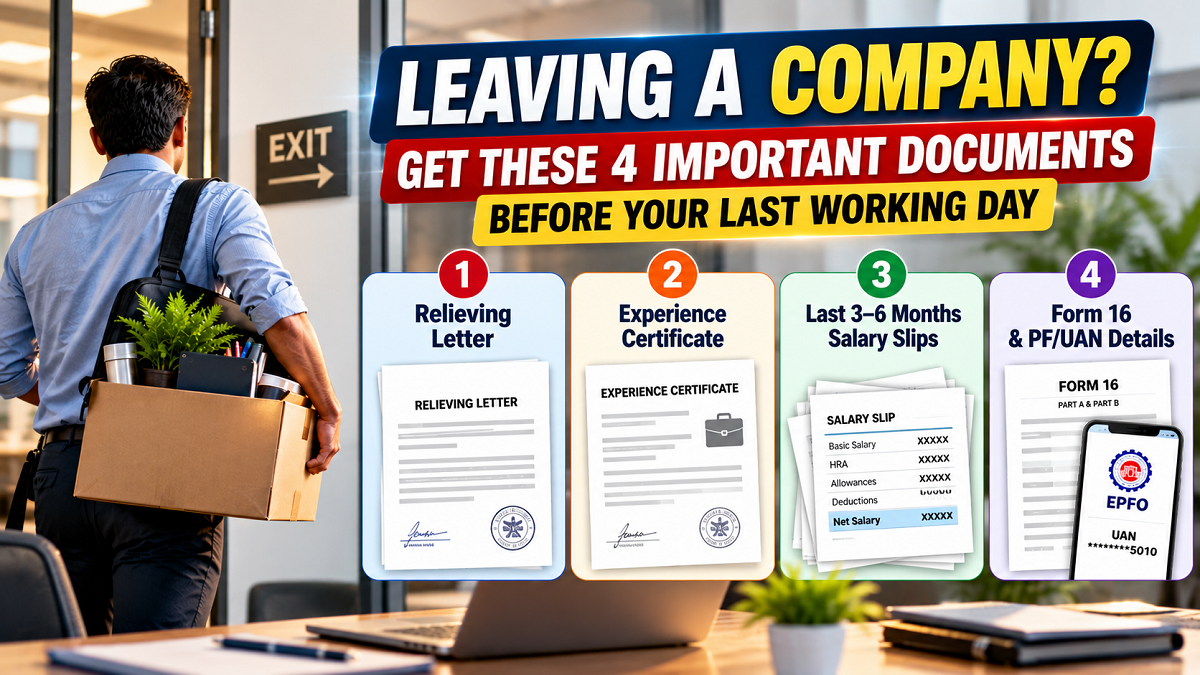
Job Change Tips 2026: Switching jobs is an important step for many professionals looking for better salaries, career growth and new opportunities. However, while preparing for a new position, employees often focus on their notice period, resignation formalities and joining date while overlooking essential documents from their previous employer.
This small oversight can create unnecessary complications during background verification, salary negotiations, tax filing and employee onboarding.
Whether you are leaving a private company, moving to another organisation or taking a career break, collecting your employment records before your final working day can make future professional transitions much easier.
Here are four important categories of documents employees should secure when leaving a company.
1. Relieving Letter: Proof That You Officially Left the Company
A relieving letter is one of the most commonly requested documents during the hiring process.
It is generally issued by an employer after an employee completes the required resignation and exit formalities.
The document confirms that the employee has been formally relieved from their duties, usually mentioning the final working date.
Many companies request a relieving letter from newly hired employees to verify that their previous employment has officially ended.
It can also help establish that the employee has completed the applicable notice-period requirements or received an authorised release.
Why Is a Relieving Letter Important?
A relieving letter may be useful when joining another company because it provides documentary confirmation of your employment exit.
It can help human resources teams verify employment dates and avoid confusion about overlapping jobs.
Some employers may also ask for it as part of their background verification process.
However, not every company follows the same documentation policy, and a relieving letter is not universally mandatory for every job.
Employees should ask their HR department about the expected issuance date and the procedure for obtaining the document.
If the letter is not available immediately, they may request written confirmation of their last working day and completed exit formalities.
2. Experience Certificate: An Important Record of Your Professional Career
An experience certificate is another valuable employment document.
It usually contains information about the employee's designation, period of service and the organisation where they worked.
Some employers may also mention the department or nature of the employee's responsibilities.
The certificate helps establish a person's professional work history.
For example, if you have worked for a company for five years, an experience certificate can serve as supporting evidence of that employment period.
When Might You Need an Experience Certificate?
An experience certificate can be useful when applying for positions that require a minimum number of years of professional experience.
Recruiters may request it to verify whether an applicant meets the experience criteria for a particular role.
The document may also be required for certain recruitment processes, professional applications or other employment-related formalities.
Employees should check that their name, designation and employment dates are correctly mentioned.
Any discrepancy should be reported to the HR department before the document is finalised.
A relieving letter and an experience certificate may sometimes be issued together, but they serve different purposes.
The relieving letter confirms the employment exit, while the experience certificate primarily establishes the employee's work history.
3. Salary Slips: Download Your Last Three to Six Months' Records
Salary slips are important financial documents that employees should preserve throughout their careers.
They provide a detailed record of monthly earnings and deductions.
A typical salary slip may include basic salary, house rent allowance, other allowances, provident fund contributions, professional tax and income tax deductions, where applicable.
The document also shows the employee's net salary for the relevant month.
Why Should You Keep Previous Salary Slips?
Some employers request recent salary slips during recruitment or background verification.
They may also be useful when reviewing a compensation offer, applying for loans or checking past salary payments.
Employees should ideally download at least their last three to six months' salary slips before leaving the organisation.
This is particularly important because access to employee self-service portals may be disabled after the last working day.
Once the account is deactivated, retrieving old salary records may require contacting the former employer's payroll department.
For convenience, save the documents in a secure personal folder or encrypted digital storage.
Avoid storing sensitive salary information on shared devices or forwarding it to unverified recipients.
Employees should also remember that salary slips contain personal financial information and should be shared only when reasonably necessary.
4. Form 16 and PF/UAN Details: Important for Tax and Retirement Records
The fourth category includes income tax documents and provident fund information.
These records are especially important for employees whose salaries are subject to tax deduction at source or who are covered under the Employees' Provident Fund system.
Why Is Form 16 Important?
Form 16 is a tax certificate issued by an employer in applicable cases where tax has been deducted from an employee's salary.
It provides details of salary income and tax deducted at source for the relevant financial year.
Employees may use this information while preparing their income tax returns and reconciling their tax records.
If you change jobs during a financial year, you may need salary and tax information from both employers.
This helps ensure that your total income and applicable deductions are correctly considered.
Important: Form 16 is generally issued after the end of the relevant financial year within the prescribed timeline. Employees leaving before that date may not receive it on their final working day.
In such cases, they should confirm how and when their former employer will provide the certificate.
Why Should You Save Your PF and UAN Information?
Employees covered by EPFO should also keep their Universal Account Number (UAN) and relevant provident fund details readily available.
The UAN is designed to remain associated with the employee across eligible EPF-covered employment.
When joining another company, employees generally need to provide their existing UAN rather than unnecessarily creating a new one.
Keeping these details accessible can help with provident fund continuity, account verification and eligible transfer-related processes.
Employees should also review their EPF passbook and check whether contributions have been reflected correctly.
For official provident fund services, visit the Employees' Provident Fund Organisation website:
Never share your UAN password, OTP or other confidential login credentials with unauthorised individuals.
Other Important Things to Complete Before Leaving a Company
Apart from collecting the four document categories, employees should complete all relevant exit formalities.
This may include returning company equipment, obtaining necessary clearances and confirming the final settlement process.
Employees should also review their pending salary, leave encashment, reimbursements and other payments according to their employment terms and applicable rules.
Where eligible, they may need to check gratuity-related documentation and settlement arrangements.
A copy of the resignation acceptance email can also be useful for future reference.
Employees should ensure that their personal email address and contact details are updated with HR so that important documents can reach them after they leave.
What Should You Do If Your Previous Employer Has Not Provided the Documents?
If an employer has not issued an expected document, the employee should first contact the HR or payroll department through an official communication channel.
It is advisable to make the request in writing and mention the employee ID, department and last working date.
If the document is being processed, ask for an expected timeline.
Maintain copies of relevant emails and employment records.
The availability and timing of particular documents may depend on company policies, contractual arrangements and applicable employment laws.
If a dispute remains unresolved, employees may seek appropriate professional or legal guidance based on their circumstances.
Quick Checklist Before Your Last Working Day
| Document | Main Purpose |
|---|---|
| Relieving Letter | Confirms formal exit from previous employment |
| Experience Certificate | Establishes professional work history |
| Last 3–6 Months' Salary Slips | Supports salary records and employment verification |
| Form 16 and PF/UAN Details | Helps maintain tax and provident fund records |
Conclusion
Changing jobs can open the door to better professional opportunities, but completing the exit process properly is equally important.
Before leaving an organisation, employees should make sure they have requested their relieving letter, experience certificate, recent salary slips and relevant tax and provident fund records.
Keeping these documents organised can reduce complications during future recruitment, background verification, financial applications and income tax filing.
A few simple precautions before your last working day can save considerable time and effort later.
Disclaimer: Employment documentation requirements may differ between organisations. Employees should follow their company's official exit procedure and applicable employment and tax rules.