QR codes have become a common part of everyday life. From making digital payments and opening websites to accessing product information and sharing links, these square-shaped codes allow users to access information within seconds.
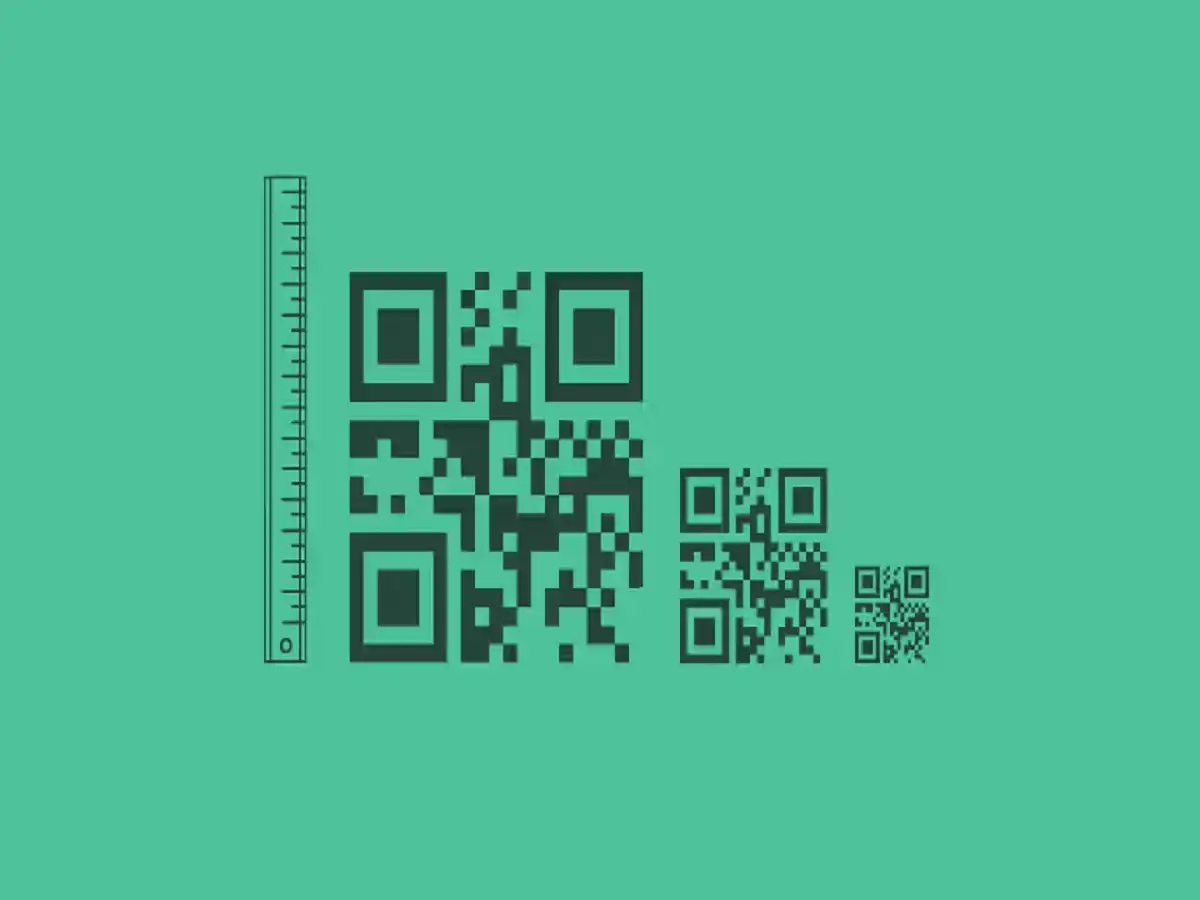
But have you ever wondered how small a QR code can actually be?
Many people believe that a QR code should be at least 2 to 2.5 centimetres wide to work properly. Some recommendations even suggest keeping it around 1 centimetre or larger. However, from a technical perspective, QR codes can be produced at much smaller sizes under the right conditions.
The actual minimum size depends on several factors, including the type of QR code, the number of modules it contains, printing quality, contrast and the technology being used to scan it.
What Determines the Size of a QR Code?
A QR code is not simply measured as one large square. It is made up of numerous tiny squares known as modules.
According to information from Denso Wave, the Japanese company associated with the development of QR code technology, the dimensions of a QR code depend significantly on the size of these individual modules.
For a standard QR code, the smallest version contains a grid of 21 × 21 modules. Under highly controlled conditions, a module can be extremely small. With high-quality printing and an appropriate scanning system, a standard QR code can theoretically be produced at only a few millimetres in width.
One commonly cited example uses a module size of approximately 0.17 mm, resulting in a QR code around 3.57 mm wide for a 21 × 21 configuration.
However, this does not mean that a QR code of this size will reliably work in everyday situations.
Why Smaller Does Not Always Mean Better
A technically readable QR code is very different from one that can be conveniently scanned by an ordinary smartphone.
When a QR code is reduced in size, even small printing imperfections can affect its readability. Blurred edges, poor contrast, damaged surfaces or insufficient spacing around the code may prevent a phone camera from recognising it.
The distance between the QR code and the camera also matters. A tiny code may require the user to hold the phone very close to it, which is not practical for posters, advertisements, packaging or menus.
For everyday applications, businesses should therefore test the printed QR code using the types of smartphones their customers are likely to use rather than relying only on theoretical minimum dimensions.
Micro QR Codes Can Be Even Smaller
There is also a smaller format known as the Micro QR Code.
Denso Wave introduced the Micro QR Code in 2004. It was designed for situations where available printing space is extremely limited.
Unlike a conventional QR code, a Micro QR Code can use a much smaller module arrangement. Depending on the version, it can contain between 11 and 17 modules on each side.
Tests have demonstrated that Micro QR Codes can be produced at sizes of only a few millimetres and still be read under suitable conditions. Some examples have been successfully scanned at approximately 2 mm, while slightly larger versions can accommodate more information.
However, these results depend heavily on the quality of the printed code and the scanning equipment. A tiny Micro QR Code that works under controlled testing conditions may not provide the same reliability when printed on a rough, curved or low-quality surface.
What Is the World's Smallest QR Code?
The concept of a tiny QR code becomes even more remarkable when looking at specialised records.
According to the Guinness World Records information cited in reports about microscopic QR technology, one recorded QR code measures only around 1.977 square micrometres.
This is vastly smaller than anything that could be used for normal consumer applications. Such a microscopic code cannot be viewed or scanned with a standard smartphone camera.
Specialised scientific equipment, including calibrated Scanning Electron Microscopy (SEM), is required to examine and read such extremely small structures.
This demonstrates the difference between what is technically possible in a laboratory and what is useful in everyday life.
What Is the Right QR Code Size for Everyday Use?
There is no single size that works perfectly for every situation. The appropriate dimensions depend on how much information the QR code contains, where it will be displayed and how far away users will be when scanning it.
A QR code printed on a business card can generally be much smaller than one placed on a large outdoor poster. Similarly, a code printed on product packaging may require additional consideration because the surface could be curved, textured or exposed to wear.
Before publishing a QR code, businesses should check several factors:
- Keep sufficient contrast between the QR pattern and its background.
- Maintain the required blank space around the code.
- Use high-quality printing.
- Avoid excessive distortion or compression.
- Consider the expected scanning distance.
- Test the final printed version with multiple smartphones.
The Bottom Line
QR code technology allows these codes to become surprisingly small, especially when specialised formats, high-quality printing and advanced scanning equipment are involved. Standard QR codes can theoretically reach sizes of only a few millimetres, while Micro QR Codes can be even more compact.
However, the smallest possible QR code is not necessarily the most useful one.
For regular users and businesses, reliable scanning should always take priority over extreme size reduction. A slightly larger QR code with strong contrast, clean printing and adequate surrounding space is generally more practical than a microscopic code that only works under ideal laboratory conditions.
So, while QR technology can push the boundaries of size, everyday applications should focus on making the code easy and dependable for smartphone users to scan.