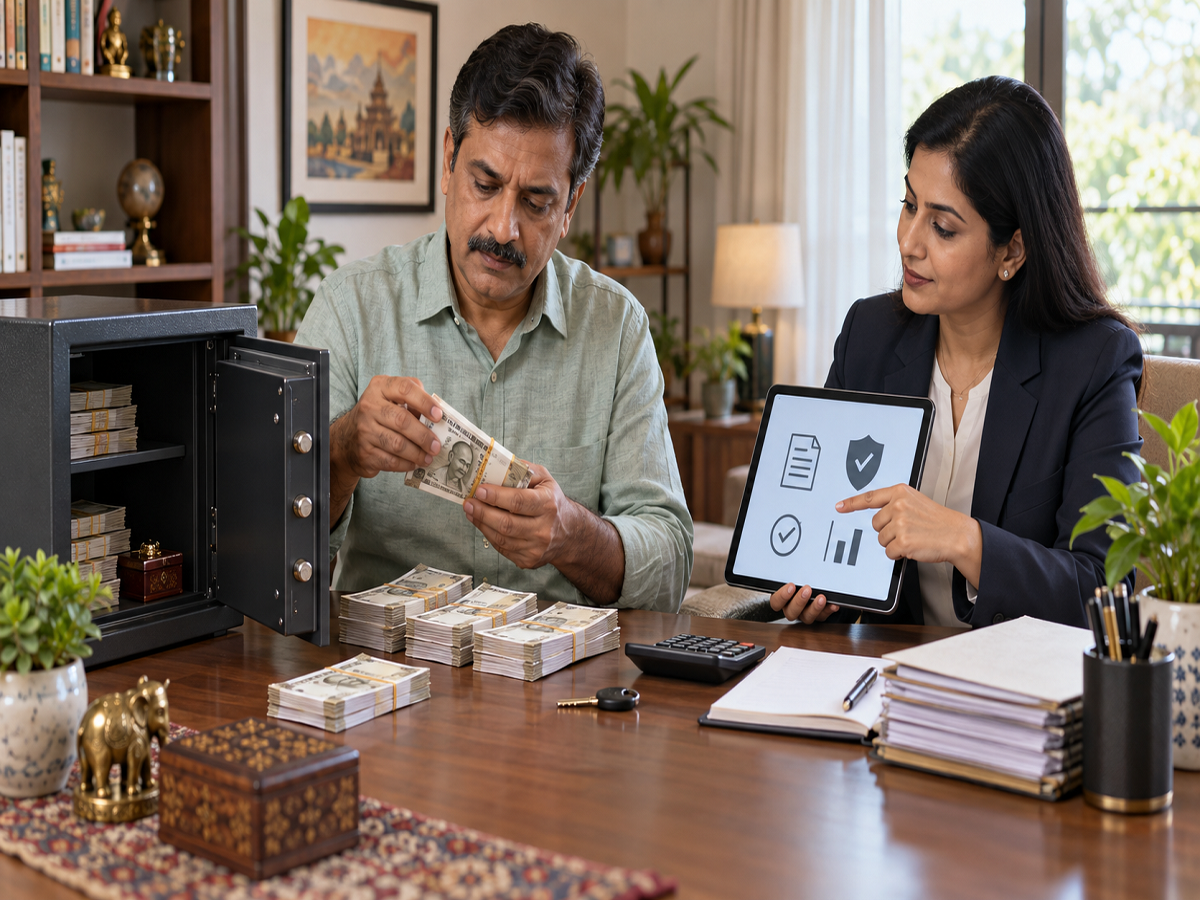
Keeping cash at home is not illegal in India. Contrary to several claims circulating online, income-tax law does not prescribe a standard ceiling such as ₹50,000, ₹1 lakh or ₹10 lakh on the amount an individual may keep at home.
A person can hold a substantial amount of cash, provided it has come from a legitimate source and can be supported by appropriate records. Therefore, the most important issue is not the amount stored at home but whether the owner can satisfactorily explain how it was acquired.
Cash that does not correspond with a person’s declared income, bank withdrawals, business accounts or other documented receipts may lead to scrutiny and serious tax consequences.
Is There a Fixed Limit on Cash Kept at Home?
There is no general provision that sets a maximum amount of cash a person can keep at home. The law does not automatically treat someone as an offender merely because a large amount is found at the residence.
For example, an individual may have withdrawn money from a bank for a family function, medical treatment, property-related expenditure or business requirement. A shop owner may also hold cash generated through properly recorded daily sales.
In such situations, the cash is not unlawful simply because the amount is high. The person should, however, possess records that establish its source and purpose.
Tax authorities may raise questions when the amount appears inconsistent with the individual’s declared income, financial history or books of account.
Why Is the Source of Cash Important?
During a tax search, survey or investigation, the person holding the money may be asked to explain where it came from. A satisfactory explanation should normally be supported by reliable evidence rather than only a verbal claim.
Legitimate sources may include:
- Cash withdrawn from a bank account
- Salary or professional income already disclosed
- Properly recorded business receipts
- Agricultural income supported by relevant records
- Proceeds from the lawful sale of an asset
- A documented gift from an identifiable person
- Money received through inheritance
- Past savings accumulated from declared income
The explanation must be reasonable in relation to the person’s financial circumstances. Claiming that a very large amount represents household savings may not be accepted if reported income and previous cash withdrawals do not support that explanation.
Does Cash at Home Automatically Attract Tax?
No. Merely keeping cash at home does not create a separate tax liability. Tax is generally connected to the income or transaction through which the money was earned or received.
Suppose a person withdraws ₹5 lakh from a bank account and keeps it at home. The withdrawal itself does not ordinarily create fresh taxable income because the money was already in the person’s account.
However, if ₹5 lakh is discovered and the individual cannot connect it to any disclosed income, recorded transaction or identifiable source, the tax authorities may treat it as unexplained money under the applicable law.
What Happens If the Cash Cannot Be Explained?
Unexplained money can be added to the person’s taxable income under the relevant provisions. Such income may face a special and significantly higher tax treatment, along with applicable surcharge and cess.
Depending on the circumstances, penalties may also be imposed. More serious cases involving deliberate concealment, false documents or other violations can result in additional proceedings.
India’s Income-tax Act, 2025 came into force on April 1, 2026 and consolidates the country’s direct-tax law. Readers dealing with cash discovered in the 2026–27 tax year or later should refer to the provisions and section numbers applicable to that period rather than relying only on older references. The updated legislation is available through the Income Tax Department’s official publication.
The treatment of unexplained cash depends on the facts of the case. Anyone facing a notice, search or assessment should obtain advice from a qualified tax professional.
Cash at Home and Cash Deposited in a Bank Are Different Issues
Rules concerning cash held at home should not be confused with financial-transaction reporting by banks.
Banks and post offices must report certain high-value transactions through the Statement of Financial Transactions. Cash deposits aggregating to ₹10 lakh or more during a financial year in one or more savings and other qualifying non-current accounts may fall within this reporting requirement.
The threshold applies to the total deposits made during the financial year, not merely to a single deposit. Splitting the money across several transactions or qualifying accounts does not necessarily prevent aggregation.
Crossing the ₹10 lakh reporting threshold does not make a deposit illegal, nor does it automatically generate a tax demand. It allows the Income Tax Department to compare the reported transaction with the account holder’s return, income and other financial information.
Cash-Transaction Restrictions Must Also Be Considered
Although there is no fixed limit on the amount stored at home, restrictions apply to certain cash receipts and payments.
Tax law generally restricts a person from receiving ₹2 lakh or more in cash:
- From one person in a single day
- For one transaction
- For transactions connected with one event or occasion
The rule focuses on receiving cash, not merely holding it at home. Breaking one payment into smaller instalments may not solve the problem if the amounts relate to the same transaction or event.
Separate restrictions may apply to cash loans, deposits, property transactions, business expenses and other payments. The nature of the transaction is therefore just as important as the amount.
Which Records Can Help Explain Cash?
People who need to keep a meaningful amount of cash should maintain a clear documentary trail. Useful evidence may include:
- Bank statements showing cash withdrawals
- Withdrawal slips and ATM receipts
- Cash books and business ledgers
- Sales invoices and GST records
- Property or asset-sale agreements
- Gift deeds and the donor’s details
- Inheritance or succession documents
- Agricultural land and produce-sale records
- Income Tax Returns and financial statements
- Documents showing the intended use of the money
A bank withdrawal proves that cash was taken out, but it may not always be sufficient by itself. If a long period has passed or the money appears to have been spent elsewhere, the authorities may ask for a complete explanation of the cash flow.
Should People Avoid Keeping Large Amounts at Home?
Holding cash at home involves practical risks even when the money is fully accounted for. It may be lost through theft, fire or another emergency, and ordinary household insurance may not cover the entire amount.
Cash also does not generally earn interest while it remains unused. Keeping funds in an appropriate bank account or financial product may provide better security, easier documentation and potential returns.
Nevertheless, some households and businesses require cash for genuine purposes. In such cases, the amount should be reasonable for the stated need and supported by proper records.
Final Takeaway
Indian income-tax law does not prescribe a general maximum limit on the cash that an individual can keep at home. A person may legally hold a large amount if it comes from a lawful and explainable source.
Problems arise when the cash does not match declared income or when the holder cannot provide credible records showing how it was acquired. Such money may be treated as unexplained income and could attract substantial tax and penalties.
The safest approach is to maintain bank statements, invoices, tax returns and other supporting documents. The amount of cash is important, but the evidence behind it matters far more.
Disclaimer: This article provides general information and should not be considered legal or tax advice. Tax treatment depends on individual facts and the law applicable to the relevant tax year.