NEWS
Can You Transfer a Flight Ticket to Someone Else? Know the Rules Before Changing Your Travel Plan
Booking a flight several weeks or months in advance can often help travellers secure a convenient schedule or a better fare. But plans can change unexpectedly. A work commitment, illness, family event or another last-minute situation could make it impossible to take the journey.
That leads to a common question: If you cannot travel, can your confirmed flight ticket be given to a family member or friend instead?
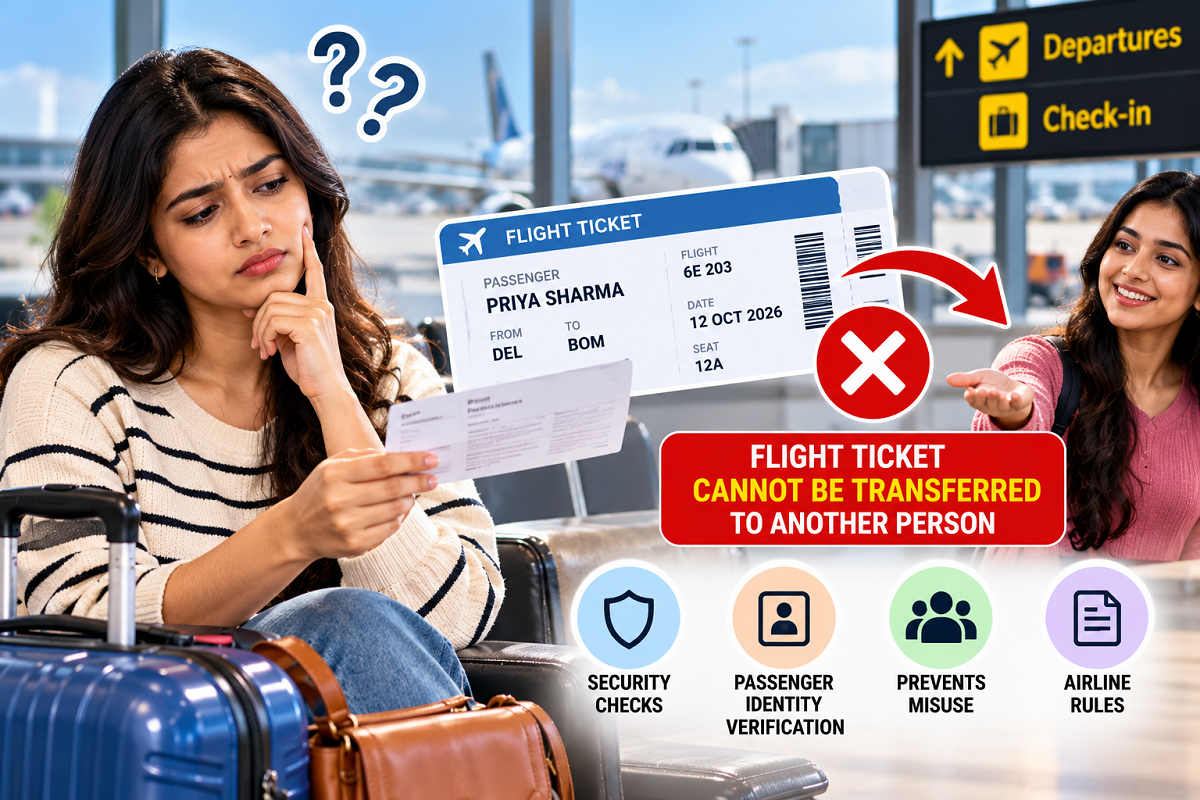
In most cases, the answer is no. Commercial airline tickets are generally issued for a specific passenger and are non-transferable. The person whose name appears on the booking is normally the person who must travel.
A simple spelling correction may be possible under an airline's policy, but replacing the original passenger with an entirely different person is a different matter.
Here's what travellers should understand before attempting to change the passenger name on a flight booking.
Why Can't a Flight Ticket Simply Be Given to Someone Else?
Air travel involves strict identity and security checks.
Passenger information provided during booking is linked to the individual who is expected to board the aircraft. At different stages of the journey, travellers may be required to show identification matching the details on their ticket or boarding pass.
Airlines and aviation-security authorities use passenger information as part of the travel and security process.
Allowing one person to purchase a ticket and freely hand it over to someone else could complicate passenger identification and related security procedures.
Therefore, a ticket booked in one passenger's name generally cannot simply be used by another person.
Ticket Transfer and Name Correction Are Different
One point that often creates confusion is the difference between a name correction and a passenger change.
Suppose a passenger's name is Rahul Sharma, but a small spelling error appears in the booking. Depending on the airline's policy and supporting identification, the carrier may allow the error to be corrected.
Airlines can have different rules regarding what qualifies as a minor correction, how quickly the passenger must request it and whether a fee applies.
However, changing a booking from Rahul Sharma to Amit Verma would not be a spelling correction. It would effectively replace one passenger with another.
That is generally treated as a ticket transfer rather than a correction and is typically not permitted on ordinary passenger bookings.
Travellers should contact the airline directly if their booking contains an incorrect name rather than trying to make an unauthorized change themselves.
Why Airlines Restrict Ticket Transfers
Security is one of the major reasons passenger identity matters, but there is another practical consideration.
If airline tickets could be freely transferred between unrelated passengers, people could potentially buy large numbers of tickets when fares are low and resell them later when prices rise.
That could create an unofficial resale market similar to ticket scalping in other industries.
Non-transferability helps keep the reservation tied to the passenger whose details were provided when the booking was created.
What Can You Do If You Can No Longer Travel?
Being unable to transfer your ticket does not necessarily mean that the entire amount paid is automatically lost.
The options available will depend heavily on the airline, fare type and conditions attached to the booking.
The first option is to check whether the ticket can be cancelled.
If cancellation is permitted, the airline may deduct applicable cancellation charges and refund the remaining eligible amount. The exact refund can vary significantly depending on whether the ticket is refundable, partially refundable or sold under restrictive fare conditions.
Some statutory or airport-related components may also be handled differently from the base fare, depending on applicable rules and circumstances.
Check Whether Rescheduling Is More Useful
If your trip has only been postponed rather than cancelled completely, changing the travel date could be more useful than cancelling the ticket.
Many airlines allow eligible bookings to be rescheduled after payment of a change fee and any applicable fare difference.
For example, if the new flight costs more than the original ticket, the passenger may have to pay the difference in addition to any applicable change charges.
Some flexible fares may provide more favourable change conditions.
This is why travellers should review fare rules before purchasing a ticket, particularly when their travel dates are uncertain.
What Is an Airline Credit Shell?
Under certain circumstances, an airline may provide the eligible ticket value as a credit balance, travel credit or credit shell instead of immediately refunding it to the original payment method.
That credit can generally be used according to the airline's specific terms, including its validity period and passenger restrictions.
A credit shell should not be assumed to mean that the ticket can now be used by anyone. Some travel credits remain linked to the original passenger or booking details.
Always read the applicable conditions before choosing this option.
Contact the Airline Before Making Any Changes
Rules can vary between airlines and fare categories. International tickets can also involve additional conditions depending on the carrier, route and ticketing arrangement.
If you cannot travel, check the fare conditions shown on your booking and contact the airline or authorized booking platform as early as possible.
Ask specifically about cancellation charges, refund eligibility, date changes, travel credits and name-correction rules.
The earlier you act, the more options you may have under the fare conditions.
The Bottom Line
A flight ticket should generally be treated as a booking for the specific passenger named on it, not as an item that can freely be handed over to someone else.
Airlines may permit legitimate corrections to minor errors in passenger details, subject to their policies. But changing the passenger completely—for example, replacing one traveller with a friend or relative—is generally not the same as correcting a typo and is typically prohibited.
If your plans change, cancelling, rescheduling or using an eligible airline travel credit may be better alternatives.
Most importantly, check the latest fare rules directly with the airline before taking action, as fees, refund conditions, name-correction policies and other terms can vary by carrier and ticket type.