NEWS
AC Electricity Bill Too High? New 5-Star and AI-Powered Air Conditioners Could Help You Save Money
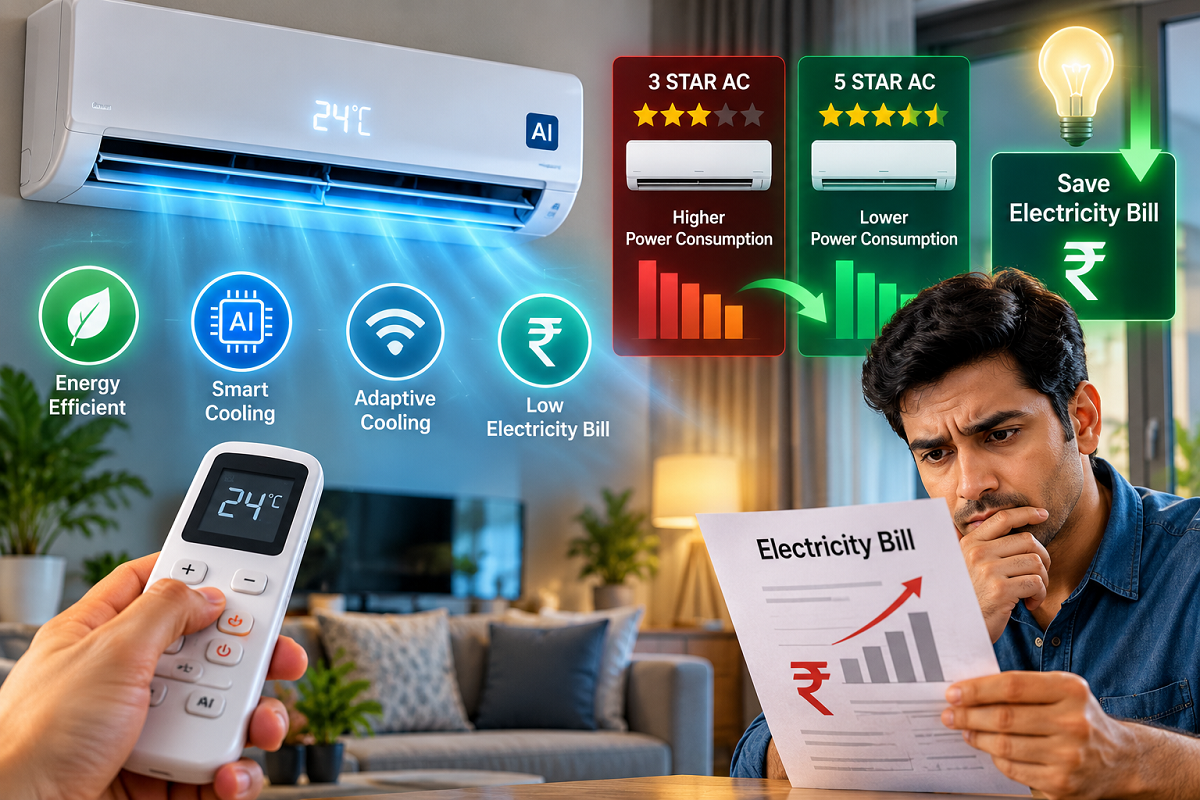
AC Electricity Saving Tips 2026: Air conditioners have become essential appliances for many Indian households, especially during the intense summer months. While ACs provide relief from extreme heat, their electricity consumption can significantly increase monthly household expenses.
With electricity bills becoming a major concern, air conditioner manufacturers are introducing advanced technologies designed to improve cooling efficiency and reduce unnecessary power consumption.
Leading brands such as LG, Voltas, Daikin and Samsung are increasingly focusing on energy-efficient 5-star air conditioners, inverter technology and artificial intelligence-powered cooling features.
These technologies aim to maintain comfortable indoor temperatures while using electricity more efficiently.
However, the amount consumers can save depends on several factors, including the air conditioner's energy rating, room size, daily usage and local electricity tariffs.
India's Air Conditioner Market Is Growing Rapidly
India's air conditioner industry is witnessing strong growth as rising temperatures, urbanisation and changing consumer preferences increase demand for cooling appliances.
According to estimates attributed to market research firm IMARC Group, India's air conditioner market was valued at approximately $6.15 billion in 2025.
The market was projected to reach around $7.07 billion in 2026.
Long-term forecasts suggest that the industry's value could rise to approximately $21.59 billion by 2034.
These figures are market estimates rather than guaranteed outcomes, and actual growth will depend on economic conditions, consumer demand and industry developments.
Increasingly hot summers and growing demand for indoor comfort are among the factors encouraging households to invest in air conditioners.
At the same time, electricity costs are influencing the types of ACs consumers prefer.
Instead of considering only the purchase price, more buyers are examining the long-term running expenses of cooling appliances.
How Much Electricity Do ACs Consume in Indian Homes?
Cooling appliances account for a considerable portion of household electricity consumption.
A 2024 survey conducted by the Bureau of Energy Efficiency (BEE) and CLASP reportedly examined 4,321 households across 20 Indian states.
According to the survey findings cited in the report, fans, air conditioners and air coolers collectively accounted for approximately 40% of household electricity consumption.
Air conditioners alone contributed around 11% of total household electricity use, with the figure rising to approximately 12% in urban households.
These are survey averages, not fixed percentages applicable to every home.
For households operating multiple air conditioners for long periods, the share of electricity consumed by cooling can be considerably higher.
This explains why improvements in AC efficiency can make a meaningful difference to household expenses.
Why Are 5-Star Air Conditioners Becoming Popular?
The Bureau of Energy Efficiency uses star ratings to help consumers compare the energy efficiency of appliances.
For comparable air conditioners covered by the same rating standard and label period, a 5-star model is generally more energy-efficient than a 3-star model.
An efficient air conditioner can deliver the required cooling while consuming less electricity under comparable conditions.
Although 5-star ACs often cost more initially, they may offer lower running expenses over time.
The financial benefit depends on how frequently the appliance is used and the price difference between the models.
For households using air conditioning for several hours daily, higher efficiency may be particularly valuable.
However, buyers should compare the actual annual energy consumption displayed on the BEE label rather than relying only on the number of stars.
LG Reports Growing Demand for Energy-Efficient ACs
LG is among the manufacturers focusing on energy-efficient cooling appliances in India.
According to the supplied industry report, the company has observed increasing demand for high-efficiency air conditioners.
It also reported that 5-star models account for more than half of its overall AC sales.
This suggests that many customers are increasingly willing to consider higher-efficiency products despite potentially higher upfront costs.
Energy-efficient inverter air conditioners are designed to adjust compressor operation according to cooling requirements.
This can reduce unnecessary electricity consumption compared with less efficient operation, particularly when the AC is used for extended periods.
However, the actual benefit varies by model and usage conditions.
Voltas Introduces AI-Powered Cooling Features
Voltas is also incorporating intelligent cooling technologies into its air conditioner lineup.
Its AI-powered Vertis split AC range includes features such as adaptive cooling, geofencing and energy management.
Adaptive cooling technology can adjust certain operating settings according to environmental conditions or user requirements.
Geofencing features, where supported and enabled, may use a connected smartphone's location to trigger selected automation functions.
Energy management tools can help users monitor or control aspects of AC operation.
These features are designed to improve convenience and potentially reduce unnecessary cooling.
However, AI-powered operation does not guarantee a specific reduction in electricity bills.
Savings depend on how the technology is implemented and how consumers use the appliance.
Daikin 5-Star vs 3-Star AC: How Much Electricity Can Be Saved?
The supplied report highlights an example comparing the estimated annual electricity consumption of two Daikin 1.5-ton air conditioner models.
The 5-star model is reported to have an Indian Seasonal Energy Efficiency Ratio (ISEER) of 5.70 and estimated annual electricity consumption of 716.97 kWh.
The compared 3-star model has an estimated annual consumption of 880.1 kWh.
Here is the comparison:
| Particulars | 5-Star AC | 3-Star AC |
|---|---|---|
| Brand | Daikin | Daikin |
| Capacity | 1.5 Ton | 1.5 Ton |
| Energy rating | 5 Star | 3 Star |
| Estimated annual electricity consumption | 716.97 units | 880.10 units |
| Difference in annual consumption | 163.13 fewer units | — |
These figures are for the specific models cited and should not be applied to every 5-star or 3-star air conditioner.
The comparison indicates that the more efficient model could consume approximately 18.5% less electricity under the stated rating conditions.
How Much Money Could You Save With a 5-Star AC?
Using the estimated difference of 163.13 electricity units annually, potential savings can be calculated at different electricity rates.
| Electricity Rate | Estimated Annual Savings |
|---|---|
| ₹6 per unit | ₹979 |
| ₹7 per unit | ₹1,142 |
| ₹8 per unit | ₹1,305 |
| ₹9 per unit | ₹1,468 |
| ₹10 per unit | ₹1,631 |
For example, at an assumed electricity rate of ₹8 per unit, the difference would be approximately ₹1,305 annually.
Over five years, this could amount to roughly ₹6,525 in electricity cost savings, assuming the same annual consumption difference and tariff.
These are illustrative calculations based on the supplied annual consumption figures.
Actual household savings may differ because electricity tariffs, usage patterns, weather conditions and cooling requirements vary.
The calculation also excludes differences in purchase price, maintenance expenses and other electricity bill components.
Samsung Is Also Focusing on AI-Based Energy Management
Samsung is another major manufacturer incorporating AI-assisted features into selected air conditioners.
Such technologies can support automatic cooling adjustments and provide users with additional control over energy consumption.
Some connected AC models also offer app-based monitoring and scheduling functions.
For example, users may be able to adjust temperatures remotely, set operating schedules or monitor electricity usage through compatible applications.
These features can be useful for people who frequently forget to switch off their air conditioners or want more control over daily cooling schedules.
However, feature availability varies across models, and not every Samsung AC includes the same capabilities.
3-Star vs 5-Star AC: Which One Should You Buy?
Choosing between a 3-star and a 5-star air conditioner depends on both the purchase budget and expected usage.
A 3-star AC may be suitable for households that use cooling only occasionally.
A 5-star model may be worth considering for people who operate their ACs for several hours every day.
According to the BEE-CLASP survey figures cited in the report, approximately 40% of the analysed AC models were rated 3-star, while around 33% were rated 5-star.
Although efficient appliances can reduce operating costs, higher purchase prices remain an important consideration for many buyers.
Consumers should therefore compare the total cost of ownership rather than looking only at the initial price.
The total cost includes purchase price, electricity consumption, maintenance and expected appliance lifespan.
Simple Tips to Reduce Your AC Electricity Bill
Even without purchasing a new air conditioner, households can take practical steps to improve cooling efficiency.
1. Set a comfortable temperature: Avoid unnecessarily low thermostat settings. A setting around 24–26°C may provide comfortable cooling for many households, depending on humidity and personal preference.
2. Use ceiling fans when appropriate: Fans can improve air circulation and help occupants feel comfortable at a slightly higher AC temperature.
3. Clean air filters regularly: Dirty filters can restrict airflow and reduce cooling performance. Follow the manufacturer's cleaning recommendations.
4. Keep doors and windows closed: Preventing warm outdoor air from entering can reduce the cooling load.
5. Limit direct sunlight: Curtains, blinds and external shading can help reduce heat entering a room.
6. Choose the correct AC capacity: An air conditioner that is poorly matched to the room's cooling requirements may operate inefficiently.
7. Use timers and smart features: Scheduling functions can help avoid running the AC when cooling is unnecessary.
8. Maintain the appliance: Regular servicing can help identify airflow problems, refrigerant issues and other faults affecting performance.
What Should You Check Before Buying a New AC?
Before purchasing an air conditioner, compare its BEE star rating, annual electricity consumption and cooling capacity.
The ISEER value is also useful because it indicates seasonal energy efficiency under defined testing conditions.
Buyers should ensure that the star ratings being compared belong to the same applicable rating period, as efficiency standards can change.
Other considerations include warranty coverage, installation expenses, maintenance requirements and the availability of service support.
AI features can provide additional convenience, but they should not replace a careful comparison of basic energy efficiency and cooling performance.
Final Thoughts
India's growing demand for air conditioners is encouraging manufacturers to develop more efficient and intelligent cooling technologies.
Companies including LG, Voltas, Daikin and Samsung are focusing on 5-star energy ratings, adaptive cooling and connected energy management features.
These developments may help households reduce electricity consumption, particularly when combined with sensible usage habits.
However, a more expensive AC is not automatically the most economical choice for every buyer.
The key takeaway: If your AC electricity bill is rising, compare annual power consumption, choose the right capacity and use efficient cooling settings. A suitable 5-star model may offer long-term savings, especially in households where air conditioning is used frequently.