Business
SIP Calculator: Can ₹6,000 a Month Grow to ₹9 Crore? Step-Up Strategy and Retirement SWP Explained
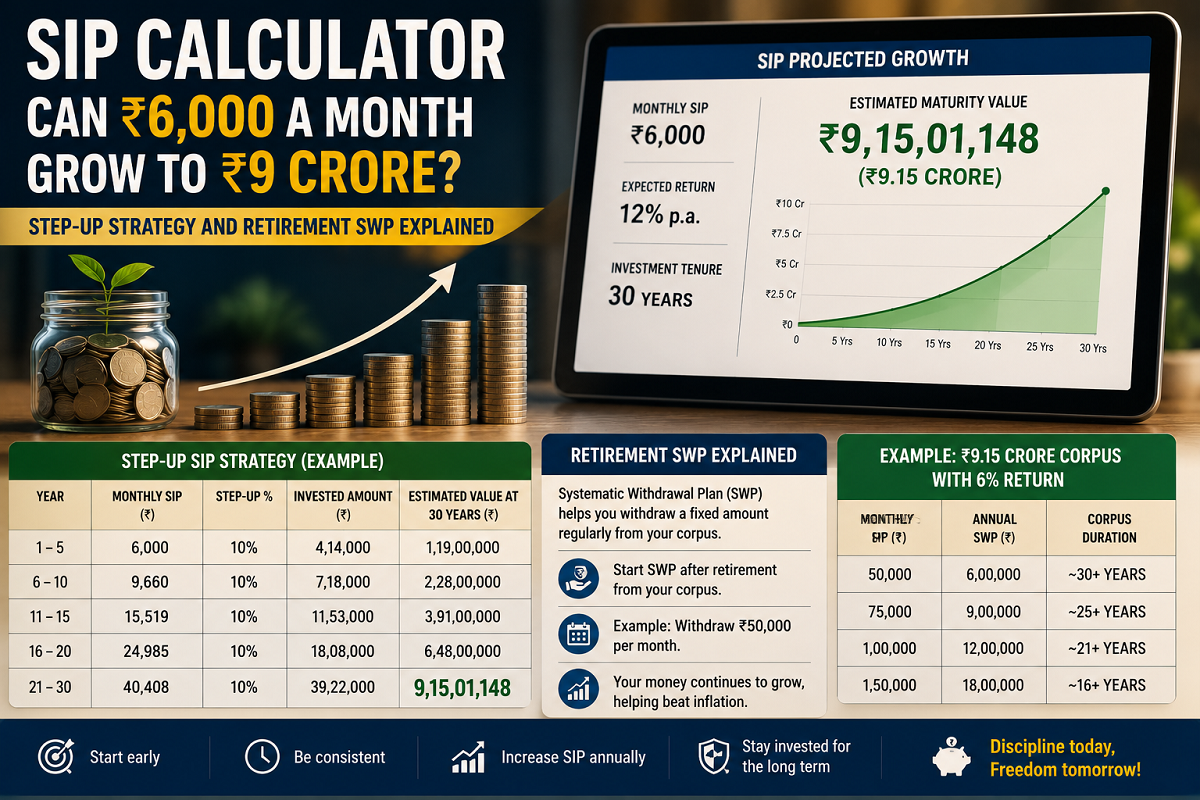
SIP Calculator for Retirement: A monthly investment of ₹6,000 may not look large enough to create a multi-crore retirement corpus. However, if the SIP amount is increased every year and the investment is continued for several decades, the final value can rise significantly because of compounding.
One illustration shows that an investor starting with a ₹6,000 monthly SIP, increasing the contribution by 10% every year and investing for 30 years could potentially build a corpus of around ₹9.01 crore, assuming an annualised return of 15%.
The same illustration suggests that this retirement corpus could later be used through a Systematic Withdrawal Plan (SWP) to generate a monthly cash flow of around ₹6 lakh.
However, both figures depend heavily on assumed market returns. Mutual fund returns are not fixed or guaranteed, and an SWP is not the same as a guaranteed pension.
What Is a Step-Up SIP?
A normal SIP allows investors to contribute a fixed amount at regular intervals.
For example, if you start investing ₹6,000 every month and never increase the contribution, you will continue investing the same amount even if your salary rises substantially over the years.
A Step-Up SIP works differently.
Under this strategy, the monthly investment is increased periodically, typically once a year.
If a ₹6,000 monthly SIP is increased by 10% annually, the contribution would move approximately like this:
- First year: ₹6,000 per month
- Second year: ₹6,600 per month
- Third year: ₹7,260 per month
- Fourth year: ₹7,986 per month
The contribution continues increasing in the same way over the investment period.
This approach can help investors direct a portion of future salary increases toward long-term financial goals instead of allowing all additional income to move into higher spending.
How Could ₹6,000 SIP Potentially Become ₹9 Crore?
The calculation in this retirement illustration uses four major assumptions:
Starting SIP: ₹6,000 per month
Annual increase: 10%
Investment period: 30 years
Assumed annual return: 15%
Under these assumptions, the projected corpus after 30 years comes to approximately:
₹9,01,33,619, or about ₹9.01 crore.
The ₹6,000 starting SIP is equivalent to saving roughly ₹200 a day.
However, it is important to understand that the investor does not contribute only ₹6,000 every month for the entire 30-year period. The contribution rises by 10% each year, which substantially increases the amount invested during later years.
The ₹9 crore projection also depends on the assumed 15% return being achieved over a very long period.
What Happens With a Regular SIP Without Step-Up?
The difference between a fixed SIP and a Step-Up SIP can become substantial over three decades.
According to the cited illustration, investing ₹6,000 every month for 30 years at the same assumed return could build a corpus of around ₹4.20 crore.
Increasing the contribution by 10% every year takes the projected amount to approximately ₹9.01 crore.
This highlights the potential impact of increasing investments as income rises.
However, the exact difference will vary depending on the return earned, the timing of the annual step-up and market performance.
Is a 15% Annual Return Guaranteed?
No.
A 15% CAGR is only an assumption used for the calculation.
Equity mutual funds are market-linked investments. Their returns fluctuate according to stock-market conditions, portfolio performance and several other factors.
Some long-term periods may deliver returns above 15%, while others may produce substantially lower returns.
Therefore, investors should not interpret a calculator showing ₹9 crore as a promise that ₹6,000 per month will definitely create that amount.
A retirement plan should ideally be tested under several return assumptions rather than relying exclusively on an optimistic scenario.
How Can ₹9 Crore Generate ₹6 Lakh a Month?
After retirement, investors often need regular cash flow rather than continued wealth accumulation.
One method used for this purpose is a Systematic Withdrawal Plan, or SWP.
Through an SWP, investors periodically redeem a predetermined amount from a mutual fund investment.
In the illustration provided:
Retirement corpus: ₹9 crore
Monthly withdrawal: ₹6 lakh
Withdrawal period: 25 years
Assumed portfolio return: 7% to 8% annually
Based on these assumptions, the investor could potentially withdraw ₹6 lakh every month between the ages of 60 and 85 and still retain a remaining corpus.
The illustration estimates that approximately ₹2.64 crore could remain at the end of 25 years.
Again, this result depends on the actual investment return achieved during retirement.
SWP Is Not the Same as a Guaranteed Pension
Calling an SWP a "fixed pension" can be misleading.
Unlike certain guaranteed pension or annuity products, an SWP generally involves periodic redemption from an investment whose value may continue to fluctuate.
If markets perform poorly, particularly during the early years of retirement, repeatedly withdrawing money can reduce the corpus faster than expected.
This is known as sequence-of-returns risk.
Therefore, retirees may need an asset-allocation strategy that balances growth potential with stability rather than simply transferring the entire retirement corpus into one product.
Why Could ₹6 Lakh a Month Be Needed After 30 Years?
Inflation is one of the biggest challenges in retirement planning.
Money loses purchasing power over time as the prices of goods and services increase.
The illustration assumes that a household spending around ₹50,000 per month today could require several lakh rupees per month after three decades if inflation remains high.
At an assumed inflation rate of 8%, ₹50,000 of monthly expenses today would increase dramatically over 30 years.
This is why retirement planning should focus not merely on building a large number such as ₹1 crore or ₹5 crore, but on estimating future living expenses.
Healthcare costs deserve particular attention because medical inflation can significantly affect retirement budgets.
Why Starting Early Helps
A 30-year investment horizon gives compounding much more time to work.
Someone starting at age 30 and investing until 60 has significantly more time than someone who begins at 45.
A later investor may need to contribute much larger monthly amounts to target the same retirement corpus.
Starting early can therefore reduce the initial investment burden while allowing contributions to increase gradually with income.
Step-Up SIP Can Match Rising Income
One practical advantage of a Step-Up SIP is that it can align investment growth with salary growth.
Suppose your salary increases by 8% to 10% annually.
Instead of allowing your lifestyle expenses to absorb the full increase, you could redirect a portion toward your SIP.
This can help maintain financial discipline without requiring a very large starting investment.
Investors who cannot manage a 10% annual increase may choose a smaller step-up, such as 5%, depending on their financial capacity.
Consistency matters more than selecting an increase that becomes unaffordable after a few years.
Don't Ignore Emergency Savings
Long-term mutual fund investing should not replace an emergency fund.
Unexpected medical expenses, job loss or urgent family needs can force investors to redeem long-term investments at an unfavourable time.
Keeping several months of essential expenses in a liquid emergency reserve can reduce this risk.
Insurance, particularly adequate health and term insurance where appropriate, can also protect the retirement plan from major financial shocks.
Review Your Retirement Plan Regularly
A 30-year financial plan cannot simply be created once and forgotten.
Income, family responsibilities, inflation, taxation and market conditions can all change.
Investors should periodically check whether their actual corpus remains aligned with their retirement target.
If returns are lower than expected, increasing the SIP contribution or extending the investment horizon may be necessary.
Similarly, if expenses rise faster than originally estimated, the retirement target may need to be revised upward.
SIP to ₹9 Crore: The Key Takeaway
A ₹6,000 monthly SIP with a 10% annual step-up can potentially create a substantial retirement corpus over 30 years.
Under an illustrative assumption of a 15% annualised return, the final amount could reach approximately ₹9.01 crore.
That corpus could then potentially be used through an SWP to generate monthly withdrawals of around ₹6 lakh for 25 years, assuming the remaining investment earns sufficient returns.
But neither the ₹9 crore corpus nor the ₹6 lakh monthly withdrawal is guaranteed.
The more important lesson is the strategy behind the calculation: start early, invest consistently, increase your contribution as your income rises and regularly review whether your retirement corpus is keeping pace with inflation and your future needs.
Mutual fund investments are subject to market risks, and investors should evaluate their goals, risk tolerance and asset allocation carefully before committing money.