A personal loan can provide quick access to money for expenses such as medical emergencies, weddings, home improvements, travel or other financial requirements. However, because personal loans are generally unsecured, their interest rates can be higher than those of some secured loans.
Borrowers therefore need to look beyond the monthly EMI and understand the total interest payable over the entire loan tenure.
A longer repayment period can reduce the monthly EMI, but it can also increase the total amount of interest paid. If your finances allow it, making additional payments towards the principal and reducing the repayment tenure can potentially save a considerable amount of money.
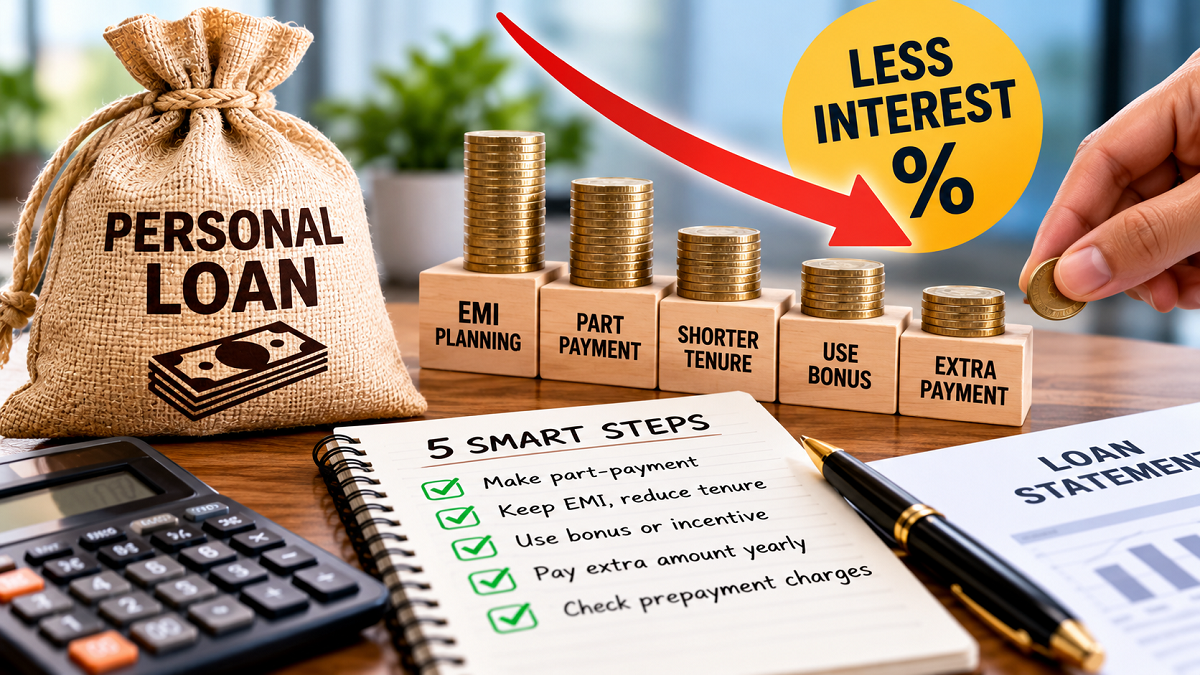
Here are five strategies borrowers can consider to reduce their personal loan interest burden and become debt-free sooner.
Understand How Loan Tenure Affects Your Total Cost
Consider a simple example. Suppose a borrower takes a ₹5 lakh personal loan for five years at an annual interest rate of 12%.
At these assumptions, the monthly EMI would be approximately ₹11,122. Over 60 months, the borrower would repay around ₹6.67 lakh in total.
That means roughly ₹1.67 lakh of the total repayment would represent interest, although actual calculations may vary slightly depending on the lender's methodology, repayment dates and other applicable terms.
Reducing the outstanding principal earlier in the tenure can lower the amount on which future interest is calculated.
1. Consider Making a Part-Payment
One of the most effective ways to reduce the cost of a personal loan is to make a lump-sum part-payment when extra funds become available.
Suppose that after paying 12 EMIs, the borrower in the above example has an outstanding principal of roughly ₹4.22 lakh.
If the borrower makes an additional ₹1 lakh part-payment, the outstanding principal could fall to approximately ₹3.22 lakh.
Because future interest is then calculated on a smaller outstanding balance, this can reduce the overall interest burden.
However, borrowers should check their loan agreement first because some lenders may impose restrictions or charges on part-payments.
2. Reduce the Tenure Instead of Immediately Lowering the EMI
After making a substantial part-payment, borrowers may sometimes have the option to reduce either their EMI or the remaining loan tenure.
If cash flow permits, continuing with roughly the same EMI while shortening the repayment period can generally result in greater interest savings than simply lowering the monthly instalment.
In the example above, maintaining the EMI after a ₹1 lakh part-payment could allow the loan to be closed significantly earlier than the original 60-month schedule.
Depending on the exact repayment calculation, the interest saving could be around ₹45,000 compared with continuing under the original schedule.
This is only an illustrative calculation. Actual savings will depend on the lender's interest calculation, timing of the prepayment, applicable fees and revised repayment schedule.
3. Use Bonuses and Incentives to Reduce Outstanding Principal
Salary bonuses, performance incentives or other occasional income can provide an opportunity to accelerate loan repayment.
Instead of spending the entire amount, borrowers may consider directing a portion towards the outstanding personal loan.
Even if the bonus is not large enough to close the loan, reducing the principal earlier can lower future interest payments.
Before doing so, however, it is important to maintain sufficient savings for emergencies. Using every available rupee to repay a loan could create another financial problem if an unexpected expense arises later.
4. Try Paying One Additional Amount Every Year
Not everyone receives a large bonus or has enough savings to make a major one-time prepayment.
In such situations, a smaller but consistent approach can also help.
Borrowers could consider making an additional payment once a year, depending on their financial capacity. Even an amount equivalent to one regular EMI may gradually reduce the outstanding principal and potentially shorten the loan tenure.
The earlier these additional payments are made during the loan period, the greater their potential impact because interest is generally charged on the outstanding balance.
Again, borrowers should first confirm whether their lender permits such payments and whether any minimum prepayment amount or other conditions apply.
5. Check Prepayment and Foreclosure Charges Before Closing the Loan
Paying off a personal loan early may appear to be an obvious financial win, but borrowers should calculate the actual benefit before proceeding.
Banks and other lenders may have different policies regarding part-payment, prepayment and foreclosure charges. The applicable rules can also depend on factors such as whether the interest rate is fixed or floating, the type of borrower and the terms of the loan agreement.
Before making a major payment, compare the interest you expect to save with any charges imposed for early repayment.
For example, saving ₹20,000 in future interest may be less attractive if substantial foreclosure or prepayment costs apply.
Don't Empty Your Emergency Fund Just to Close a Loan
Reducing debt is important, but liquidity also matters.
Borrowers should avoid exhausting their emergency savings simply to close a personal loan early. Ideally, there should still be enough money available to manage essential expenses and unexpected financial emergencies.
A balanced strategy may therefore involve maintaining an emergency fund while using genuine surplus income for loan prepayments.
Smart Repayment Can Reduce the Cost of a Personal Loan
Borrowers looking to reduce their personal loan burden should focus on more than simply lowering the monthly EMI.
Making strategic part-payments, reducing the outstanding principal, shortening the tenure where affordable and using occasional surplus income can potentially reduce the overall interest paid.
At the same time, every borrower should carefully check prepayment conditions, foreclosure charges and lender-specific rules before taking action.
The key is to calculate the net saving rather than assuming that every early payment will automatically be beneficial. With proper planning, a personal loan can potentially be repaid faster while reducing the total interest burden.