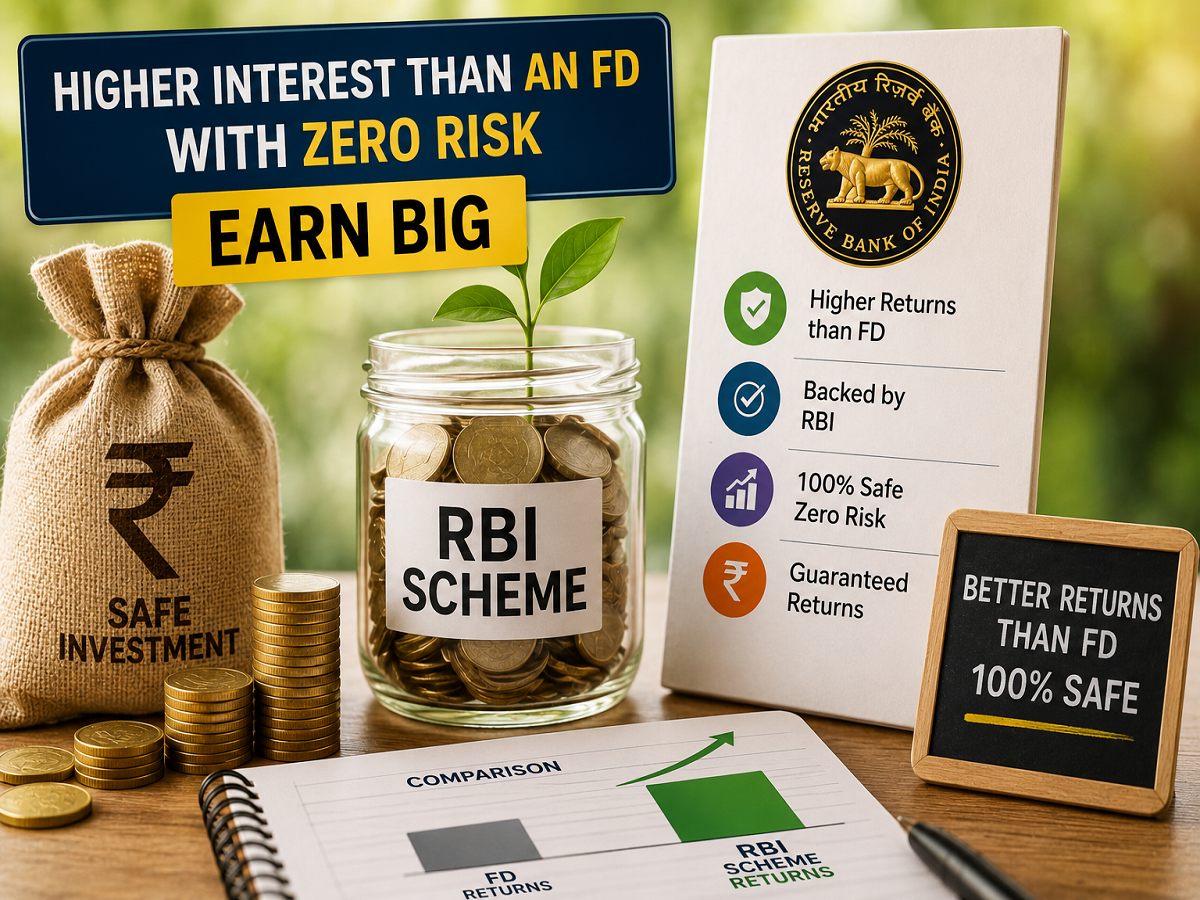
Investors looking beyond traditional bank fixed deposits for relatively stable interest income have another government-backed option to consider: Floating Rate Savings Bonds, 2020 (Taxable). These bonds are issued by the Government of India, with the Reserve Bank of India handling the operational framework through authorised channels.
Unlike a fixed deposit, where the interest rate is generally locked for a chosen tenure, the interest on these savings bonds is variable. The coupon is reset every six months, which means the return can move up or down depending on the benchmark used to determine the rate.
This feature can make the bonds attractive when benchmark interest rates remain high, but investors should understand the lock-in period, taxation and withdrawal conditions before putting money into the scheme.
How Is the Interest Rate Decided?
The Floating Rate Savings Bonds do not carry the same interest rate throughout their entire tenure.
Their coupon is linked to the interest rate offered on the National Savings Certificate (NSC). Under the existing framework, the bond rate is set at 0.35 percentage points above the prevailing NSC rate.
For example, if the applicable NSC interest rate is 7.7%, the corresponding Floating Rate Savings Bond coupon works out to 8.05% per annum.
Since the benchmark can change, the bond's interest rate is reviewed every six months. This is why it is called a “floating rate” savings bond rather than a fixed-rate investment.
Investors should check the latest applicable coupon before investing instead of assuming that a previously announced rate will remain available throughout the seven-year tenure.
Interest Is Paid Every Six Months
Another important feature is the frequency of interest payments.
Interest is payable semi-annually, generally on January 1 and July 1. This can make the bonds useful for investors seeking periodic income rather than waiting until maturity to receive all their returns.
However, the scheme does not offer a cumulative interest option. In other words, investors cannot choose to automatically accumulate all the interest within the bond until maturity in the same way some fixed deposits allow.
The interest received periodically can, of course, be reinvested separately depending on the investor's financial strategy.
What Is the Maturity Period?
Floating Rate Savings Bonds have a maturity period of seven years from the date of issue.
This makes them more suitable for investors who can keep their money committed for a relatively long period.
Liquidity is therefore an important consideration. Someone who may need access to the invested capital within a few years should carefully examine the premature redemption rules before investing.
The bonds are not designed to function like a regular savings account or short-term fixed deposit where funds can be withdrawn easily whenever required.
Senior Citizens Get Special Premature Redemption Facility
Although the normal tenure is seven years, eligible senior citizens are provided premature redemption facilities after completing a specified minimum lock-in period.
The lock-in period depends on the investor's age category. Older investors may be permitted to redeem the bonds earlier than younger senior citizens, subject to the applicable conditions.
This concession can make the bonds more practical for senior citizens who want government-backed interest income but may not want their money locked away for the entire seven-year period.
Investors should nevertheless check the latest premature redemption conditions before investing, as penalties or specific rules may apply.
Is There a Maximum Investment Limit?
One attractive feature of Floating Rate Savings Bonds is that there is no specified maximum investment ceiling under the scheme.
The minimum investment is ₹1,000, and investments are generally made in multiples of ₹1,000.
This allows investors to choose the amount according to their available funds and income requirements.
However, putting a very large proportion of one's savings into a single long-term product may not suit everyone. Liquidity needs, emergency funds and portfolio diversification should also be considered.
Can These Bonds Offer More Than Bank FDs?
Floating Rate Savings Bonds can sometimes offer a higher headline interest rate than many conventional fixed deposits, but the comparison should not be made solely on the advertised rate.
Bank FD rates vary significantly depending on the bank, deposit tenure and investor category. Senior citizens may also receive additional interest on certain bank deposits.
The Floating Rate Savings Bond coupon can change every six months, whereas a fixed-rate bank FD generally provides certainty about the interest rate for its chosen tenure.
Therefore, a higher rate today does not guarantee that the bond will continue outperforming every FD over the full seven-year period.
Are Floating Rate Savings Bonds Tax-Free?
No. The word “Taxable” in the scheme's official name is important.
Interest earned from these bonds is taxable according to the investor's applicable income-tax rules. Tax deduction at source may also apply where required under prevailing provisions.
Therefore, investors should compare post-tax returns rather than only looking at the headline interest rate.
For someone in a higher income-tax bracket, the effective return after tax can be considerably lower than the advertised coupon.
Can You Trade or Take a Loan Against These Bonds?
These bonds are intended primarily as a long-term savings product and are not freely tradable like listed securities.
Investors should therefore not expect to sell them easily in the secondary market whenever they need money.
Similarly, their characteristics differ from bank fixed deposits, which may sometimes provide overdraft or loan facilities depending on the bank's rules.
Liquidity should consequently be evaluated before investing a substantial amount.
Who May Consider These Bonds?
Floating Rate Savings Bonds may be worth evaluating for conservative investors who prioritise government backing and periodic interest income.
They can also appeal to retirees and other investors who want cash flow every six months and are comfortable with the longer tenure.
At the same time, they may not be ideal for investors who need frequent access to their principal or those seeking tax-free income.
The floating-rate mechanism also means investors should be comfortable with the possibility that their future coupon could decline if the benchmark NSC rate falls.
Check These Points Before Investing
Before investing in Floating Rate Savings Bonds, compare the prevailing coupon with bank FD rates and other government-backed savings instruments. Also consider the seven-year maturity, premature withdrawal restrictions, taxation and your requirement for regular income.
Most importantly, do not treat the current coupon as a guaranteed seven-year return. The interest rate is reset periodically according to the scheme's benchmark mechanism.
For investors who understand these conditions and can keep their capital invested for the required period, Floating Rate Savings Bonds can provide an alternative to conventional fixed deposits while offering the security associated with a Government of India-backed savings instrument.
Disclaimer: This article is for general information only and should not be treated as investment or tax advice. Interest rates, taxation and scheme rules may change. Investors should verify the latest terms through official RBI or Government of India sources and consult a qualified adviser where necessary.