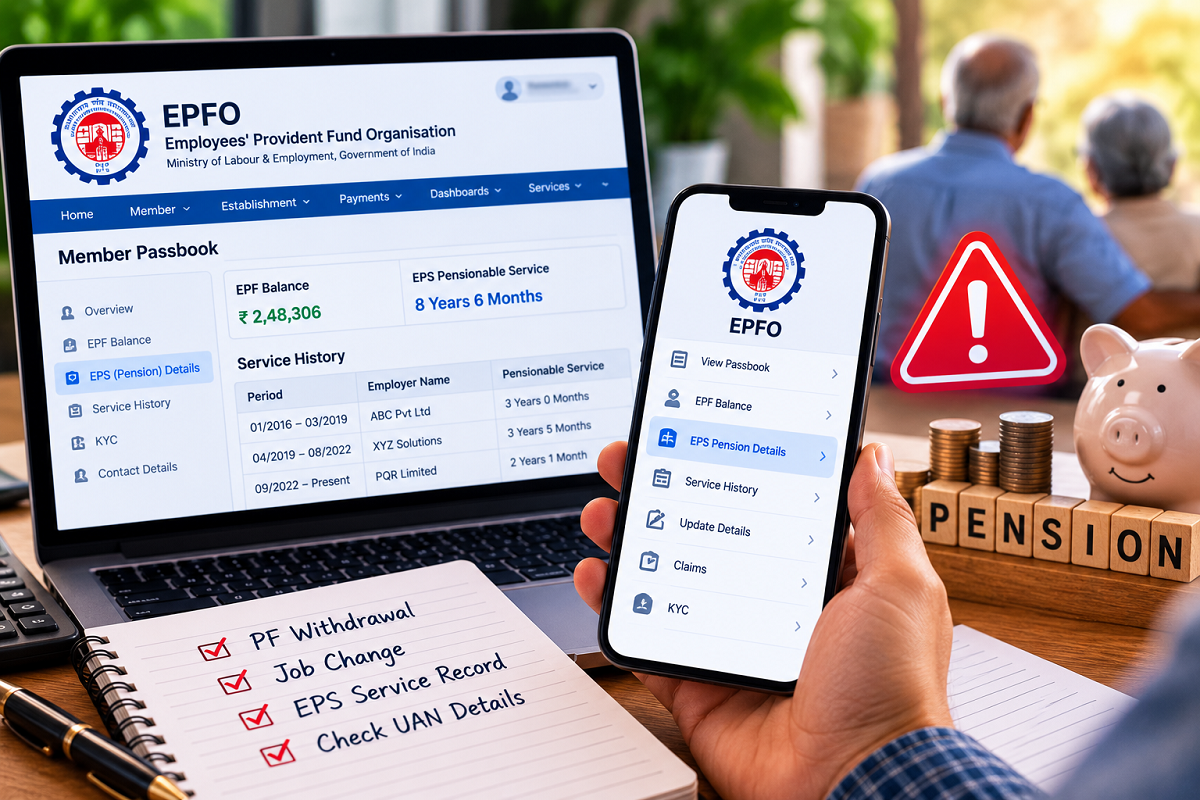
Employees changing jobs often focus primarily on what happens to their Employees' Provident Fund (EPF) balance. Some transfer their PF to the new establishment, while others may withdraw the amount when they meet the applicable eligibility conditions. However, another part of an employee's EPFO record deserves equal attention—the service history connected with the Employees' Pension Scheme (EPS).
A problem with the pensionable service record may not be immediately noticeable because it does not appear simply as a cash balance in the same way as EPF. But if eligible service from previous employment is not correctly reflected or linked, it could create complications when an employee later claims benefits under EPS.
For anyone who has worked for multiple EPFO-covered employers, checking employment history, Date of Exit and pension-related service records can therefore be an important part of changing jobs.
EPF and EPS Serve Different Purposes
Although both EPF and EPS operate within the EPFO social-security framework, they are designed for different retirement needs.
Employees' Provident Fund (EPF) builds a retirement corpus through eligible contributions made during employment. Interest is credited according to the applicable rules, and withdrawals or advances can be permitted under prescribed conditions.
Employees' Pension Scheme (EPS), on the other hand, is primarily associated with pension benefits and eligible service.
For pension purposes, the duration of eligible employment can be important. This means an employee who has worked at several companies should ensure that previous service is properly reflected in the EPFO records associated with their UAN.
Why EPS Service History Matters After Changing Jobs
Withdrawing an eligible EPF balance should not automatically be treated as meaning that all previous pension-related service has become irrelevant.
The treatment of EPS benefits depends on factors such as the employee's eligible service period and whether pension-related benefits have already been withdrawn or preserved under the applicable rules.
Under EPS, completing the required pensionable service is important for eligibility for a monthly pension. Ten years of eligible service is a key threshold for monthly pension eligibility, subject to the other applicable conditions of the scheme.
Consider an employee who works for several EPFO-covered companies over a number of years. If eligible service from those employments is correctly carried forward and recognised, the combined record can matter when pension eligibility is assessed.
If an earlier employment period is missing or incorrectly recorded, however, the employee's service history may not accurately reflect the actual period worked.
Check Your Service History Before Assuming Everything Is Transferred
Employees should review their UAN-linked employment information after joining a new organisation.
Where applicable, the EPFO transfer process, including Form 13, may be used for transferring previous employment-related PF records to the current member account.
However, employees should not assume that submitting a transfer request automatically resolves every discrepancy.
Before initiating the process, verify details such as your name, date of birth, UAN, previous Member ID, current Member ID and Date of Exit.
If there is already a mismatch between old and new employment records, it may need to be corrected before or during the transfer process.
Mistakes That Can Create Problems With EPS Service Records
Several small errors can complicate the linking of employment records.
One common problem is inconsistent personal information. For example, a difference in the employee's name or date of birth between previous and current records can create verification difficulties.
Employees should ensure that their KYC information is accurate and consistent with the records linked to their UAN.
Another important field is the Date of Exit from the previous establishment. If this information is missing or incorrect, it can affect the continuity of employment records and certain online processes.
Members should also review their complete service history rather than looking only at the PF balance shown in the account.
How to Check or Mark Date of Exit on the EPFO Portal
Where the facility is available and the applicable conditions are met, members may be able to mark their Date of Exit through the EPFO member portal.
Start by signing in to the EPFO Member e-Sewa portal using your UAN and password.
After logging in, navigate to the relevant Manage section and look for the Mark Exit facility.
Select the employment or PF Member ID concerned and carefully verify the establishment information. Enter the appropriate Date of Exit and choose the applicable reason for leaving employment.
Review the information before submission because employment dates can be important for subsequent claims and transfers.
Complete the required Aadhaar-linked OTP authentication where prompted and submit the request.
The exact options available to a member can depend on the status of the account and EPFO's current online facilities.
Don't Treat EPF Withdrawal and EPS Benefits as the Same Thing
This distinction is particularly important.
EPF and EPS benefits are governed by different rules. An employee's ability to withdraw an EPF balance does not, by itself, explain what has happened to pensionable service.
Similarly, employees should check whether they have previously claimed an EPS withdrawal benefit or obtained a scheme certificate, because this can affect how earlier pensionable service is treated.
Therefore, anyone changing jobs should avoid making assumptions based only on the amount visible in the PF passbook.
Check UAN and Pension Records Whenever You Switch Jobs
A job change is a good time to review the entire EPFO profile.
Confirm that the previous employment appears under the correct UAN, check whether the Date of Exit is accurate, ensure KYC details match and review whether the old and new employment records are properly connected.
Employees who discover missing service or discrepancies should use the applicable EPFO correction or transfer process and seek clarification through official EPFO channels where necessary.
Keeping these records accurate may not provide an immediate financial benefit, but it can become extremely important years later when pension eligibility is assessed.
For long-term retirement planning, therefore, employees should monitor both their EPF money and their EPS service history instead of focusing only on the PF balance.