NEWS
EPFO Introduces 8 Major PF Rule Changes for 2026: New Withdrawal, Nomination and Claim Process Explained
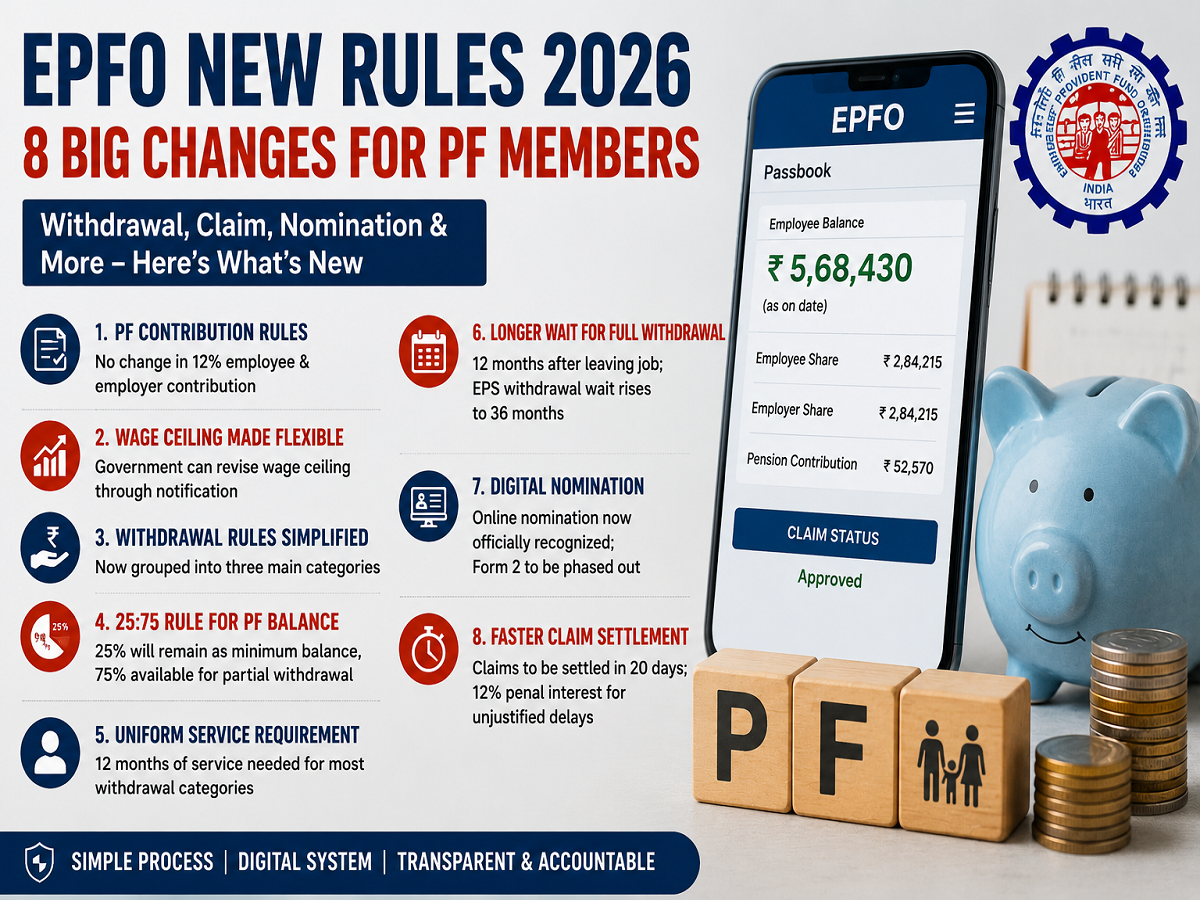
EPFO Rolls Out Updated EPF, EPS and EDLI Framework; Here's What Every PF Member Should Know
The Employees' Provident Fund Organisation (EPFO) has introduced a revised framework for the Employees' Provident Fund (EPF), Employees' Pension Scheme (EPS), and Employees' Deposit Linked Insurance (EDLI) for 2026. While the basic contribution structure remains unchanged, several important rules governing provident fund withdrawals, nominations, wage ceiling provisions, and claim settlements have been updated.
The objective of these reforms is to make the EPF system more transparent, digitally driven, and easier for members to understand and use. The revised provisions are expected to simplify procedures, reduce paperwork, and improve accountability in claim processing.
Here are the eight key changes every EPF account holder should know.
1. EPF Contribution Rules Continue Without Changes
The contribution pattern under the EPF scheme remains the same. Employees will continue contributing 12% of their basic salary towards their provident fund account, while employers will contribute an equal amount as per existing provisions.
Mandatory EPF coverage will continue to apply to employees earning a basic monthly salary of up to ₹15,000. Employees and employers may continue making voluntary contributions beyond the prescribed limit where applicable.
2. Wage Ceiling Can Be Revised More Easily
One of the significant policy changes relates to the wage ceiling.
Instead of specifically mentioning the current wage limit of ₹15,000 within the scheme itself, the revised framework now refers to the wage ceiling notified by the Central Government. This allows the government to revise the ceiling through an official notification without requiring amendments to the EPF scheme each time.
The move is expected to provide greater administrative flexibility for future policy updates.
3. PF Withdrawal Rules Have Been Simplified
EPFO has reorganised the withdrawal provisions to make them easier for members to understand.
Instead of multiple withdrawal conditions spread across different categories, withdrawals are now broadly classified into three major groups:
- Essential personal requirements
- Housing-related purposes
- Special circumstances
This restructuring aims to simplify eligibility rules and reduce confusion among EPF subscribers.
4. New 25:75 Rule for PF Balance Management
The revised framework introduces a new structure for managing PF balances.
Under the updated system:
- 25% of the accumulated balance will remain as the minimum retained amount.
- Up to 75% of the balance may become available for eligible partial withdrawals, subject to applicable conditions.
The objective is to maintain long-term retirement savings while allowing members access to funds for approved financial needs.
5. Uniform Service Requirement for Most Withdrawals
Previously, different withdrawal purposes required different minimum service periods.
Under the new rules, EPFO has standardised the eligibility criteria by requiring 12 months of continuous service for most withdrawal categories.
Medical withdrawals, which earlier had separate conditions, will also generally require completion of 12 months of service under the revised framework.
This change is expected to make withdrawal eligibility more consistent and easier to understand.
6. Longer Waiting Period for Full PF Withdrawal After Leaving Employment
The revised rules extend the waiting period for withdrawing the entire PF balance after leaving a job.
Earlier, members could generally apply for full settlement after remaining unemployed for two months. Under the new framework, members will now need to wait 12 months before becoming eligible for complete PF withdrawal.
However, eligible members can still apply for partial withdrawals based on the prescribed conditions.
For benefits under the Employees' Pension Scheme (EPS), the waiting period has also been extended to 36 months under the updated provisions.
7. Online Nomination Receives Official Recognition
EPFO has taken another major step towards complete digital administration.
The traditional physical Form 2 nomination process will gradually be phased out, with online nominations becoming the officially recognised method.
This digital transition is expected to reduce paperwork, speed up verification, and make nominee records easier to update and maintain.
Members who have not yet updated their online nominations are encouraged to complete the process through the EPFO portal.
8. Faster Claim Settlement with Accountability for Delays
The revised framework places greater emphasis on timely claim processing.
EPFO has set a target of settling provident fund claims within 20 days. If claims are delayed without valid justification, a 12% penal interest may become payable.
According to the revised provisions, the financial responsibility for unjustified delays may be recovered from the salary of the concerned Regional Provident Fund Commissioner, introducing greater accountability within the claim settlement process.
What These Changes Mean for EPF Members
The 2026 EPFO reforms focus primarily on simplifying procedures rather than changing contribution benefits. While the contribution structure remains unchanged, members will notice significant improvements in digital services, nomination procedures, claim processing timelines, and withdrawal guidelines.
Employees are advised to review the updated rules carefully, ensure their online nomination details are up to date, and understand the revised withdrawal conditions before planning any future PF claims. Staying informed about these changes can help members make better financial decisions while ensuring smoother access to their retirement savings whenever eligible.