Business
Electricity Bill Tips: Does Switching Your Fan On and Off Repeatedly Increase Power Consumption?
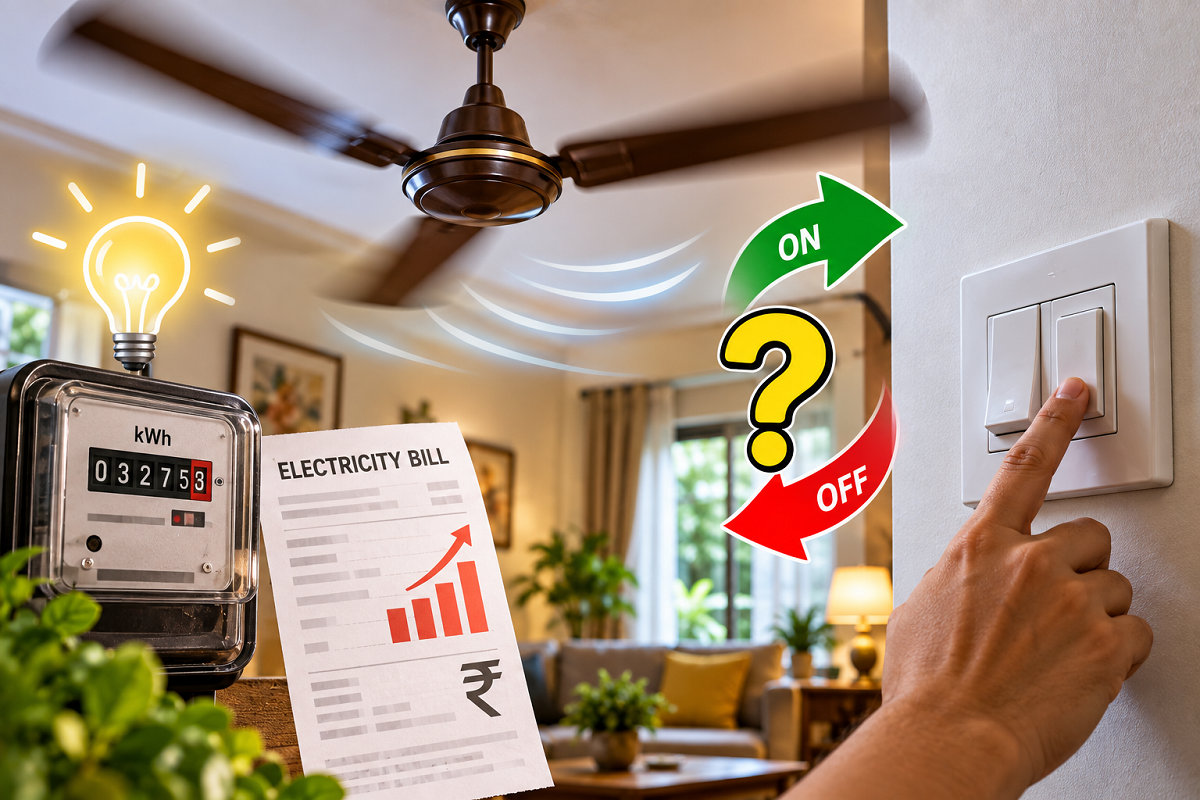
With electricity costs taking up a noticeable share of monthly household expenses, many families look for simple ways to reduce power consumption. One of the most common habits is switching off fans and lights immediately after leaving a room. However, there is also a widespread belief that repeatedly turning electrical appliances on and off may actually consume more electricity.
Similar questions arise around air conditioners, mobile chargers, refrigerators, televisions and other household appliances. Does switching a fan on again consume so much extra electricity that it is better to leave it running? Does reducing fan speed always save power? And does a charger continue consuming electricity even when no phone is connected?
Understanding how these appliances use electricity can help separate common myths from practical energy-saving habits.
Does Turning a Fan or Light On and Off Increase Your Electricity Bill?
The idea that repeatedly switching a household fan or light on and off significantly increases electricity consumption is generally misleading.
Some electrical devices may briefly draw additional current when they are switched on. However, for ordinary household fans and lights, this short-duration effect is generally not a good reason to leave them running unnecessarily for long periods.
When a fan or light is switched off, it stops consuming electricity for its normal operation. Therefore, if nobody is using a room, switching off unnecessary lights and fans can reduce overall energy consumption.
In simple terms, leaving a fan running for an extended period just to avoid switching it on again is unlikely to be an effective electricity-saving strategy.
Does Running a Fan at a Lower Speed Always Save Electricity?
The answer depends partly on the fan's motor, regulator and underlying technology.
Older ceiling fans may use conventional regulators that control speed differently from modern electronic systems. With some older regulator designs, part of the electrical energy can be dissipated as heat instead of producing useful output.
Modern electronic regulators can manage power more efficiently. Newer energy-efficient fans, including models designed specifically to reduce electricity consumption, may also consume considerably less power than older conventional fans.
Instead of relying only on reducing fan speed, households can focus on using an appropriate speed for comfort while choosing an energy-efficient fan when replacing an older appliance.
Does a Charger Consume Electricity When Nothing Is Connected?
A charger left plugged into an electrical socket can consume a small amount of power even when it is not actively charging a phone. This is often referred to as standby or no-load power consumption.
For many modern, good-quality chargers, this consumption is typically very small. A single unused charger is therefore unlikely to create a dramatic increase in a household's monthly electricity bill.
However, the situation becomes more relevant when multiple devices remain connected or in standby mode throughout the day.
Televisions, set-top boxes, computers, chargers and other electronics can all have some level of standby consumption. Individually, these amounts may be small, but together and over long periods they can add to overall household electricity use.
Switching off or unplugging devices that will not be used for an extended period can therefore be a sensible habit.
What About Air Conditioners?
Air conditioners are among the higher-power appliances found in many homes, so their usage habits can have a much greater impact on electricity consumption than repeatedly switching a light or fan.
Avoid running an AC in an empty room for long periods. Doors and windows should also be properly closed while the air conditioner is operating so that cooled air does not continuously escape.
The thermostat should be set according to comfort requirements rather than automatically selecting the lowest possible temperature. Maintaining the AC properly, including cleaning filters as recommended by the manufacturer, can also help it operate effectively.
LED Lights Can Help Reduce Power Consumption
Replacing older, inefficient lighting with LED bulbs can be another practical step toward lowering household electricity use.
LED bulbs generally require less electricity to produce comparable illumination than traditional incandescent bulbs. They also typically have longer operating lives.
For homes where lights remain on for several hours each day, switching to efficient lighting can make a meaningful difference in long-term power consumption.
Simple Ways to Reduce Your Electricity Bill
There is no single trick that will dramatically reduce electricity consumption in every household. Instead, a combination of sensible daily habits can produce better results.
Switch off lights and fans when a room is not being used. Avoid operating an air conditioner unnecessarily and keep doors and windows closed while cooling a room. Use LED lighting where appropriate and consider energy-efficient appliances when replacing old equipment.
Televisions, computers and other electronics do not need to remain in standby mode indefinitely. Chargers and other devices that will not be required for a long period can also be disconnected.
For fans, use a comfortable speed and consider a more energy-efficient model if an old fan consumes excessive electricity.
The Simple Rule: Switch It Off When You Don't Need It
For most everyday household situations, worrying about the tiny amount of additional electricity that may be drawn when a fan or light is switched on should not encourage people to leave appliances running unnecessarily.
If a light, fan, AC or another appliance is not required, switching it off is generally the straightforward way to avoid unnecessary energy consumption.
Small savings repeated every day across multiple appliances can add up over weeks and months. Instead of depending on electricity-saving myths, households can focus on efficient appliances, sensible usage and switching off devices when they are genuinely not needed.