Business
Credit Card Bill: Pay ₹69,000 on ₹1 Lakh Debt, Still Owe ₹78,000 After One Year? See Calculation
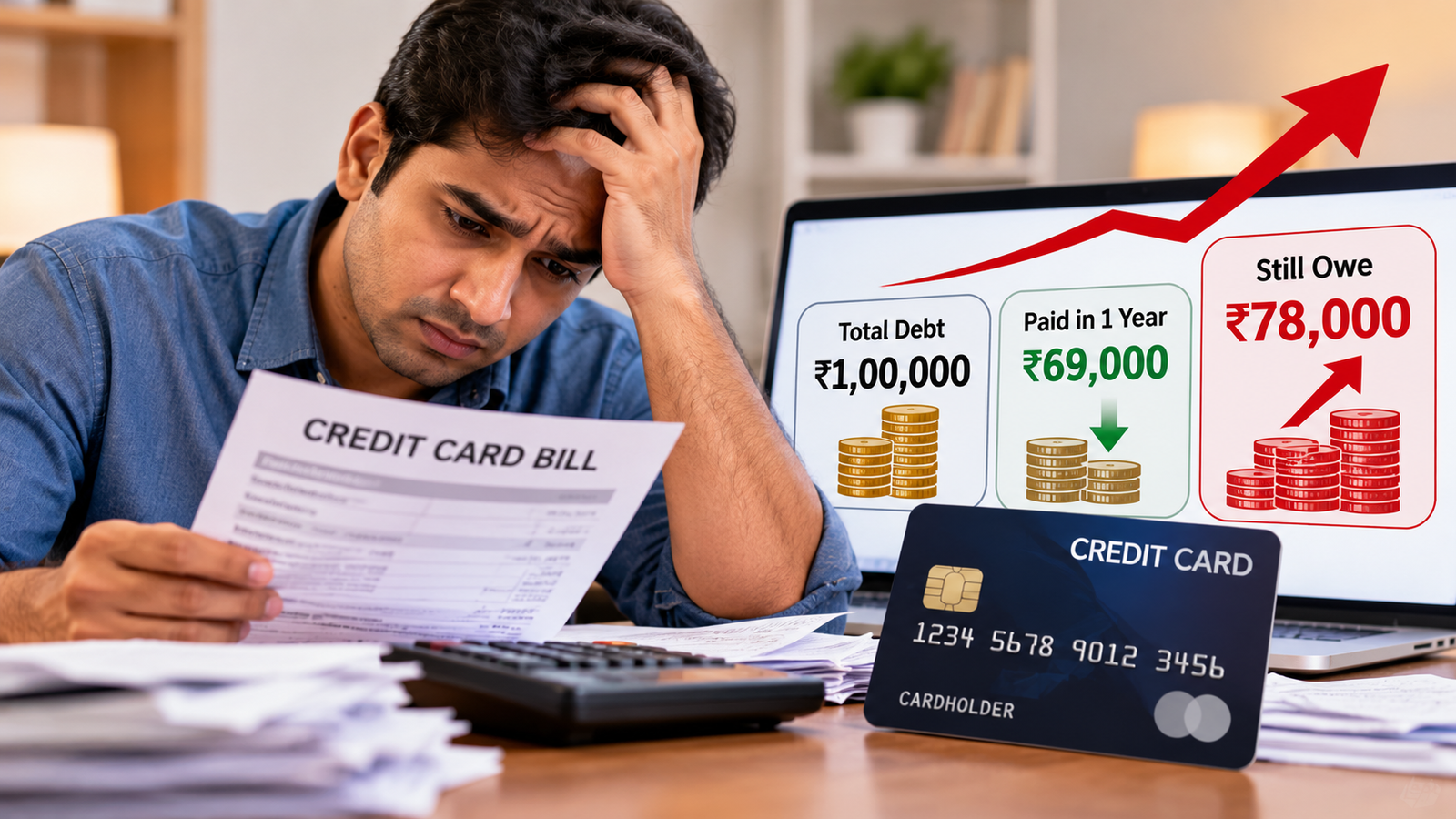
Credit Card Minimum Payment Rules 2026: Credit cards make shopping and online payments convenient, but paying only the minimum amount due every month can become an expensive financial habit.
Many cardholders believe that paying the minimum amount shown on their monthly statement is enough to keep their credit card account under control. However, this payment generally prevents late payment charges only when the required amount is paid by the due date. It does not stop finance charges from accumulating on the unpaid balance.
A calculation involving an outstanding credit card bill of ₹1 lakh shows how costly this approach can become.
According to the example shared by financial experts, a customer could pay approximately ₹69,160 over 12 months and still have nearly ₹78,470 outstanding.
The reason is that a substantial portion of the payments goes towards finance charges and applicable GST instead of reducing the original debt.
Credit Card Minimum Payment: Understand the ₹1 Lakh Example
Suppose a cardholder has an outstanding credit card bill of ₹1,00,000.
The customer decides to pay only the minimum amount due every month instead of clearing the full statement balance.
For this illustration, the monthly finance charge is assumed to be 3.75%, equivalent to a nominal annual rate of 45%.
The calculation also assumes that the customer does not make additional purchases or incur other charges beyond those included in the model.
Credit Card Bill Calculation After 12 Months
| Particulars | Illustrative amount |
|---|---|
| Original credit card outstanding | ₹1,00,000 |
| Monthly finance charge assumed | 3.75% |
| Nominal annual finance charge | 45% |
| Total minimum payments over 12 months | ₹69,160 |
| Finance charges and GST paid | ₹47,630 |
| Reduction in original outstanding | ₹21,530 |
| Remaining outstanding after one year | ₹78,470 |
Note: These figures reproduce the illustrative calculation in the supplied report. Actual results depend on the card issuer's minimum amount due formula, transaction dates, daily interest calculation, GST and payment allocation rules.
Why Does the Credit Card Bill Reduce So Slowly?
The main reason is the high cost of carrying forward an unpaid credit card balance.
When the full statement amount is not paid, the card issuer generally applies finance charges according to its terms and conditions.
GST is also applicable to the finance charges.
As a result, the monthly payment must cover a significant amount of interest-related costs before the original outstanding balance reduces substantially.
For example, the illustrative calculation shows that a customer paying ₹69,160 during the year reduces the original debt by only ₹21,530.
The remaining ₹47,630 is absorbed by finance charges and GST.
This demonstrates why making minimum payments repeatedly may not be an effective long-term repayment strategy.
What Is the Minimum Amount Due on a Credit Card?
The minimum amount due is the amount a credit card issuer requires the customer to pay by the payment deadline to avoid being treated as having missed the required minimum payment.
The amount is calculated according to the issuer's terms.
It may include a percentage of the outstanding balance, billed interest, taxes, fees, instalment obligations and other applicable amounts.
The formula can differ between card issuers.
Paying the minimum amount on time generally helps avoid a late payment fee, but it does not mean the remaining balance becomes interest-free.
Customers should therefore distinguish between the minimum amount due and the total amount due.
Minimum Amount Due vs Total Amount Due
| Feature | Minimum amount due | Total amount due |
|---|---|---|
| Amount paid | Required minimum | Full statement balance |
| Late payment fee | Generally avoided if paid on time | Avoided if paid on time |
| Finance charges on unpaid balance | Usually apply | Generally avoided on eligible purchases when grace-period conditions are met |
| Outstanding balance | Remains | Statement balance cleared |
| Interest-free benefit | May be lost | Generally preserved if applicable conditions are satisfied |
| Long-term debt risk | Higher if repeated | Lower when paid consistently |
The precise treatment depends on the cardholder agreement and the nature of transactions.
Cash advances, for example, may have different interest rules from ordinary retail purchases.
How Expensive Is a 3.75% Monthly Finance Charge?
A monthly finance charge of 3.75% may appear smaller than an annual interest rate.
However, its cost can be substantial when applied repeatedly to an outstanding balance.
Multiplying 3.75% by 12 gives a nominal annual rate of 45%.
If a 3.75% monthly rate were compounded for 12 months without repayments, its effective annual equivalent would be approximately 55.5%, before considering GST and other charges.
Actual credit card calculations are more complex because issuers commonly calculate finance charges based on daily balances and transaction dates.
Nevertheless, the example illustrates why credit card revolving debt can be costly.
What Happens to the Interest-Free Period?
Credit cards generally offer an interest-free period on eligible purchases when the cardholder satisfies the issuer's repayment conditions.
One important requirement is usually the full payment of the previous statement balance by its due date.
If a customer pays only part of the bill and carries the remaining amount forward, the interest-free benefit on eligible purchases may no longer apply.
New purchases can also attract finance charges according to the card issuer's rules.
This means that continuing to use the card while carrying unpaid debt can increase the total amount owed.
The customer may then find it increasingly difficult to clear the balance.
Why Can New Purchases Make the Problem Worse?
Suppose a customer already has a substantial unpaid credit card balance.
Instead of reducing the outstanding amount, the customer continues using the card for shopping, travel or household expenses.
The new transactions increase the balance while finance charges continue to accumulate under the applicable terms.
Even if the customer pays the minimum amount every month, the total outstanding debt may remain high or increase.
This can create a cycle in which a large share of monthly payments goes towards interest and taxes rather than repayment of the amount borrowed.
During festive shopping periods, this risk can become particularly relevant.
Customers should avoid making purchases that they cannot reasonably repay within their available budget.
Does Paying Only the Minimum Amount Affect Your Credit Score?
Paying at least the required minimum amount by the due date can help prevent the account from being reported as overdue solely because of a missed minimum payment.
However, carrying a large outstanding balance may increase credit utilisation.
Credit utilisation is the proportion of the available credit limit that a customer is using.
High utilisation can affect credit assessments, depending on the credit bureau's scoring methodology and the customer's broader credit profile.
Therefore, making minimum payments should not be confused with maintaining an ideal credit profile.
Reducing outstanding debt and making payments on time are important aspects of responsible credit card management.
How to Reduce Credit Card Debt Faster
Customers who are carrying an unpaid credit card balance should consider a structured repayment approach.
The first step is to check the total outstanding amount, applicable finance charge and monthly repayment capacity.
Paying more than the minimum amount due can help reduce the principal faster and may lower future finance charges.
Cardholders can also consider temporarily limiting new credit card purchases until the outstanding amount becomes manageable.
If repayment difficulties persist, customers may contact their card issuer to ask about available repayment arrangements or eligible instalment conversion options.
However, any alternative repayment facility should be compared carefully because processing fees, interest rates and other charges may apply.
Customers should not assume that every instalment conversion or balance transfer will necessarily be cheaper.
Important Credit Card Tips During the Festive Season
Diwali and other festivals often lead to higher spending on shopping, travel and gifts.
Credit cards may offer rewards, discounts and convenient payment options, but these benefits can be outweighed by finance charges when bills remain unpaid.
Before making a major purchase, cardholders should estimate whether they can pay the full statement balance by the due date.
They should also read the terms associated with no-cost EMI offers, promotional discounts and other card benefits.
A disciplined spending plan can help customers avoid unnecessary revolving debt.
Final Update
The example of a ₹1 lakh credit card bill highlights the financial impact of repeatedly paying only the minimum amount due.
Under the assumptions used in the reported calculation, a customer pays approximately ₹69,160 over one year but reduces the original debt by only ₹21,530.
Around ₹47,630 goes towards finance charges and GST, leaving an outstanding balance of approximately ₹78,470.
The key lesson is that paying the minimum amount may help avoid late payment charges, but it does not prevent expensive interest from accumulating.
Whenever financially possible, clearing the full credit card statement balance by the due date is generally the most effective way to avoid finance charges on eligible purchases.
Disclaimer: The calculations are illustrative and are not a universal repayment schedule. Actual finance charges, minimum payments, GST, fees and outstanding balances depend on the credit card issuer's terms and the customer's transaction history. Readers should check their card's Most Important Terms and Conditions (MITC) before making financial decisions.