Bank Customer Complaint Rules 2026: Visiting a bank should be a straightforward experience, whether you need to update your KYC details, withdraw money, resolve an account issue or request another financial service. However, customers sometimes encounter rude behaviour, unnecessary delays or unexplained refusals from bank employees.
A video reportedly circulating on social media, showing an elderly customer allegedly being treated disrespectfully during a KYC-related interaction, has brought renewed attention to customer service standards in banks.
While the circumstances of the reported incident have not been independently established, it raises an important question: What can customers do if a bank employee behaves inappropriately or refuses to provide a legitimate banking service?
Customers can use their bank's grievance redressal system to report such incidents. In eligible cases involving deficiencies in banking services, unresolved complaints may also be escalated to the Reserve Bank of India (RBI).
Here is a detailed guide to filing a complaint against a bank employee, preserving evidence and understanding when RBI intervention may be available.
What Should You Do if a Bank Employee Behaves Rudely?
If a bank employee uses offensive language, treats you disrespectfully or refuses to process a legitimate request without providing an explanation, you can raise the matter through the bank's official complaint channels.
Instead of engaging in an argument, try to remain calm and document what happened.
Record the date, approximate time, branch location and the nature of the incident.
If the employee's name or designation is available, include that information in your complaint.
You should also note whether the incident affected a particular banking service, such as KYC verification, account access, cash withdrawal or document submission.
These details can help the bank investigate the matter and determine whether corrective action is necessary.
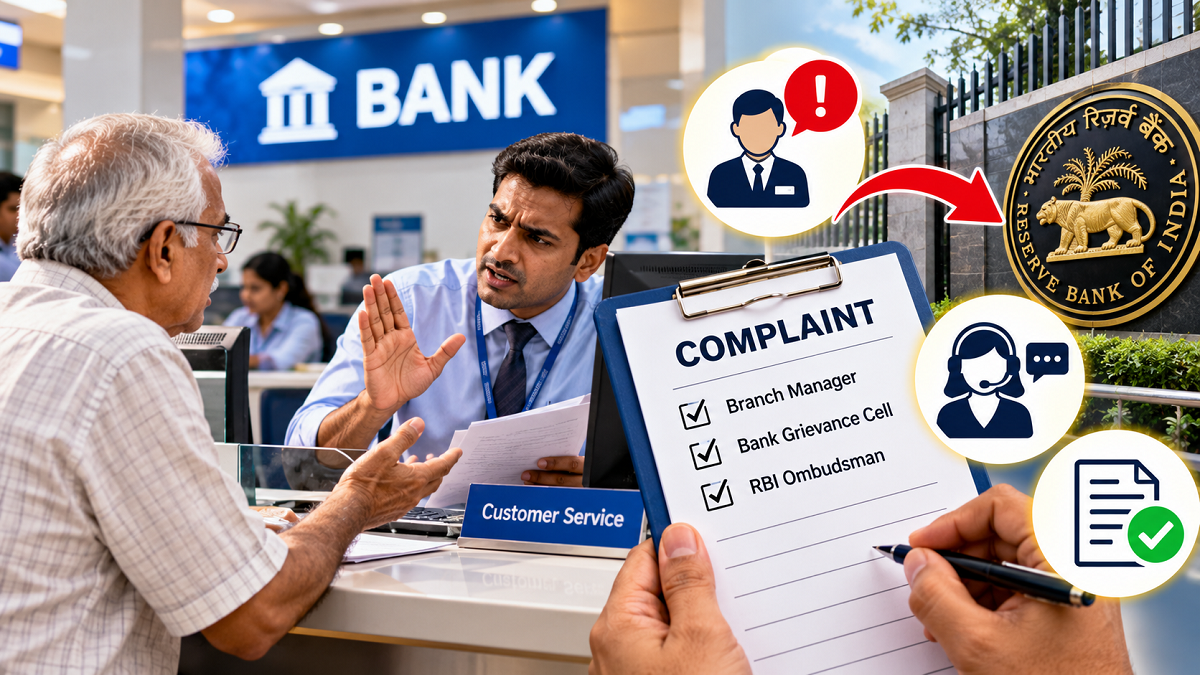
Step 1: Submit a Written Complaint to the Branch Manager
The first practical step is to approach the manager of the branch where the incident occurred.
Explain the problem clearly and request that it be formally recorded.
A written complaint is often preferable because it creates a record of the issue and the action requested.
What Information Should Your Complaint Include?
- Your name and contact information.
- Name and location of the bank branch.
- Date and time of the incident.
- Name or designation of the employee, if known.
- A factual description of the behaviour or service-related problem.
- Relevant supporting documents or other lawfully obtained evidence.
- The resolution you are requesting.
After submitting the complaint, ask for an acknowledgement.
If the bank registers the complaint digitally, save the complaint or reference number.
This will help you track the progress of the case and establish when the bank received your grievance.
Step 2: Escalate the Matter to the Bank's Grievance Department
If the branch manager does not address the complaint satisfactorily, the next step is to approach the bank's higher-level grievance redressal mechanism.
Most banks have designated officials or departments responsible for handling customer complaints.
Depending on the bank, these may include the regional office, customer grievance department or principal nodal officer.
Customers can usually find complaint submission options through the bank's official website, mobile banking application or customer service helpline.
When escalating the issue, mention your earlier complaint and attach the acknowledgement or reference number.
It is also helpful to explain why the response received from the branch was inadequate.
Keep copies of all communication, including emails, written replies and messages from the bank.
Step 3: When Can You Complain to the RBI?
The Reserve Bank – Integrated Ombudsman Scheme, 2021 provides an external complaint resolution mechanism for eligible grievances against RBI-regulated entities.
Generally, customers must first raise their complaint with the bank.
They may then approach the RBI Ombudsman if the bank rejects the complaint, provides a response that the customer finds unsatisfactory, or fails to respond within 30 days.
However, there is an important distinction between employee misconduct and a deficiency in banking service.
Not every allegation of rude behaviour automatically falls within the RBI Ombudsman's jurisdiction.
A complaint must meet the scheme's eligibility and admissibility requirements.
For example, an unresolved issue involving an unjustified refusal to provide a banking service may raise different regulatory considerations from a complaint concerning discourteous language alone.
Customers should therefore describe the actual banking problem and its consequences accurately rather than assuming that every workplace conduct dispute will be examined by the RBI.
How to File a Complaint Through RBI's CMS Portal
The RBI operates a Complaint Management System (CMS) through which eligible customers can submit complaints against regulated financial institutions.
The official portal is cms.rbi.org.in.
The general complaint process involves entering the complainant's details, identifying the bank, describing the issue and providing information about the earlier complaint submitted to the bank.
Supporting documents may also be uploaded where required.
After submission, customers should retain the acknowledgement or complaint number for future reference.
The RBI Ombudsman mechanism is intended to address eligible service-related grievances. It is not a substitute for police action in cases involving threats, violence or other alleged criminal offences.
Bank Complaint Escalation: Important Stages
| Complaint Stage | Where to Approach | Purpose |
|---|---|---|
| Initial complaint | Branch manager or official bank complaint channel | Report the incident and request action |
| Internal escalation | Bank grievance department or nodal officer | Seek review of an unresolved complaint |
| External escalation | RBI Ombudsman, if eligible | Address qualifying unresolved service deficiencies |
| Safety or criminal matter | Police or appropriate authorities | Report threats, violence or suspected criminal conduct |
Why Is Keeping Evidence Important?
Documentation can make a significant difference when a customer complaint requires investigation.
A written record helps establish what happened, when the complaint was made and how the bank responded.
Customers should preserve complaint acknowledgements, correspondence and relevant banking records.
If a particular service was denied, retaining the application form, rejection message or related communication may help explain the issue.
Any photographs, recordings or other supporting materials should be obtained and used lawfully.
Avoid sharing sensitive banking information unnecessarily while submitting evidence.
Account passwords, ATM PINs, card CVVs and one-time passwords should never be disclosed as part of a complaint.
What if a Bank Employee Refuses to Complete Your KYC?
Know Your Customer (KYC) verification is a standard regulatory requirement in banking.
Customers may need to provide identity documents, address details or updated information to comply with applicable rules.
If a bank employee refuses to process a KYC request, ask for a clear explanation.
There may be legitimate reasons for delays, such as incomplete documents, inconsistent information or additional verification requirements.
However, if the customer believes the refusal is unreasonable or the process is being unnecessarily obstructed, the issue can be reported through the bank's complaint mechanism.
Include the documents submitted, the response received and any specific service restrictions caused by the unresolved KYC issue.
What if the Bank Employee Threatens or Harasses You?
A complaint involving intimidation, threats, physical aggression or suspected criminal conduct requires special attention.
If you feel unsafe, prioritise your immediate safety and seek assistance from appropriate authorities.
You do not need to wait for the bank's internal grievance procedure to conclude before reporting a possible criminal offence to the police.
A complaint may also be submitted to the bank so that it can investigate the employee's conduct internally.
The bank's disciplinary process and any police investigation are separate matters.
Can Customers Demand Compensation for Misbehaviour?
Compensation is not automatically payable simply because a customer alleges that an employee behaved rudely.
Whether compensation is available depends on the nature of the complaint, the applicable legal or regulatory framework and the findings of the relevant authority.
Where an eligible banking service deficiency has caused a qualifying loss or other recognised harm, the RBI Ombudsman framework may provide remedies subject to its conditions and limits.
Customers should explain any actual financial loss, delay or other impact and provide supporting records wherever possible.
Important Precautions While Filing a Bank Complaint
Customers should use only verified bank complaint channels and official regulatory platforms.
Fraudsters sometimes impersonate customer support representatives and promise quick resolutions in exchange for OTPs or sensitive account information.
A legitimate complaint process should not require customers to reveal confidential passwords or transaction authentication codes.
It is also advisable to communicate factually and avoid making unsupported allegations.
A clear account of the incident, supported by relevant documents, is more useful than an emotional or confrontational complaint.
Bank Customer Rights 2026: Key Takeaway
Customers who experience inappropriate treatment or unjustified service refusal at a bank have several options for raising their concerns.
The usual approach is to submit a complaint to the branch manager, escalate it through the bank's grievance redressal system and, where the complaint meets the applicable conditions, approach the RBI Ombudsman.
The most important step is to register the complaint formally and retain proof of submission. Customers should also remember that the RBI Ombudsman primarily addresses eligible deficiencies in financial services, rather than automatically investigating every allegation of employee misconduct.
If the incident involves threats, physical violence or another suspected criminal offence, appropriate law enforcement authorities may be contacted without waiting for the banking complaint process to finish.
Disclaimer: This article provides general information about bank grievance procedures and the RBI Ombudsman framework. The admissibility of an individual complaint depends on the facts and applicable rules.