Business
8th Pay Commission Update: 5 Key Developments on Salary, Pension, Fitment Factor and Report Timeline
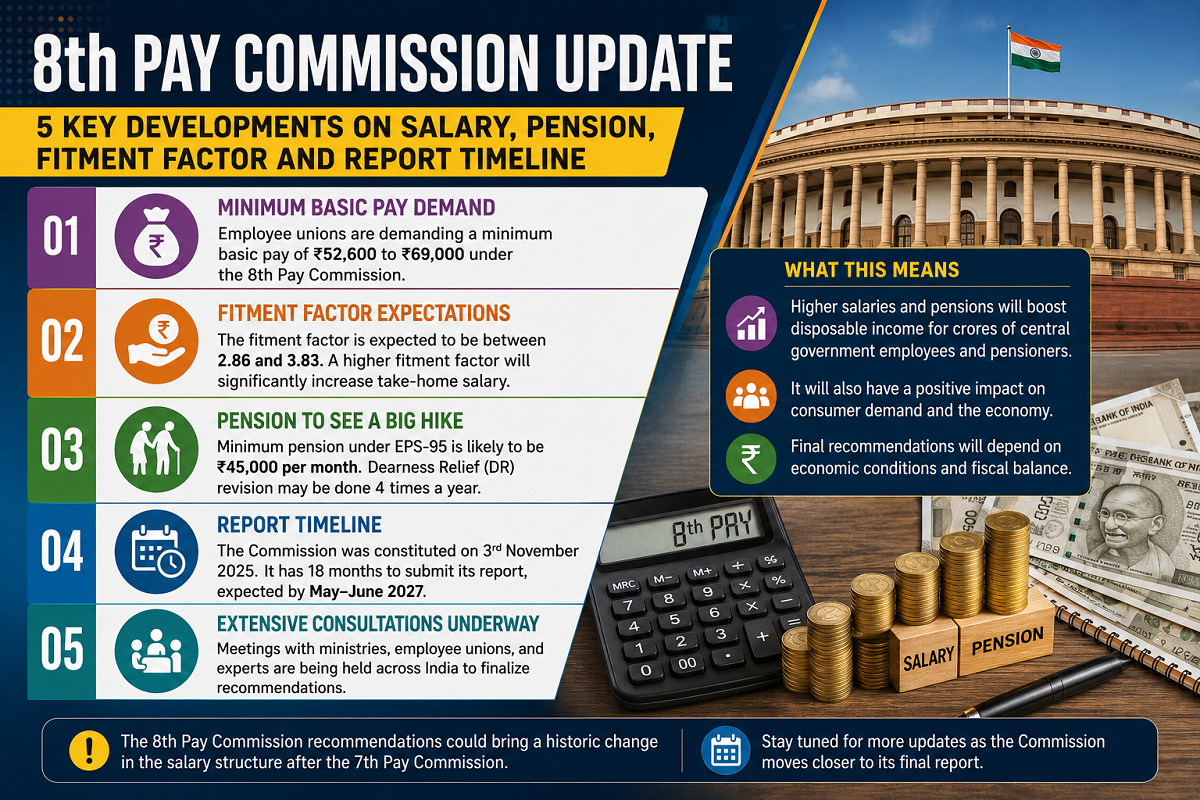
8th Pay Commission Latest News: Central government employees and pensioners are closely watching the progress of the 8th Central Pay Commission (8th CPC) as discussions over the next salary and pension revision gather pace. The Commission is currently holding consultations with employee organisations, pensioner groups and other stakeholders before preparing its recommendations.
The 8th Central Pay Commission was formally constituted by the Government of India on November 3, 2025, under the chairpersonship of Justice Ranjana Prakash Desai. Its mandate includes examining and recommending changes to pay, allowances, pensions and other service-related matters concerning central government employees.
While several figures related to minimum salary and fitment factor are circulating, employees should note that no final fitment factor, revised minimum basic pay or pension formula has yet been officially announced.
Here are five important developments that central government employees and pensioners should know.
1. 8th Pay Commission Consultations Continue Across India
The Commission has been conducting meetings in different parts of the country to collect views and representations from government employees, pensioners and their organisations.
Several consultations have already taken place, while more are scheduled over the coming weeks.
Among the upcoming visits reported for August and September are:
- Jaipur: August 31 and September 1
- Chennai: September 7 and 8
- Puducherry: September 9
- Chandigarh: September 16 to 18
These consultations are intended to give employee associations and other stakeholders an opportunity to place their demands directly before the Commission.
Earlier meetings have also been organised in cities including Bhubaneswar and Kolkata as part of the wider consultation exercise.
The nationwide meetings are significant because the Commission is expected to consider a wide range of issues rather than simply deciding a new salary multiplier.
2. Commission Is Strengthening Its Research and Consultant Framework
The 8th CPC is also building its research and analytical capacity.
Official records show that the Commission issued guidelines on April 10, 2026, for engaging consultants to support its work.
Such specialists can assist in analysing salary structures, economic data, inflation trends, pension liabilities and other information required before a new pay framework is recommended.
The Commission's task involves balancing employee expectations with broader economic and fiscal considerations.
Any major revision in salaries and pensions can have substantial implications for government expenditure. This means the final recommendations are likely to take into account not only inflation and living costs but also fiscal sustainability and the financial impact on the government.
3. Fitment Factor Debate Intensifies, but Nothing Is Final
The fitment factor has emerged as one of the biggest talking points surrounding the 8th Pay Commission.
A fitment factor is essentially a multiplier used while converting existing basic pay into a revised pay structure.
Under the 7th Pay Commission, a fitment factor of 2.57 was used for the revised pay structure.
For the 8th CPC, different employee organisations have proposed considerably higher multipliers.
One of the most discussed demands comes from the National Council-Joint Consultative Machinery (NC-JCM), which has sought a fitment factor of 3.83 and a minimum basic pay of around ₹69,000.
Other estimates and employee proposals have included figures around 3.68, while different organisations have placed varying demands before the Commission.
What Would a 3.83 Fitment Factor Mean?
The current minimum basic pay under the 7th CPC is ₹18,000.
If a 3.83 multiplier were applied directly:
₹18,000 × 3.83 = ₹68,940
That works out to approximately ₹69,000 minimum basic pay.
Similarly, a 3.68 multiplier would produce:
₹18,000 × 3.68 = ₹66,240
These calculations explain why figures such as ₹66,240 and ₹69,000 are frequently appearing in discussions about the 8th Pay Commission.
However, they remain illustrative calculations based on proposed fitment factors. The Commission has not announced that either 3.68 or 3.83 will be adopted.
4. Employees and Pensioners Are Getting More Opportunities to Submit Demands
The ongoing consultation process gives different employee and pensioner organisations a chance to present their concerns before the Commission.
These representations can cover issues including minimum pay, pension revision, allowances, annual increments and retirement benefits.
For example, employee organisations have placed demands relating not only to the fitment factor but also to changes in minimum pension, HRA, annual increment rates and pension rules.
The NC-JCM's demands reportedly include a 3.83 fitment factor, ₹69,000 minimum basic pay and a 6% annual increment, among other proposals.
Other unions have proposed different formulas, showing that there is currently no single agreed employee-side recommendation.
The Commission will have to examine these competing demands before arriving at its own conclusions.
5. When Will the 8th Pay Commission Report Be Submitted?
This is perhaps the biggest question for employees waiting for a salary increase.
The 8th Central Pay Commission has been given 18 months from its constitution to submit its recommendations. The Commission was formally constituted on November 3, 2025.
Based on that timeline, the final report could therefore be expected around May 2027, unless there is a change in the schedule or an interim report is submitted earlier.
The Commission's Terms of Reference allow it to submit interim reports on specific matters if considered necessary.
Once the final recommendations are submitted, they will still need to be examined by the Union government.
A revised pay structure would become operational only after the government accepts the recommendations and announces the implementation framework.
Will the New Pay Scale Be Effective From January 1, 2026?
The government has already provided an important indication on this point.
While approving the Terms of Reference, the Cabinet stated that, based on the historical ten-year cycle of Central Pay Commissions, the effect of the 8th CPC recommendations would normally be expected from January 1, 2026.
However, employees should understand what this means.
An expected effective date and the date on which revised salaries actually begin appearing in bank accounts are not necessarily the same.
The Commission still needs to finish its work, submit recommendations and receive government approval.
If the government eventually decides to implement revised pay retrospectively from an earlier effective date, questions relating to arrears and payment schedules would be addressed in the final implementation decision.
At present, no final arrears formula has been officially announced.
What Could Happen to Pension Under the 8th CPC?
Pension revision is another major area of interest.
The Commission's official mandate includes retirement benefits, meaning pensioners are part of the review process.
Employee and pensioner organisations have already made various demands concerning minimum pension, Dearness Relief and pension revision.
Some groups have also sought changes to the frequency of Dearness Allowance and Dearness Relief revisions. Recent employee-side proposals have included demands for more frequent revisions and changes in the way pension benefits are calculated.
But just as with salary revisions, there is currently no officially approved new minimum pension figure.
Could Minimum Basic Pay Become ₹69,000?
₹69,000 is currently one of the most discussed figures, but it should not be described as confirmed.
It arises from the demand for a 3.83 fitment factor.
If that multiplier were applied to the current ₹18,000 minimum basic pay, the revised amount would be ₹68,940.
But the Commission may recommend a lower, higher or differently structured formula.
There have also been reports suggesting the Commission could take a cautious approach because of the fiscal impact of a large fitment-factor increase on both the Centre and states.
Employees should therefore avoid treating online salary calculators as official projections.
Why the Fitment Factor Matters So Much
The fitment factor attracts attention because it can directly influence revised basic pay.
Basic pay, in turn, forms the foundation for several other components of government compensation.
However, the actual increase in take-home salary will not necessarily be equal to the percentage increase in basic pay.
The final outcome will also depend on how the new pay matrix, allowances, deductions, pension contributions and Dearness Allowance are treated under the revised structure.
This is why a simple multiplication of current pay by an assumed fitment factor cannot provide an exact future in-hand salary.
Employees Should Be Careful About Viral Salary Claims
With interest in the 8th CPC growing, social media is filled with claims such as:
"₹69,000 salary confirmed."
"3.83 fitment factor approved."
"New pension will start next month."
Such claims should be treated cautiously unless they are supported by an official notification from the government or the 8th Central Pay Commission.
As of August 16, 2026, the Commission has not announced a final fitment factor, minimum salary or revised pension structure. Its consultation and analysis process is still underway.
8th Pay Commission: What Employees Should Watch Next
The next few months will remain important for more than one crore central government employees and pensioners awaiting the new pay structure.
The Commission is continuing its consultations across different cities, while employee organisations are pressing demands related to minimum pay, pensions and the fitment factor.
The most important numbers currently being discussed — including a 3.68 to 3.83 fitment factor and minimum basic pay approaching ₹69,000 — are proposals and calculations, not final government decisions.
The 8th CPC has an 18-month window from its November 3, 2025 constitution to submit its recommendations. Only after the report is submitted and considered by the government will employees get clarity on the final salary hike, pension revision, pay matrix and implementation schedule.
Until then, central employees and pensioners should rely primarily on announcements from the 8th Central Pay Commission, Department of Expenditure and Ministry of Finance, rather than treating speculative salary figures as confirmed.