Business
8th Pay Commission: Does a 2.0 Fitment Factor Really Double Salary? Understand the Calculation
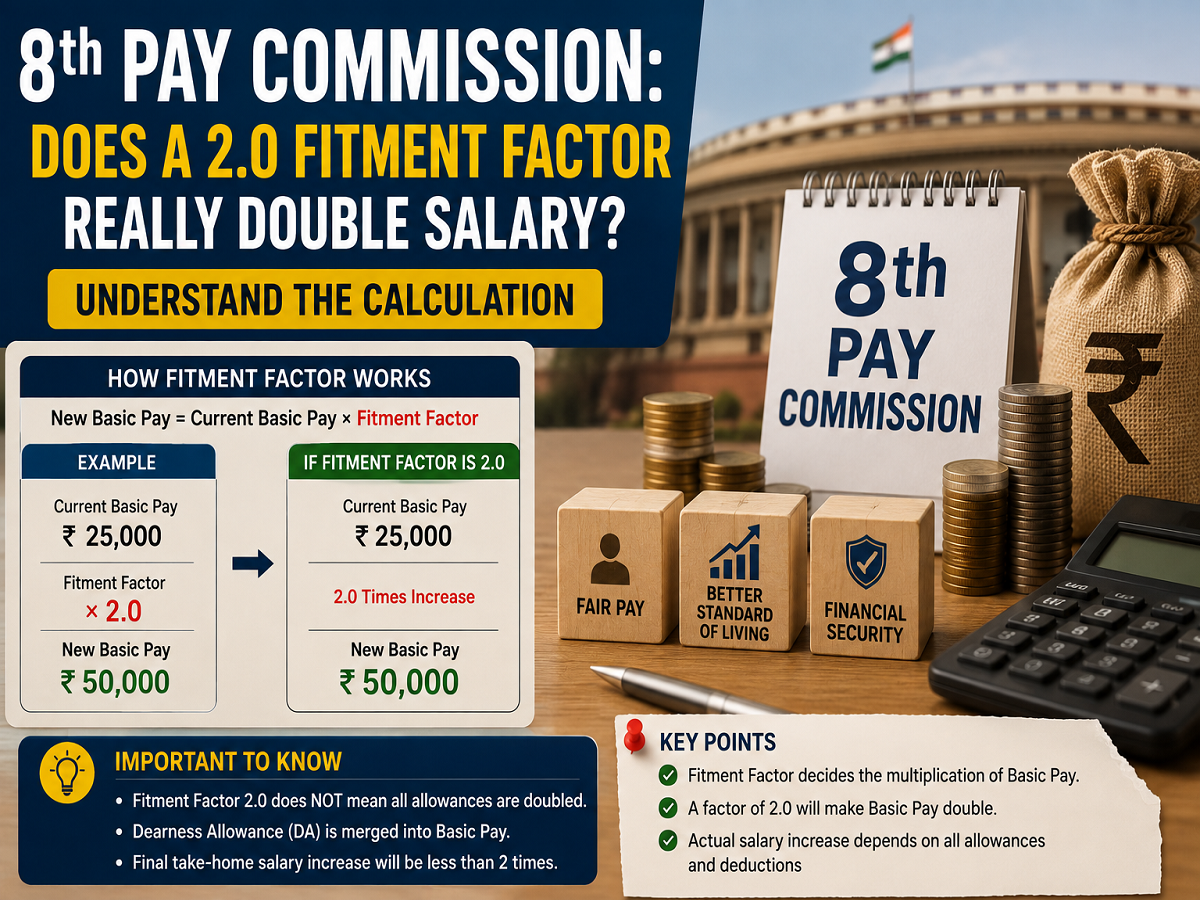
Central government employees and pensioners are closely tracking developments around the 8th Pay Commission, and one term attracting particular attention is the fitment factor. Among the different numbers being discussed, a fitment factor of 2.0 has generated considerable interest because it appears to suggest that salaries could simply double.
However, that interpretation can be misleading.
A fitment factor of 2.0 would mathematically double an employee's existing basic pay for the purpose of calculating the revised basic salary. It does not automatically mean that the employee's total monthly or take-home salary will become exactly twice the current amount.
The final impact will depend on several components, including Dearness Allowance (DA), House Rent Allowance (HRA), Transport Allowance and the structure ultimately recommended by the 8th Pay Commission. Recent calculations discussing a 2.0 fitment factor are still illustrative because the final factor has not yet been approved.
What Is a Fitment Factor?
A fitment factor is essentially a multiplier used to convert an employee's existing basic pay into a revised basic pay when a new pay structure is introduced.
The basic calculation is straightforward:
Existing Basic Pay × Fitment Factor = Revised Basic Pay
Suppose an employee currently has a basic salary of ₹30,000.
If a fitment factor of 2.0 is applied:
₹30,000 × 2.0 = ₹60,000
The revised basic pay in this simplified example would therefore become ₹60,000.
Similarly, a basic salary of ₹40,000 would mathematically become ₹80,000 if the final fitment factor were exactly 2.0.
But these figures represent basic pay, not the employee's complete monthly salary.
Why Won't Gross Salary Necessarily Double?
This is where much of the confusion surrounding the 2.0 fitment factor arises.
A government employee's salary consists of more than basic pay. Depending on eligibility and posting, the total package can include DA, HRA, Transport Allowance and other benefits.
Therefore, doubling the basic pay does not automatically double every other component.
For instance, suppose an employee currently earns ₹30,000 as basic pay but receives a substantially higher gross salary after DA, HRA and other allowances are added.
If the new basic pay becomes ₹60,000 under a hypothetical 2.0 fitment factor, the employee cannot simply assume that every existing allowance will also be multiplied by two.
The treatment of these allowances under the new pay structure will play an important role in determining the actual increase in gross salary.
Simple Calculation at a 2.0 Fitment Factor
Here are a few hypothetical examples showing how basic pay would change if a 2.0 factor were eventually adopted:
| Current Basic Pay | Hypothetical Fitment Factor | Illustrative Revised Basic Pay |
|---|---|---|
| ₹18,000 | 2.0 | ₹36,000 |
| ₹25,500 | 2.0 | ₹51,000 |
| ₹29,200 | 2.0 | ₹58,400 |
| ₹35,400 | 2.0 | ₹70,800 |
| ₹44,900 | 2.0 | ₹89,800 |
| ₹47,600 | 2.0 | ₹95,200 |
These are purely mathematical illustrations. Actual revised pay will depend on the fitment factor and pay structure finally recommended and approved under the 8th Pay Commission. Current media calculations using factors such as 2.0, 2.1, 2.25 and 2.57 are similarly being presented as scenarios rather than confirmed salary structures.
What Happens to Dearness Allowance?
Dearness Allowance is another reason why the percentage increase in total salary cannot be calculated merely by comparing old and new basic pay.
DA is currently paid as a percentage of basic salary to compensate employees for inflation. When a new Pay Commission structure is implemented, the treatment of accumulated DA becomes important in determining the effective salary increase.
There is currently no final decision establishing exactly how DA and other allowances will be handled under the 8th Pay Commission.
Until those rules are announced, calculations claiming an exact percentage increase in take-home or gross salary should be treated as estimates.
What About Pensioners?
The fitment factor is also important for pensioners because any final pension revision formula could have a major impact on their monthly pension.
This has become an important subject in the ongoing 8th Pay Commission discussions. Pensioner organisations have also raised demands concerning pension and family pension revision, including issues affecting those who retired before January 1, 2026.
However, pensioners should also avoid assuming that a hypothetical 2.0 fitment factor automatically means their final pension payment will simply double.
The actual pension revision will depend on the methodology ultimately recommended by the Commission and accepted by the government.
What Fitment Factor Has Been Finalised?
As of August 24, 2026, no final fitment factor for the 8th Pay Commission has been officially approved.
Different numbers are being discussed in employee demands, expert calculations and media reports. Recent salary illustrations have examined possible fitment factors ranging from 2.0 to 2.57, while some employee and pensioner organisations have sought substantially higher factors.
These figures should not be confused with a government-approved decision.
The 7th Pay Commission had used a fitment factor of 2.57 for revising basic pay.
8th Pay Commission Is Still Working on Recommendations
The 8th Pay Commission was constituted on November 3, 2025 and was given an 18-month period to prepare its recommendations on salaries, allowances and related matters. The Commission is currently conducting consultations with employees, pensioners and other stakeholders.
Further stakeholder discussions are scheduled in Jaipur on August 31 and September 1, followed by meetings in other cities.
This means employees may have to wait for the Commission's recommendations and subsequent government approval before knowing the actual fitment factor and revised pay matrix.
The Bottom Line: 2.0 Does Not Mean Your Entire Salary Doubles
The easiest way to understand a 2.0 fitment factor is this: it would double the basic pay used in the calculation, but it does not automatically guarantee a 100% increase in gross or take-home salary.
The eventual increase will depend on the new basic pay, treatment of DA, revised HRA and other allowances, deductions and the final pay matrix.
Therefore, employees and pensioners should treat salary calculators based on 2.0, 2.25, 2.57 or any other proposed fitment factor as illustrations for now.
Until the 8th Pay Commission submits its recommendations and the government approves the final structure, there is no confirmed fitment factor or guaranteed percentage increase in salaries and pensions.