Business
8th Pay Commission 2026: Will 60% DA Be Merged With Basic Salary? Employees Await Big Decision
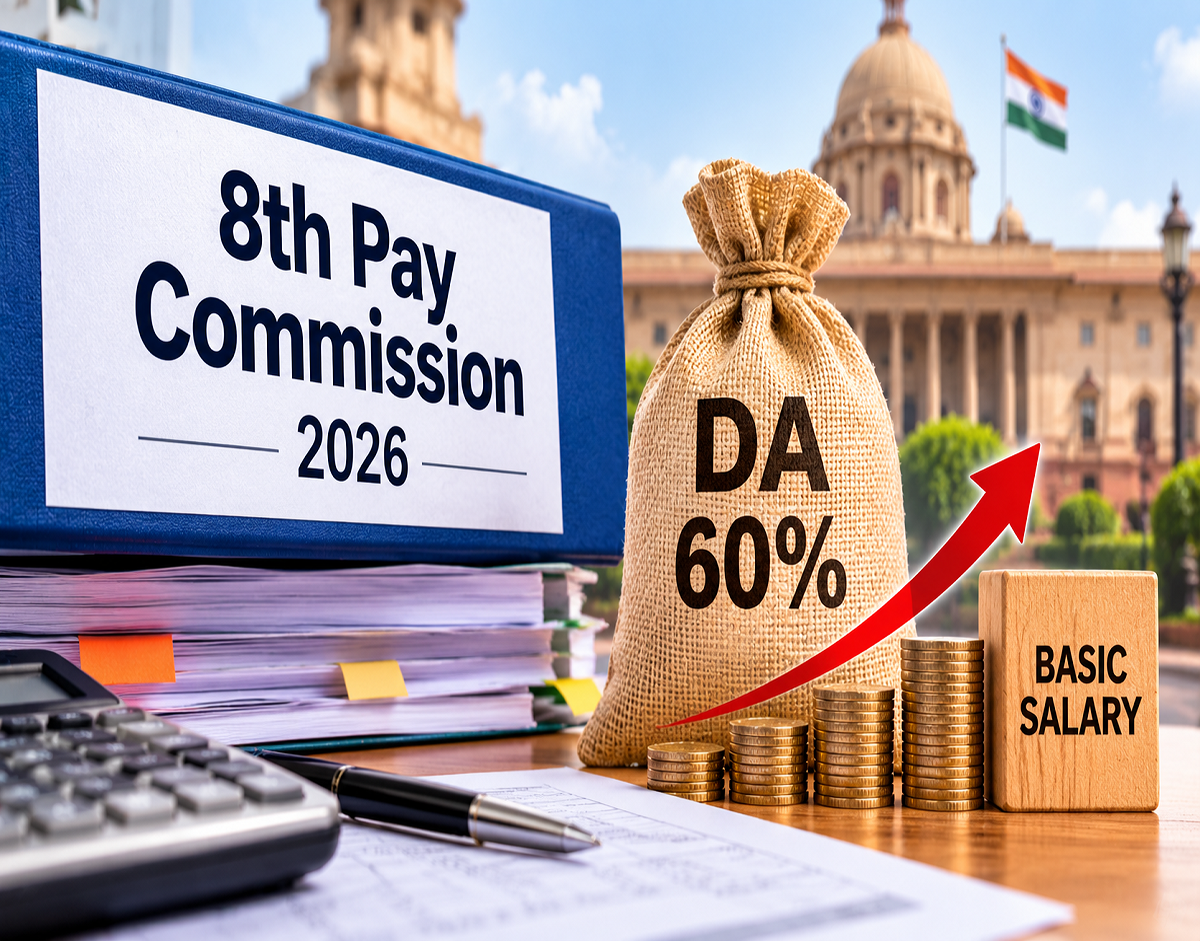
8th Pay Commission Latest Update: Central government employees and pensioners are closely watching developments surrounding the Eighth Central Pay Commission, particularly the growing demand to merge Dearness Allowance (DA) with basic salary.
Employee unions and pensioners' associations have reportedly submitted several proposals to the commission, seeking changes in the existing system of salary revision, DA calculation and Dearness Relief (DR).
The issue gained attention following the commission's two-day visit to Mumbai, where its members held discussions with representatives of employee organisations.
One of the central questions is whether the commission will recommend merging accumulated DA into basic pay.
However, no final recommendation or government approval for such a merger has been announced in the supplied report.
8th Pay Commission: What Is the Latest Update?
The Eighth Pay Commission is examining issues related to salaries, allowances, pensions and other service conditions of central government employees.
As part of its consultation process, the commission has been interacting with employee representatives and organisations.
During the Mumbai discussions, several groups reportedly raised concerns about the current DA and DR arrangements.
Their proposals include merging DA with basic pay, increasing the frequency of DA revisions and reviewing the inflation index used in the calculation.
These suggestions are demands submitted for consideration. They should not be treated as approved changes.
What Is the Current DA Rate for Central Government Employees?
According to the October 24, 2026 report, the applicable DA rate for central government employees is 60% of basic pay.
The report states that the rate reached this level with effect from January 1, 2026.
DA is an allowance intended to provide partial compensation for the impact of inflation on employees' purchasing power.
As prices of essential goods and services rise, the cost of living also increases.
The DA mechanism helps adjust compensation in response to changes in the relevant consumer price index.
Under the existing arrangement, central government DA revisions are generally effective from January 1 and July 1.
The government announces the approved changes through the prescribed process.
How Is Dearness Allowance Calculated?
Dearness Allowance for central government employees is linked to the All India Consumer Price Index for Industrial Workers, commonly known as AICPI-IW.
The index is published by the Labour Bureau.
The calculation considers the relevant 12-month average of the index and the applicable base and conversion factors.
For employees covered by the Seventh Central Pay Commission structure, the established formula uses the prescribed AICPI-IW index series and base reference.
The final DA percentage is determined according to the applicable rules and approved by the government.
A rise in the relevant inflation index can lead to an increase in DA, although the precise percentage depends on the calculation.
What Happens When DA Is Merged With Basic Pay?
Merging DA with basic salary means incorporating an amount corresponding to the applicable DA into the employee's basic pay.
For example, consider a central government employee with a basic salary of ₹30,000.
At a 60% DA rate, the employee receives ₹18,000 as DA.
The combined amount is ₹48,000.
If the entire 60% DA were merged into basic pay under a hypothetical arrangement, the revised basic salary could become ₹48,000 before considering any other pay revision rules.
However, the employee would not automatically receive an additional ₹18,000 in monthly earnings simply because of the merger.
The amount was already being paid as DA.
The financial impact would depend on how other allowances, future DA calculations and retirement benefits were treated under the revised structure.
DA Merger Calculation at 60%: Salary Examples
The following table illustrates the mathematical effect of merging the full DA amount into basic pay.
| Existing basic pay | DA at 60% | Basic pay plus DA | Hypothetical merged basic pay |
|---|---|---|---|
| ₹18,000 | ₹10,800 | ₹28,800 | ₹28,800 |
| ₹25,000 | ₹15,000 | ₹40,000 | ₹40,000 |
| ₹30,000 | ₹18,000 | ₹48,000 | ₹48,000 |
| ₹40,000 | ₹24,000 | ₹64,000 | ₹64,000 |
| ₹56,100 | ₹33,660 | ₹89,760 | ₹89,760 |
| ₹1,00,000 | ₹60,000 | ₹1,60,000 | ₹1,60,000 |
Important: This is only a mathematical illustration. It does not represent an approved Eighth Pay Commission salary structure or a confirmed increase in take-home pay.
Employee Unions Demand Changes to the DA System
Several employee organisations have reportedly submitted recommendations concerning the DA mechanism.
According to the report, the Federation of National Postal Organisations (FNPO) has suggested that DA should be merged with basic pay once it exceeds 25%.
The organisation believes such a change could benefit central government employees.
However, this remains a proposal.
There is no indication in the supplied report that the government has accepted a 25% merger threshold.
The commission will need to examine the proposal alongside other pay and allowance recommendations.
Pensioners Demand Quarterly Dearness Relief Revision
The demand for changes is not limited to serving employees.
Pensioners' organisations have also raised concerns about the existing system of Dearness Relief.
According to the report, Bharat Pensioners Samaj has proposed revising DA and DR every three months instead of every six months.
Under the present arrangement, revisions generally take effect twice a year.
If a quarterly system were recommended and subsequently approved, the number of scheduled revisions could increase from two to four annually.
However, a more frequent revision schedule would not automatically guarantee a larger annual increase.
The total adjustment would still depend on the relevant inflation index and the formula adopted.
Why Are Employee Organisations Seeking a Review of AICPI-IW?
Some employee associations have also suggested reviewing the inflation index used for DA calculations.
Their concern relates to whether the existing index and calculation methodology adequately reflect changes in employees' living expenses.
Inflation affects different households in different ways.
Expenses related to food, housing, transport, healthcare and education can vary significantly.
A review of the calculation system could involve examining the index, its weighting structure and the method used to translate inflation changes into DA revisions.
Any modification would require careful evaluation and official approval.
Could a DA Merger Increase Other Allowances?
A change in basic pay may influence certain salary components that are calculated with reference to basic salary.
However, the effect would depend on the rules adopted under the revised pay structure.
Some allowances may be recalculated, while others could be restructured or revised separately.
Transport Allowance is one area where the DA component is relevant under existing rules.
Pension calculations and retirement-related benefits may also be affected by changes to pensionable pay, subject to the applicable service rules.
Therefore, the overall financial impact of a DA merger cannot be determined by adding the DA percentage to basic salary alone.
Will DA Automatically Merge After Crossing 50%?
There is no general rule under the current Seventh Pay Commission framework requiring DA to be automatically merged with basic pay whenever it crosses 50%.
Certain allowances may be revised when DA reaches specified thresholds, but this is different from merging DA into basic salary.
The fact that DA has crossed 50% does not by itself establish that a merger must take place.
Any such change would require a specific policy decision.
When Will the Government Decide?
The Eighth Pay Commission is expected to consider the representations submitted by employee organisations and pensioners' associations before finalising its recommendations.
The commission's report may address pay structure, allowances, pension-related matters and other issues within its terms of reference.
However, a recommendation by the commission would not automatically become government policy.
The Union government would have to examine the proposals and decide which recommendations to accept, modify or reject.
The financial implications would be an important part of that evaluation.
Until an official decision is issued, employees should avoid treating projected salary figures as confirmed benefits.
Final Update
The demand to merge Dearness Allowance with basic salary has emerged as an important issue in discussions surrounding the Eighth Pay Commission.
Employee organisations have proposed changes to the DA structure, while pensioners' groups have sought more frequent DA and DR revisions.
At the 60% DA rate cited in the report, a merger could significantly change the composition of basic pay.
However, there is currently no confirmed decision that 60% DA will be merged into basic salary under the Eighth Pay Commission.
Central government employees and pensioners will need to wait for the commission's recommendations and the government's subsequent decision.
Disclaimer: The 60% DA figure and details of employee representations are based on the supplied October 24, 2026 report. Salary calculations are hypothetical and should not be interpreted as officially approved pay revisions. Employees should refer to Department of Expenditure and other relevant government notifications for confirmed decisions.